Why the Brand Name Confuses More Than It Clarifies
Drive through any North Texas neighborhood after a replacement season and you'll hear homeowners compare notes on brand names the way they'd compare car makes. It's a natural instinct, but shingles don't work quite like that. Every major manufacturer, GAF, Owens Corning, CertainTeed, and Atlas among them, sells a range of products from basic three-tab to heavyweight designer shingles, and the gap between a budget line and a premium line from the same company is often bigger than the gap between two premium lines from different companies.
That matters in the DFW Metro because our roofs face a specific combination of UV exposure, afternoon heat cycling, and periodic hail and wind events. The shingle that performs well here is defined by its wind rating, its impact class, and its warranty terms, not by which name is printed on the wrapper. Understanding those three variables lets you compare quotes apples to apples instead of brand to brand.
What Actually Separates One Shingle From Another?
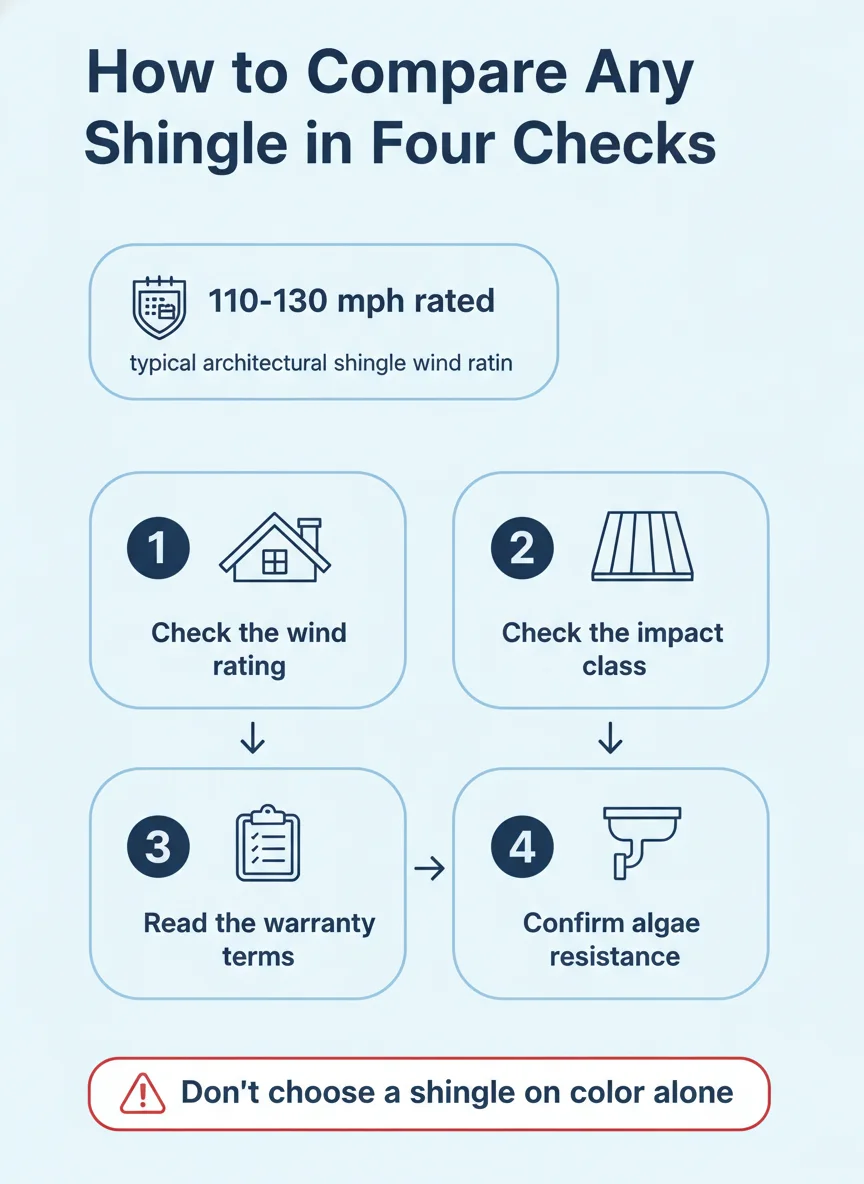
The real differences live in four places: the wind rating, the impact resistance class, the warranty structure, and the algae resistance granules. Every reputable manufacturer publishes these specs, and they're the first thing worth asking about on any quote.
Wind and Impact Ratings
Architectural shingles typically carry wind ratings in the 110 to 130 mph range when installed with the manufacturer's specified nailing pattern, while some lines are rated higher with enhanced sealant strips. Impact resistance is graded on a separate scale, with Class 4 being the toughest rating available and often tied to insurance discounts in hail-prone regions.
Both ratings depend as much on installation as on the shingle itself. A Class 4 shingle nailed with the wrong pattern or placed over worn decking won't perform to its rating, which is one reason installation to manufacturer specification matters as much as the product choice. Our roof replacement process follows manufacturer nailing and ventilation specs so the rating on the wrapper actually translates to the roof.
Warranty Structure
Warranties generally split into two parts: a materials warranty from the manufacturer and a workmanship warranty from the installer. The materials side ranges from a limited lifetime term on premium lines to a shorter, prorated term on entry-level products, and the fine print on proration matters more than the headline word "lifetime."
Some manufacturers also offer extended warranty tiers available only when the full roofing system, underlayment, starter strip, and ridge cap, all come from the same product line and the installer carries factory certification. That's worth asking about directly, since it can meaningfully extend coverage beyond the base warranty.
| Shingle Tier | Typical Wind Rating | Warranty Style |
|---|---|---|
| Three-tab / standard | 60-70 mph | Shorter, often prorated |
| Architectural / laminate | 110-130 mph | Limited lifetime, standard terms |
| Premium / designer | 110-130+ mph | Limited lifetime, often extended with system install |
| Impact-resistant Class 4 | Varies by line | Limited lifetime, may qualify for insurance discount |
What's in the Shingle Itself
Underneath the color blend, a shingle is built from a fiberglass mat, asphalt coating, and mineral granules. The mat thickness and asphalt saturation are what separate a three-tab from an architectural shingle in terms of durability, while the granules handle UV protection and, when treated with algae-resistant copper or zinc, resistance to the black streaking common in humid climates.
Algae resistance is worth asking about specifically. North Texas humidity and shaded northern slopes are prime conditions for the algae growth that causes streaking, and a shingle without that treatment can show streaks within a few years even though the shingle underneath is structurally fine.
Step-by-Step: How to Compare Shingle Options on a Quote
When a quote lists a specific product name, here's a simple sequence to evaluate it without needing to know every manufacturer's catalog by heart.
- Find the wind rating: Ask for the specific mph rating of the exact product listed, not a general brand claim.
- Check the impact class: Confirm whether it carries a Class 4 impact rating if that matters for your insurance policy.
- Read the warranty document: Look past the word 'lifetime' to the proration schedule and what voids coverage.
- Ask about algae resistance: Confirm the granules include an algae-resistant treatment and how many years it's covered.
- Confirm system eligibility: Ask if an extended warranty requires the full product system, not just the shingle.
- Compare color and profile samples in daylight: Colors shift under different light, so view samples outside before deciding.
What Different Homeowners Actually Prioritize
Some homeowners weight the decision toward impact resistance because of past hail activity in the area, prioritizing a Class 4 rated product even at a heavier mat weight. Others care more about matching an existing HOA-approved color palette, which narrows the field to whichever manufacturer offers that specific blend.
Resale and Curb Appeal Considerations
Buyers and appraisers rarely ask which manufacturer made the shingles, but they do notice a clean, uniform color and a straight ridge line. A well-installed mid-tier architectural shingle from any major manufacturer will read the same on a listing photo as a premium designer line.
Where the designer tiers earn their keep is in dimensional depth and shadow lines that mimic wood shake or slate from the street. That's an aesthetic call more than a performance one, and it's reasonable to weigh it alongside the technical specs rather than instead of them.
What You Can Research Yourself vs. What a Roofer Should Confirm
Homeowners can absolutely research wind ratings, impact classes, and warranty terms on a manufacturer's public website before ever calling a contractor. That homework helps you ask sharper questions and recognize whether a quote is comparing comparable products.
What's harder to verify alone is whether a specific installer is certified to offer a manufacturer's extended warranty tier, and whether your roof's current ventilation and decking condition will actually let a premium shingle perform to its rating. Both require a trained eye on the roof, not just a spec sheet comparison.
A factory-certified installer can also catch whether mismatched components, an off-brand starter strip under a premium field shingle, for example, would void the very warranty you're paying extra for. That's a detail worth confirming before, not after, the roof replacement begins.
Bringing It Back to Your Roof
The brand name is a starting point for a conversation, not the deciding factor. Whether you're weighing options for a home in Plano or anywhere else across the DFW Metro, the questions that actually matter are the wind rating, the impact class, the warranty proration schedule, and whether algae resistance is included, the same questions worth asking alongside choosing shingle grades for your specific home.
Absolute Professional Roofing Contractors works with several major manufacturer lines and can walk through which specific products fit your roof's exposure and your warranty priorities.
Frequently asked questions
Is one shingle brand better than another?
Not in any universal sense. The major manufacturers all make a lineup from basic three-tab to premium designer shingles, so the better choice depends on which specific product line, wind rating, and warranty you compare, not the logo on the box.
Does a more expensive shingle brand last longer?
A higher-tier product line within a brand usually carries a thicker mat and a longer warranty term, which often does correlate with longevity. But installation quality, attic ventilation, and local sun and hail exposure affect lifespan as much as which manufacturer made the shingle.
What does algae resistance mean on a shingle warranty?
It means the shingle includes copper or other granules designed to resist the black streaking caused by algae growth, and the manufacturer backs that resistance for a stated number of years. Without it, most asphalt shingles in humid climates will show streaking well before the shingle itself wears out.
Can I mix shingle brands on one roof?
It's not recommended. Manufacturer warranties are written around their own product system, and mixing brands can void coverage or create subtle color and profile mismatches between slopes.
Do all shingle brands offer the same warranty length?
No. Warranty length varies by product tier within each manufacturer's lineup, typically ranging from limited lifetime coverage on premium lines to shorter, prorated terms on entry-level three-tab products, so it's worth reading the specific document rather than assuming based on the brand.