Why Roof Pitch in Degrees Comes Up for DFW Homeowners
Most roofers talk pitch in rise-over-run, like 4/12 or 6/12, but homeowners researching online often run into pitch expressed in degrees instead, especially from architectural drawings, drone measurement reports, or online pitch calculators. A 25-degree angle is one of the more common figures that shows up, and it lands in a very normal, very buildable range for homes across Plano, Dallas, Frisco, and the rest of the DFW metro.
Knowing the conversion matters when you're comparing quotes, reading an inspection report, or just trying to understand why your roofer recommends one material over another. A 25-degree roof isn't flat and it isn't a steep A-frame either. It's right in the middle, which is exactly where most traditional homes in North Texas sit.
How Does the Degree-to-Pitch Conversion Actually Work?
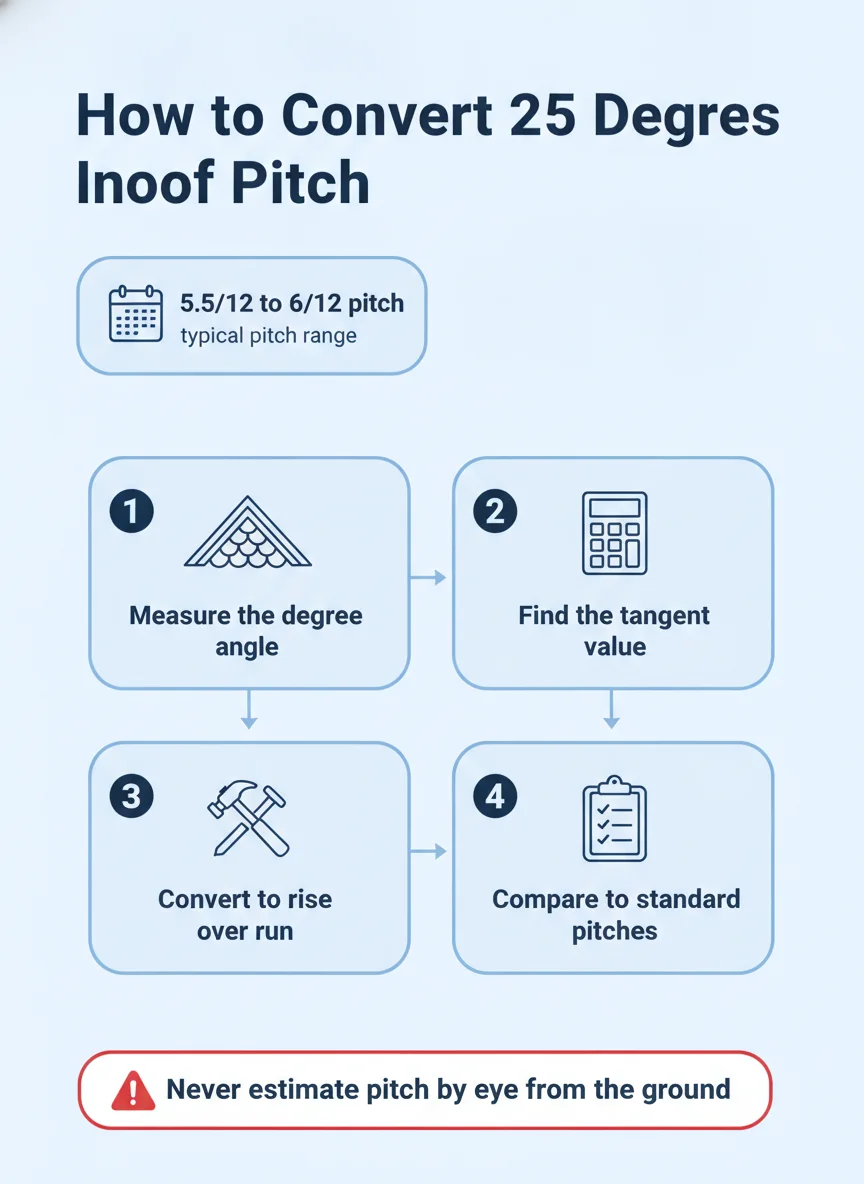
Roof pitch in degrees converts to rise-over-run using basic trigonometry. You take the tangent of the angle and multiply it by 12, since roof pitch is always expressed per 12 inches of horizontal run. For 25 degrees, the tangent is about 0.466, and multiplying that by 12 gives you roughly 5.6, which rounds to a 5.5/12 or 6/12 pitch depending on how precise the framing is.
The Math Behind the Number
Picture a right triangle where the roof slope is the hypotenuse. The angle at the base is measured in degrees, the vertical rise and horizontal run are the two legs. Tangent equals rise divided by run, so solving for rise at a 12-inch run gives you the pitch number roofers actually use on site.
This is why two numbers that sound similar, like 25 degrees and a 5/12 pitch, aren't identical even though they're close. A 5/12 pitch works out to about 22.6 degrees, while a true 6/12 pitch is closer to 26.6 degrees. A 25-degree roof sits almost exactly between those two standard framing pitches.
Why Roofers Round to Standard Pitches
Framing lumber, trusses, and most shingle warranty specs are built around whole or half-number pitches like 4/12, 5/12, or 6/12, not odd degree figures. When a measurement comes back at 25 degrees, your roofer will typically round it to the nearest standard pitch for ordering materials and calculating ventilation requirements.
That rounding doesn't change how the roof performs. It just makes the math cleaner for underlayment overlap, fastener patterns, and flashing details, all of which are referenced in manufacturer installation guides by pitch, not by degree.
| Degrees | Approximate Pitch | Typical Use |
|---|---|---|
| 18.4° | 4/12 | Common ranch-style roofs |
| 22.6° | 5/12 | Traditional gable homes |
| 25° | 5.5/12 | Blended moderate-slope roofs |
| 26.6° | 6/12 | Standard steeper residential pitch |
What a 25-Degree Pitch Means for the Roofing System
A 25-degree slope sheds water well without being difficult to walk safely with proper equipment, which is part of why it's such a common pitch on homes across Richardson, Carrollton, and the rest of the metro. It's steep enough that standing water isn't a concern on a properly installed system, and it accepts asphalt shingles, metal panels, or tile when each is installed to the manufacturer's specifications.
Ventilation also factors in at this pitch. Ridge vents, turbines, and soffit intake all rely on consistent airflow along the slope, and a moderate pitch like this one generally supports standard ventilation and energy efficiency upgrades without the custom detailing that very low-slope or very steep roofs sometimes require.
Step-by-Step: Estimating Your Roof's Pitch at Home
You don't need to climb onto the roof to get a rough estimate of its pitch. These steps use tools most homeowners already have, and they'll get you close enough to understand what range your roof falls into before a professional measurement.
- Find a gable end: Stand where you can see the triangular end wall of the roof clearly from the ground or an upstairs window.
- Measure the rise: Estimate the vertical height from the base of the triangle to its peak using a known reference point, like a door or window frame.
- Measure the run: Estimate the horizontal distance from the center peak to the outside wall, which is half the total building width.
- Calculate rough pitch: Divide rise by run and multiply by 12 to get an approximate rise-over-run pitch figure.
- Use an angle app: Hold a smartphone level app against a straight edge on the gable trim to get a direct degree reading if you can access it safely.
- Confirm with a professional: Have a roofer verify the exact pitch during an on-roof measurement, since ground estimates can be off by several degrees.
What Does a 25-Degree Pitch Look Like on an Actual Home?
On the ground, a 25-degree roof reads as a moderate, traditional slope, not dramatically steep and not noticeably flat. It's the kind of roofline you'd see on a classic one-and-a-half story brick home in older sections of Dallas or on newer construction in Prosper and Murphy, where builders often favor a consistent, predictable slope across the whole subdivision.
Signs Your Roof Is in This Range
If your attic rafters rise noticeably but the roof doesn't look like a steep A-frame from the street, you're likely in the 20 to 30 degree range. Homes with simple gable or hip designs, rather than dramatic cathedral-style peaks, tend to fall closest to the 25-degree mark.
A quick way to confirm is comparing your roofline to a neighbor's known pitch, or asking your roofer to note the exact figure the next time they're on site for a repair or an estimate. It's a detail worth having on file, especially if you're planning a roof replacement down the line.
Can You Figure This Out Yourself, or Call a Pro?
Estimating pitch from the ground is something most homeowners can do with a tape measure, a level, and a little patience, and it's a reasonable first step before calling anyone out. The math itself isn't complicated, it's just rise divided by run, multiplied by 12.
Where it gets harder is getting an accurate rise measurement without walking the roof itself, since ground-based estimates can easily be off by a few degrees in either direction. That margin of error doesn't matter much for curiosity, but it matters a lot when it's feeding into material selection, warranty eligibility, or a repair scope.
For anything tied to an actual project, whether that's a repair, a full replacement, or planning new ventilation upgrades, it's worth having a licensed roofer confirm the exact pitch on site. It takes them minutes and removes the guesswork from material and fastener decisions.
Getting an Exact Answer for Your Home
A 25-degree roof converts to roughly a 5.5/12 to 6/12 pitch, a moderate and very common slope across the DFW metro that handles standard shingle, metal, and tile systems without special engineering. If you're trying to nail down exactly where your home falls, ground estimates get you close, but an on-site measurement gets you certain.
If you want that number confirmed before planning any work, or you're curious how pitch factors into a quote for a different slope entirely, the 10-degree pitch guide walks through the lower end of the range for comparison. Absolute Professional Roofing Contractors LLC can measure your exact pitch and walk you through what it means for your project.
Frequently asked questions
What pitch in inches is a 25-degree roof?
A 25-degree angle converts to roughly 5.5/12, meaning the roof rises about five and a half inches for every twelve inches of horizontal run. Roofers usually round this to a 6/12 pitch for material and ventilation planning.
Is a 25-degree roof considered steep?
No, a 25-degree slope is a moderate pitch, not a steep one. It's common on traditional ranch and colonial-style homes across North Texas and sits comfortably in the range most asphalt shingle manufacturers rate for standard installation.
Can you walk safely on a 25-degree roof?
Most roofers can walk a 25-degree (roughly 6/12) roof with standard fall protection and proper footwear, though it still requires care, especially when the surface is wet or dusty. It's not a pitch a homeowner should treat as walkable without the right gear.
Does roof pitch affect material choice?
Yes, pitch affects which materials and underlayment methods are appropriate, since lower slopes drain slower and need more water-resistant layering. A 25-degree pitch is steep enough for most asphalt shingle, metal, or tile systems installed to manufacturer specifications.
How do I find out my roof's pitch without climbing up?
A level and tape measure against the attic rafter, or a smartphone angle app held against a gable end, can give you a rough estimate. For an exact number, it's safer to have a roofer measure it during a [roof inspection](/services/roof-repair) or replacement estimate.