Why Roof Pitch Matters on a North Texas Home
Pitch is simply the angle of a roof, and it drives almost every decision that comes after it, from which materials will hold up to how water leaves the structure. In the Dallas-Fort Worth area, where afternoon downpours can dump a lot of rain fast and summer sun bakes a roof deck for months at a time, getting the pitch-to-material match right isn't a cosmetic choice. It determines whether water sheds quickly or lingers.
A roof pitch of 10 degrees sits at the low end of the spectrum. It's steep enough that water does move, but shallow enough that it moves slowly, which is exactly why low-slope roofs use different materials and detailing than the steep-pitched roof most people picture on a single-family home. Understanding where 10 degrees falls on that scale helps you know what to expect if you're dealing with a porch roof, an addition, or a commercial building at that angle.
How a 10-Degree Pitch Compares to Standard Roof Slopes
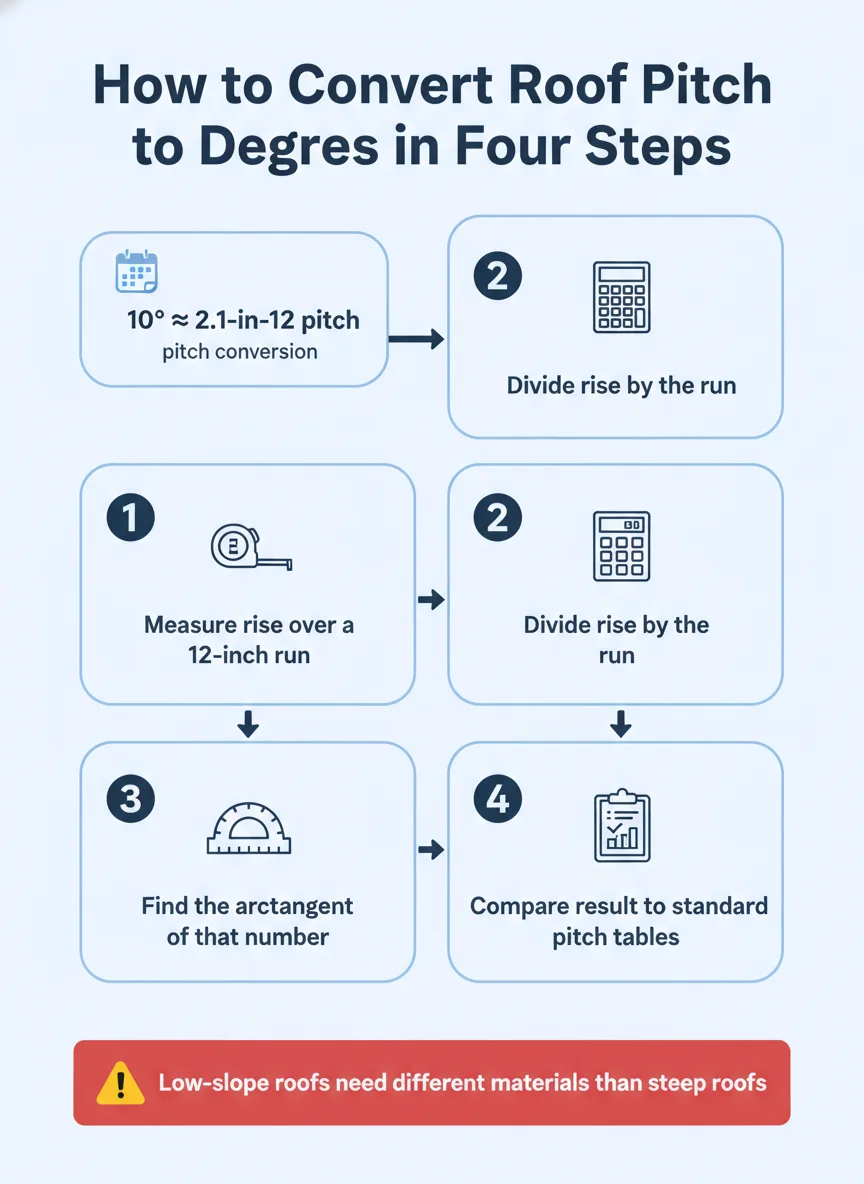
Roofing pitch gets described two ways: in degrees, the way you'd measure any angle, or in rise-over-run, the way roofers typically talk about it on the job. A 10-degree pitch converts to roughly 2.1 inches of rise for every 12 inches of horizontal run, often written as a 2/12 pitch when rounded.
Converting Degrees to Rise and Run
The math behind the conversion uses the tangent function: rise divided by run equals the tangent of the pitch angle. At 10 degrees, that works out to about 0.176, which multiplied by a 12-inch run gives roughly 2.1 inches of rise. That's why a 10-degree roof and a 2/12 pitch roof are essentially the same thing described two different ways.
For comparison, a common residential roof runs somewhere between a 4/12 and 8/12 pitch, which lands between about 18 and 34 degrees. If you want to see how a steeper angle changes the material picture, What Roof Pitch Is 30 Degrees? walks through that range in detail.
Why 10 Degrees Counts as Low-Slope
The roofing industry generally draws the line for low-slope roofing somewhere around a 2/12 to 3/12 pitch. Below that threshold, standard overlapping shingles don't shed water fast enough on their own, and wind-driven rain can push moisture up and under the shingle tabs instead of running off the surface.
A 10-degree roof falls right at that threshold, which is why it's treated as a low-slope system rather than a traditional steep-slope roof. That one classification changes nearly every material and detailing choice that follows, from the underlayment to how seams get sealed.
| Pitch Range | Typical Materials | Drainage Behavior |
|---|---|---|
| Under 2/12 (roughly 0-9°) | Fully adhered membrane, built-up roofing | Relies on tapered insulation or slight slope to drain, water can pond |
| 2/12 to 3/12 (roughly 9-14°, includes 10°) | TPO, EPDM, modified bitumen membranes | Slow, steady runoff, needs continuous waterproof membrane |
| 4/12 and above (18°+) | Asphalt shingles, metal, tile | Fast shedding, gravity does most of the drainage work |
The Roof System a 10-Degree Pitch Actually Needs
At 10 degrees, the roof deck needs a continuous, fully sealed membrane rather than overlapping individual pieces. That's the same principle behind flat-roof systems on commercial buildings: a single waterproof layer, properly flashed at every penetration and edge, does the job that shingle overlap does on a steeper roof.
This is also why low-slope sections show up more often on additions, porch roofs, and commercial structures than on a typical house's main roofline. If you're dealing with a low-slope section on a business building, that falls squarely into commercial roofing territory, where membrane systems and coatings are the standard approach rather than the exception.
Step-by-step: Checking Your Roof's Pitch From the Ground
You don't need to climb a ladder to get a rough sense of your roof's pitch. These steps give you a working estimate, though anything near the low-slope threshold is worth confirming with an on-roof measurement.
- Find a gable end: Stand where you can see the triangular end of the roofline clearly, away from trees or obstructions.
- Hold a level horizontal: Use a 12-inch level or a straight board marked at 12 inches, held level against the roof surface.
- Measure the rise: At the 12-inch mark, measure straight down to the roof surface in inches. That number is your rise.
- Compare to pitch tables: A rise around 2 inches over that 12-inch run puts you close to a 10-degree, or 2/12, pitch.
- Use a pitch-finder app: A smartphone app using the phone's level sensor, held steady against the roofline from a safe vantage point, gives a quick cross-check.
- Confirm on the roof: For anything near the low-slope threshold, have a professional measure directly on the deck before choosing materials.
What a 10-Degree Roof Looks Like Up Close
Membrane Seams and Flashing Points
On a low-slope roof, the seams between membrane sheets and the flashing around any penetration, like a vent pipe or an HVAC curb, are the most vulnerable points. Because water moves slower across a 10-degree surface, any gap at a seam has more time to let moisture work its way underneath before it ever reaches a drain or edge.
This is also where a roof repair call most often starts on a low-slope section: a lifted seam, a cracked pipe boot, or flashing that's pulled away from a wall. Catching those early matters more on a shallow pitch than on a steep one, where gravity gives a little more margin for error.
Ponding and Drainage Signs
Ponding water, areas where water sits for more than a day or two after rain, is the clearest visual sign of a drainage problem on a low-slope roof. It shows up as discoloration, algae growth, or a visibly low spot in the membrane after a storm.
A 10-degree pitch is steep enough that persistent ponding usually points to a drainage issue rather than the pitch itself, things like a clogged drain, debris buildup, or a section of membrane that's settled over time. Checking gutters and drains after storms is part of catching this early, which ties directly into keeping gutters clear on any attached low-slope sections.
DIY Check vs Calling a Professional
Getting a rough estimate of your roof's pitch from the ground is something most homeowners can do safely with a level and a tape measure. It's useful for general planning, like figuring out whether a porch addition or a shed roof falls into low-slope territory before you start shopping for materials.
What you shouldn't do yourself is climb onto a low-slope roof to inspect seams, flashing, or ponding up close. Low-slope roofs can look deceptively walkable from the ground but often have soft spots, standing water, or weakened membrane that aren't visible until you're standing on them, and that's a fall and damage risk best left to someone experienced on that kind of surface.
A licensed roofer also brings something a tape measure can't: the ability to tell whether a drainage issue is a pitch problem, a clogged drain, or a membrane that's reached the end of its service life. That distinction changes whether the right next step is a repair, a recoat, or a full roof replacement.
Getting a Straight Answer on Your Roof's Pitch
Whether you're dealing with a porch addition in Frisco, a low-slope commercial building, or just curious what angle you're looking at, the pitch number tells you almost everything about what should be up there. A 10-degree roof isn't flat, but it behaves like one in terms of material requirements, and treating it like a standard steep-slope roof is where most low-slope leaks start.
If you're not sure what pitch you're working with, or you've got a low-slope section showing signs of ponding or a lifted seam, Absolute Professional Roofing Contractors can take a direct look and tell you exactly what that angle needs.
Frequently asked questions
What does a 10-degree roof pitch look like compared to a normal roof?
A 10-degree pitch looks almost flat from the street, close to 2.1 inches of rise for every 12 inches of run. Most residential roofs homeowners picture, with visible peaks, sit well above that angle, so a 10-degree section usually shows up on additions, porches, or commercial buildings rather than a main home roofline.
Can you put regular shingles on a 10-degree roof?
No, standard asphalt shingles are not designed for pitches this low because water doesn't shed fast enough and can back up under the tabs. Roofs at or near 10 degrees typically call for a continuous low-slope membrane system instead, such as TPO, EPDM, or modified bitumen.
How do I find my roof's pitch without climbing up there?
You can get a rough read from the ground using a level and tape measure against a gable end, or by comparing the roofline to a smartphone pitch-finder app held steady at eye level. For an exact number, especially anything you suspect is in the low-slope range, a professional measurement on the roof itself is more reliable.
Is a 10-degree pitch considered a flat roof?
It's generally classified as low-slope rather than fully flat, since true flat roofs have a barely perceptible pitch built in just for drainage. In practical terms, a 10-degree roof is treated like a flat roof for material and drainage purposes even though it isn't dead level.
Does a low-slope roof need more maintenance than a steep one?
Yes, low-slope roofs generally need closer attention because water sits longer and debris doesn't wash off as easily. Regular checks of seams, flashing, and drains matter more on a 10-degree roof than on a steep roof where gravity does most of the work.