Commercial roofing, built to perform.
Flat and low-slope roofs across the DFW Metro carry their own set of problems, ponding water, seam wear, membrane aging, and we handle the installation, repair, and coating work that keeps them watertight.
Absolute Professional Roofing Contractors LLC installs and repairs commercial roofing systems for buildings across the DFW Metro, including Plano, Dallas, Irving, Carrollton, and the surrounding business corridors. That covers TPO, EPDM, and modified bitumen membranes, protective roof coatings, and repair work on flat and low-slope roofs, which fail differently than a residential shingle roof and need to be inspected and maintained on their own terms.
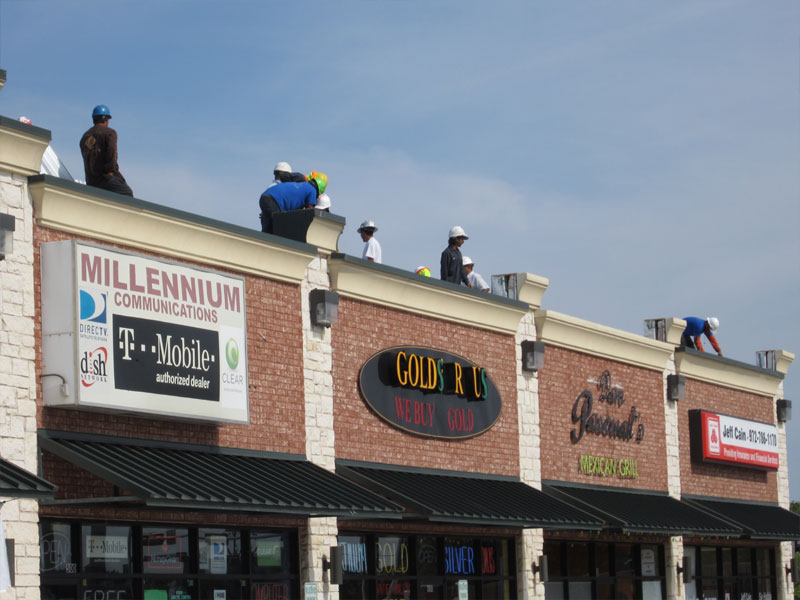
Is water pooling on your flat roof after every rain?
Standing water that doesn't drain within a day or two after a rain means the membrane and drainage system aren't doing their job, and it's one of the most common ways a flat roof fails early. Ponding water accelerates membrane breakdown, adds weight the structure wasn't necessarily designed to carry long-term, and finds any weak seam or puncture faster than dry conditions would. It's not something to wait out, since the longer water sits, the more it works into the roofing system underneath it. An inspection can tell you whether it's a drainage issue, a low spot in the membrane, or both.
Warning signs to watch for
Standing water that doesn't drain
Water sitting on the roof for more than a day or two after rain points to a drainage problem or a low spot in the membrane, and it accelerates wear wherever it collects.
Blistering or cracking in the membrane
UV exposure and heat cycling over the years cause TPO, EPDM, and modified bitumen to blister or crack, and once the membrane's surface is compromised, water finds its way underneath.
Seams pulling apart
Membrane seams are the most common failure point on a flat roof, and separated or lifted seams let water into the insulation layer well before a leak shows up inside the building.
Interior stains below the flat roof
A stain on a ceiling below a flat or low-slope roof usually traces back to a membrane or seam failure somewhere in the general area, though water can travel before it drips through.
What is causing the problem
UV and heat degradation of the membrane
Flat membranes take direct sun exposure year-round, and that constant UV load is what dries out and cracks the material over time.
Poor drainage or roof pitch
Flat roofs still need enough slope and enough drains to move water off efficiently, and when either is inadequate, ponding becomes a recurring problem instead of a one-time event.
Aging or failed seams
Seams are welded or adhered during installation, and as the membrane ages, those joints are typically the first place to give way.
Foot traffic and equipment damage
Maintenance crews, HVAC work, and general foot traffic on a flat roof can puncture or wear through the membrane in high-traffic paths, particularly around rooftop units.
What to expect during the visit
We inspect the full membrane surface, checking for blistering, cracking, seam separation, and any areas holding water. We check the drainage system and roof pitch to see whether ponding is a design issue or a maintenance issue. From there, we give you a clear recommendation, whether that's a targeted repair, a protective coating to extend the membrane's life, or a full membrane replacement if the system has aged past the point where coating and patching make sense.
Related services you may need
Commercial buildings with steeper sections or attached residential-style roofing sometimes need Roof Repair or Roof Replacement work alongside the flat roof scope. Gutters and drainage components around the building perimeter are also part of keeping water moving off the roof correctly.
The cost of waiting
A small seam separation or a cracked patch of membrane doesn't stay small on a flat roof, especially with standing water sitting on it after every rain. Left alone, it works into the insulation layer below, which then holds moisture and stops insulating effectively, and eventually shows up as an interior leak that's harder to trace than the original surface problem. Addressing membrane wear early, with a coating or a targeted repair, is generally far less disruptive than dealing with a full system failure later.
How do I know if my flat roof needs a coating or a full replacement?
It depends on how much of the membrane is still sound. If the damage is isolated to a few seams or small areas, a coating or targeted repair can extend the roof's life. If blistering, cracking, or ponding covers most of the surface, a full membrane replacement is usually the more reliable long-term fix.
What membrane types do you install for commercial roofs?
We install and repair TPO, EPDM, and modified bitumen membrane systems, along with protective roof coatings, matched to the building and its existing roof structure.
Can a commercial roof be repaired without shutting down the building?
Most commercial roof repairs and coating work happen entirely on the exterior and don't require interrupting business operations inside. Larger membrane replacement projects are scoped with the building's use in mind.
If your building's flat or low-slope roof needs a look, call Absolute Professional Roofing Contractors LLC anywhere in the DFW Metro. We'll inspect the membrane and give you a straight recommendation.