Why roofing financing matters in the DFW Metro right now
A full roof replacement is a major expense, and most homeowners in Plano, Dallas, and the surrounding towns don't have that amount sitting in a savings account ready to spend. That's why financing has become a normal part of the roofing conversation, not a last resort for people who can't pay cash.
The DFW Metro sees its share of hail and wind events, which means replacements often come up on a schedule the homeowner didn't choose. Understanding financing ahead of time, before you're standing in a leaking attic, puts you in a much stronger position to compare offers calmly instead of signing the first thing in front of you.
How does roofing financing actually work?
Roofing financing works the same way most consumer financing does: a lender covers the project cost upfront, and you repay it over a set term with interest, unless the offer is a promotional 0% window. The roofing company itself usually isn't the one holding the loan, it's partnering with a bank or specialty lender who underwrites the credit and manages payments.
Third-party lender partnerships
Most roofing companies that advertise financing have an arrangement with one or more outside lenders who specialize in home improvement loans. The contractor submits the project details, the lender runs a credit check, and if approved, the funds go toward the job while you make monthly payments directly to the lender.
This setup is common because it lets a roofing company focus on the roof instead of acting as a bank. The tradeoff is that you're dealing with two parties, the contractor for the work and the lender for the money, so it pays to understand which one you call with which kind of question.
Personal loans, credit cards, and home equity
Outside of a contractor's financing partner, homeowners also use personal loans from their own bank, a home equity loan or line of credit against the house, or in some cases a credit card for smaller repair jobs. Each comes with different rates, terms, and approval speed, so it's worth getting a quote from your own bank before assuming the contractor's offer is the only option.
A home equity option often carries a lower rate because it's secured by the house, but it also means the roof becomes collateral along with everything else tied to that loan. A personal loan skips that risk but usually comes with a higher rate in exchange.
| Financing type | How it's secured | Typical consideration |
|---|---|---|
| In-house or partner lender plan | Unsecured, credit-based | Convenient, but compare the rate against outside options |
| Home equity loan or line | Secured by the home | Often lower rate, but the house is collateral |
| Personal loan | Unsecured, credit-based | No collateral risk, rate depends on credit profile |
| Credit card | Unsecured, revolving | Fast but usually the highest rate for a large balance |
What should be in writing before you finance a roof?
A detailed written scope of work should exist before any financing paperwork gets signed, full stop. That scope should spell out the materials, the square footage, what's included like tear-off and disposal, and the warranty terms, so the loan amount matches an agreed project, not a verbal estimate.
The financing agreement itself should separately spell out the interest rate (APR), the term length, the monthly payment, and whether there's a penalty for paying it off early. If any of those four numbers is missing or unclear, that's the moment to ask questions before signing anything.
Step-by-step: comparing a roofing financing offer
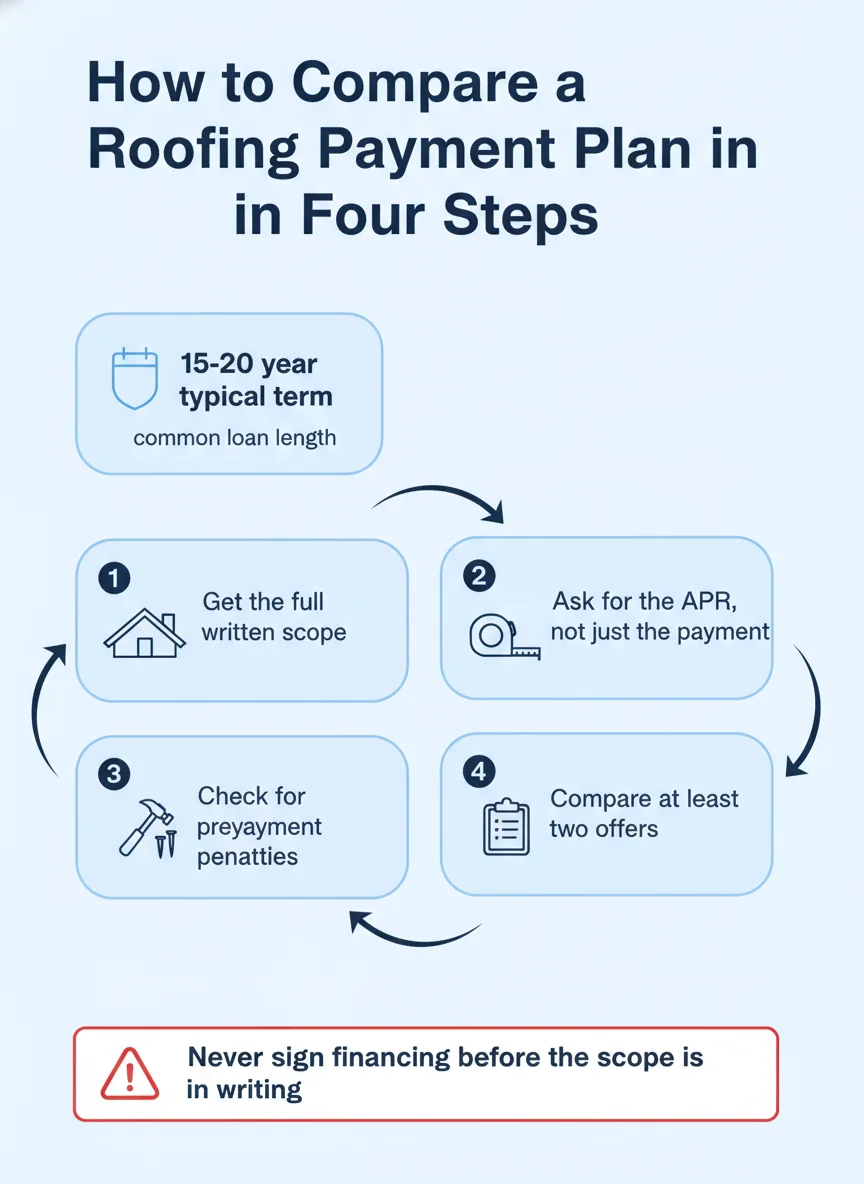
Treat a financing offer the same way you'd treat a loan for a car or a major appliance. These steps help you compare apples to apples instead of getting anchored on the monthly payment number alone.
- Get the written scope first: Confirm exactly what's being replaced, including tear-off, decking repair if needed, and the materials, before any loan amount is finalized.
- Ask for the APR: A low monthly payment can hide a high rate stretched over a long term, so always ask for the annual percentage rate, not just the payment.
- Check the term length: A longer term lowers the monthly payment but increases the total interest paid over the life of the loan.
- Look for prepayment penalties: Some loans charge a fee if you pay the balance off early, which matters if you expect an insurance settlement or extra cash later.
- Compare at least two offers: Check your own bank or credit union against the contractor's financing partner before deciding which route actually costs less.
- Read the promotional terms: If the offer includes a 0% promotional window, confirm what happens to the rate if the balance isn't paid off inside that window.
What should homeowners watch for after approval?
Once financing is approved, the next thing to watch is how the payment schedule lines up with the project timeline, not just the loan terms themselves. Most reputable arrangements tie the first payment or draw to a completed stage of the work, like material delivery or the start of a roof replacement, rather than the full amount upfront.
Payment timing and project milestones
A roofing company should be able to explain when funds are released and what triggers each payment, whether that's a deposit, a mid-project draw, or final payment at completion. If the financing structure doesn't match how the work actually proceeds, that's worth a direct conversation before the crew shows up.
It's also reasonable to ask what happens if the project scope changes partway through, for example if decking damage is found once old shingles come off. A clear financing agreement spells out how a change order affects the loan amount instead of leaving it open-ended.
Insurance claims and financing together
If a storm & hail restoration claim is part of the picture, the insurance payout and the financing decision are connected. Waiting for the adjuster's approved scope before finalizing a loan amount keeps you from financing more than the claim ends up covering.
Homeowners sometimes finance the gap between what insurance approves and what the full project costs, rather than financing the entire job. That's a narrower loan amount and usually a shorter, more manageable payoff.
Should you handle financing yourself or let the contractor arrange it?
Researching your own financing through a bank or credit union is something every homeowner can and should do, even if you ultimately use the contractor's partner lender. It costs nothing to get a second rate quote, and it gives you a real benchmark to compare against whatever the roofing company presents.
Letting the contractor arrange financing through their lender partner is often the more convenient path, especially when timelines are tight after storm damage. The lender evaluation, credit check, and paperwork are things a licensed, insured roofing company's office staff typically handles routinely, which can move faster than starting from scratch at a bank that doesn't do home improvement loans often.
What a homeowner should not do is skip reading the agreement because the contractor is handling it. Whoever arranges the loan, the signature and the repayment obligation are yours, so reviewing the APR, term, and any fees before signing stays your responsibility no matter which path you take.
Bringing it back to your project
Financing is just one piece of planning a roof replacement, and it works best when it's lined up after you understand the actual scope of the work, whether that's a straightforward replacement or a project tied to an insurance claim. If you're also weighing material choices, this breakdown of what roofing material lasts longest in Texas is a useful next read before you lock in a loan amount.
Homeowners across Plano and the wider DFW Metro are welcome to ask Absolute Professional Roofing Contractors LLC for a written scope and a straightforward conversation about how a project would be priced and sequenced.
Frequently asked questions
Do roofing companies offer in-house financing?
Some do, and some instead partner with an outside lender who handles the paperwork while the roofing company manages the job itself. Either way, the loan terms, not just the monthly payment, are what matter most when comparing offers.
Can I use a home equity loan to pay for a new roof?
Yes, many homeowners use a home equity loan or line of credit for a roof replacement because the rate is often lower than unsecured financing. Talk to your bank or credit union about what you qualify for before you commit to a contractor's financing partner.
Is 0% financing for roofing too good to be true?
Not necessarily, but promotional 0% offers usually come with a set repayment window, and missing it can trigger retroactive interest on the full balance. Read the fine print on the term length and what happens if a payment is late.
Will my homeowner's insurance payout affect my financing options?
It can, since an approved insurance claim often covers a large share of a storm-related replacement and reduces how much you need to finance. If you're pursuing a claim, it usually makes sense to wait for the adjuster's scope before locking in a loan amount.
What credit score do I need to finance a roof?
Requirements vary by lender and program, and some options are built for a range of credit profiles, including secured options like a home equity line. The best way to know where you stand is to ask the contractor or lender directly what their minimum requirements are before you apply.