Why Roof Age Matters in North Texas
North Texas homes deal with intense summer sun, sudden hailstorms, and temperature swings that stress roofing material in ways milder climates never do. A roof that might coast for three decades in a cooler region often shows real wear well before that in the DFW metro, simply because of how hard the sun and the weather work on it here.
That's why knowing the signs matters more than just knowing a number. Two roofs installed the same year can age completely differently depending on ventilation, slope, material quality, and how many storms rolled through in between. The goal isn't to panic at a certain birthday, it's to recognize what active wear actually looks like before it turns into a bigger problem.
What Actually Wears a Roof Out
Every roofing material has a breaking point, and in Texas that point usually gets reached through a combination of sun exposure and sudden wind or hail events rather than any single cause. Understanding both helps explain why two neighboring houses can need very different timelines for work.
Sun and Heat
Asphalt shingles are built with a layer of granules that shield the asphalt underneath from UV rays. Year after year of Texas sun slowly bakes that asphalt, drying out the oils that keep shingles flexible. Once that happens, shingles start to curl at the edges or cup in the middle, and granules wash off into the gutters.
Attics that don't vent properly make this worse. Trapped heat bakes the underside of the roof deck as well as the top, which speeds up aging from both directions. That's part of why ventilation and energy efficiency upgrades often get mentioned in the same breath as roof longevity, they're doing real work to slow this process down.
Wind and Hail
Sudden weather does a different kind of damage than slow sun exposure. Wind can lift shingle edges and loosen the seal strips that hold them flat, and hail can bruise or crack the mat underneath the granule layer even when the shingle looks okay from the ground.
That kind of hidden damage is why a close inspection after a bad storm matters, even on a roof that's nowhere near its expected age. A roof that took a direct hit two years ago can be in worse shape than one that's simply old and weathered evenly.
| Condition | Likely Repair | Likely Replacement |
|---|---|---|
| A few cracked or missing shingles in one area | Yes, a patch repair usually holds | Not yet, unless the deck underneath is also damaged |
| Granule loss and curling across the whole roof | Rarely holds long term | Yes, this is widespread material failure |
| Roof is 18+ years old with multiple soft spots | Short-term patch only | Yes, the underlying material is past its service life |
| Daylight or water stains visible in the attic | Depends on the source | Often yes, especially if multiple areas are affected |
The Roofing System, Explained
A roof isn't just the shingles you see from the street. Underneath them sits an underlayment layer that acts as a second water barrier, then the roof deck itself, usually plywood or OSB, and a ventilation system that moves hot, moist air out of the attic. Flashing seals the joints where the roof meets chimneys, walls, and vents.
Replacement matters more than repair when damage has worked its way past the shingles and into these layers. A soft, spongy deck under your feet, rusted or bent flashing, or underlayment that's visibly deteriorated all point to a system that's breaking down from the inside, not just showing cosmetic wear on top.
Step-by-Step: How to Check Your Roof's Condition
You don't need to get on the roof to get a reasonable read on its condition. Most of this can be done safely from the ground and the attic, with a pair of binoculars doing most of the heavy lifting.
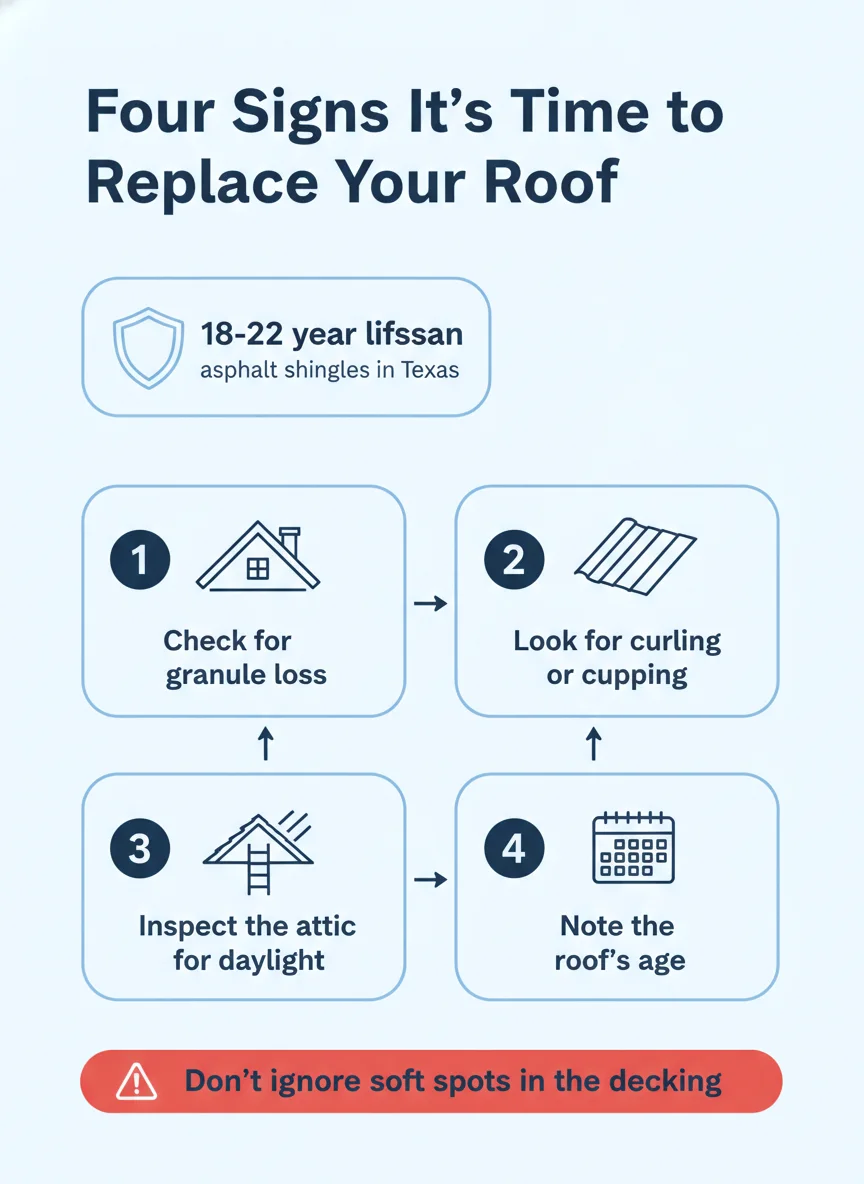
- Walk the perimeter: Look up at the roofline from several angles and note any shingles that look curled, cupped, or missing entirely.
- Check the gutters: A buildup of dark, sandy granules in the gutters or at downspout outlets is a sign shingles are shedding their protective coating.
- Scan for discoloration: Dark streaks or uneven coloring can point to algae growth, trapped moisture, or aging material underneath.
- Note the roof's age: If you know when the roof was installed, compare that against the typical 18 to 22 year lifespan for the region.
- Head into the attic: On a sunny day, look for pinpoints of daylight coming through the roof boards, a clear sign of gaps or damage.
- Feel for dampness: Touch the insulation and wood near the roofline for moisture, staining, or a musty smell.
- Get a professional look: A trained eye can catch bruised shingles, failing flashing, and deck issues a homeowner would miss from the ground.
What You'll Find When You Look Closer
From the Ground
Ground-level signs tend to show up first because they're the most visible. Curling shingle edges catch light differently than flat ones, so a roof in decline often has a slightly rougher, uneven texture when viewed from across the street compared to a newer one nearby.
Granules collecting in the gutters are one of the most reliable early warnings. A little bit is normal even on a newer roof, but heavy, consistent buildup season after season means the protective layer is wearing thin faster than it should.
From the Attic
The attic tells a different part of the story. Water stains on the underside of the roof deck, especially ones with dark rings around them, show where moisture has been getting in over time, sometimes long before it ever shows up as a ceiling stain inside the house.
Rusted nail tips poking through the deck, sagging boards, or insulation that's compressed and damp are all signs the roofing system above has been letting water or humidity through for a while. These are the kinds of findings that usually move the conversation from repair toward a full roof replacement.
DIY vs Calling a Pro
A homeowner can safely handle the ground-level checks and the attic walk-through described above. Spotting granule loss in the gutters, checking for obvious curling or missing shingles, and feeling for dampness in the attic are all reasonable tasks that don't require climbing onto a sloped roof.
What a homeowner generally can't assess safely or accurately is the structural condition of the deck, the state of flashing around penetrations, or whether storm damage has bruised shingles in ways that aren't visible yet. That requires getting up on the roof itself and knowing what hail bruising or wind-lifted seal strips actually look like under close inspection.
A licensed roofer carries the training and the insurance to get up there safely, and can tell you honestly whether you're looking at a repair or a full tear-off. That distinction matters a lot for how you plan the work and the budget around it.
Making the Call on Replacement
There's rarely one single moment where a roof suddenly needs replacing. It's usually a combination of age, visible wear, and a few of the signs covered above showing up together, which is why a physical inspection carries more weight than guesswork from the driveway. If you're weighing the decision, it helps to understand how long a roof typically lasts in Texas and how your own roof compares to that range.
Homeowners in Frisco and across the rest of the DFW metro deal with the same sun and storm cycle, so the signs described here apply broadly across the region. When several of these warning signs line up at once, it's worth getting a second set of eyes on the roof, and Absolute Professional Roofing Contractors LLC is one option for that kind of honest, on-roof assessment.
Frequently asked questions
How do I know if my roof needs to be replaced instead of repaired?
If the damage is spread across the whole roof rather than one isolated spot, or the shingles are past their expected lifespan and brittle, replacement usually makes more sense than another round of patching. A roof with one bad flashing seam is a repair. A roof with granule loss everywhere and multiple soft spots is a replacement conversation.
What is the average lifespan of a roof in Texas?
Asphalt shingle roofs typically run 18 to 22 years in Texas heat and UV exposure, though that number shifts with ventilation quality, material grade, and how many layers were installed. A roof pushing past that window is worth a closer look even if it's not leaking yet.
Can a roof be replaced over the old shingles?
In some cases a single layer can be roofed over, but most roofers recommend a full tear-off so the deck can be inspected and any rot or sagging addressed before new material goes down. Covering a damaged deck just hides the problem instead of fixing it.
What are the warning signs of roof failure from inside the house?
Daylight visible through the attic roof boards, damp insulation, or water stains spreading across a ceiling are all signs the roofing system has let moisture through. These interior clues often show up before any obvious exterior damage is visible from the ground.
Does roof age alone mean it needs replacing?
Age is one factor but not the only one. A well-ventilated roof with quality materials can hold up near the top of its expected range, while a poorly ventilated one can fail early, so a physical inspection matters more than the calendar alone.