A Small Repair Decision Homeowners Across North Texas Face Often
A missing shingle, a small drip in the garage ceiling, a loose piece of flashing around a vent pipe. These small roof issues show up constantly across the Dallas-Fort Worth metro, and the first question most homeowners ask is whether they really need a licensed roofer or whether a handyman can knock it out cheaper and faster. It's a fair question. Not every roof issue needs a full crew and a specialty trade license.
The honest answer depends less on the size of the visible damage and more on where it sits on the roof and what's underneath it. A one-shingle fix on an open, flat section of roof is a very different job than the same-looking fix two feet from a chimney or valley. This guide walks through how to tell the difference before you hire anyone.
Why the Location of the Damage Matters More Than the Size
Roofs fail at their transitions, not their open fields. Flashing around chimneys, skylights, vent pipes, and valleys is where water finds its way in, because those spots rely on layered, overlapped materials doing their job in the right order. A handyman who isn't trained in roofing systems often treats these spots the way they'd treat a wall or window: seal the gap with caulk and call it done. That approach can hold for a season or two, then fail again, often somewhere new.
Open-Field Repairs
A shingle that's curled, cracked, or blown off in the middle of a roof slope, with no flashing or penetration nearby, is about as low-risk as roof repair gets. There's no layered waterproofing system to disturb, just a single shingle course to lift, swap, and re-nail. This is the category where a careful, experienced handyman can often do acceptable work.
Even here, matching the existing shingle matters. Color fading over years of Texas sun means a brand-new shingle can stand out visibly next to weathered ones, and if the exact product line isn't available anymore, a true match may not exist at all. A roof repair crew that works with shingles daily is more likely to source a close match or know how to blend it in.
Flashing, Valley, and Penetration Repairs
Anything touching a chimney, skylight, pipe boot, or valley involves layered flashing that has to be installed in a specific sequence so water sheds over each layer instead of behind it. Getting this wrong doesn't always cause an immediate leak. Sometimes it takes a hard rain from a specific wind direction, months later, before the mistake shows up as a stain on a ceiling.
This is also where most insurance disputes start, because reworked flashing that was never properly integrated into the roofing system can be flagged during a later claim inspection as improper repair, not storm damage. A licensed roofer understands how these layers interact with the rest of the roof system and can repair them so they hold.
| Repair Type | Handyman | Licensed Roofer |
|---|---|---|
| Single loose or missing shingle, open field | Often acceptable with care | Also handles it, with matching material |
| Flashing around chimney, skylight, or vent | Higher risk of improper seal | Trained in layered flashing systems |
| Valley repair | Not recommended | Standard scope of work |
| Repair tied to a storm or insurance claim | No documentation for a claim | Can document damage and support the claim |
What's Actually Happening Under the Surface
A shingle roof is a layered system, not a single surface. Underlayment sits beneath the shingles as a secondary water barrier, flashing directs water around penetrations and transitions, and the shingles themselves are the visible top layer designed to shed water downhill. A repair that only addresses the shingle you can see, without checking what's underneath it, can leave a damaged or missing section of underlayment exposed and still leaking.
This is why a roof repair sometimes costs more or takes longer than a homeowner expects even when the visible damage looks minor. Lifting shingles to check the underlayment, replacing a section of felt or synthetic barrier, and resealing properly takes more time than a surface patch, but it's the difference between a repair that lasts and one that needs redoing within a year.
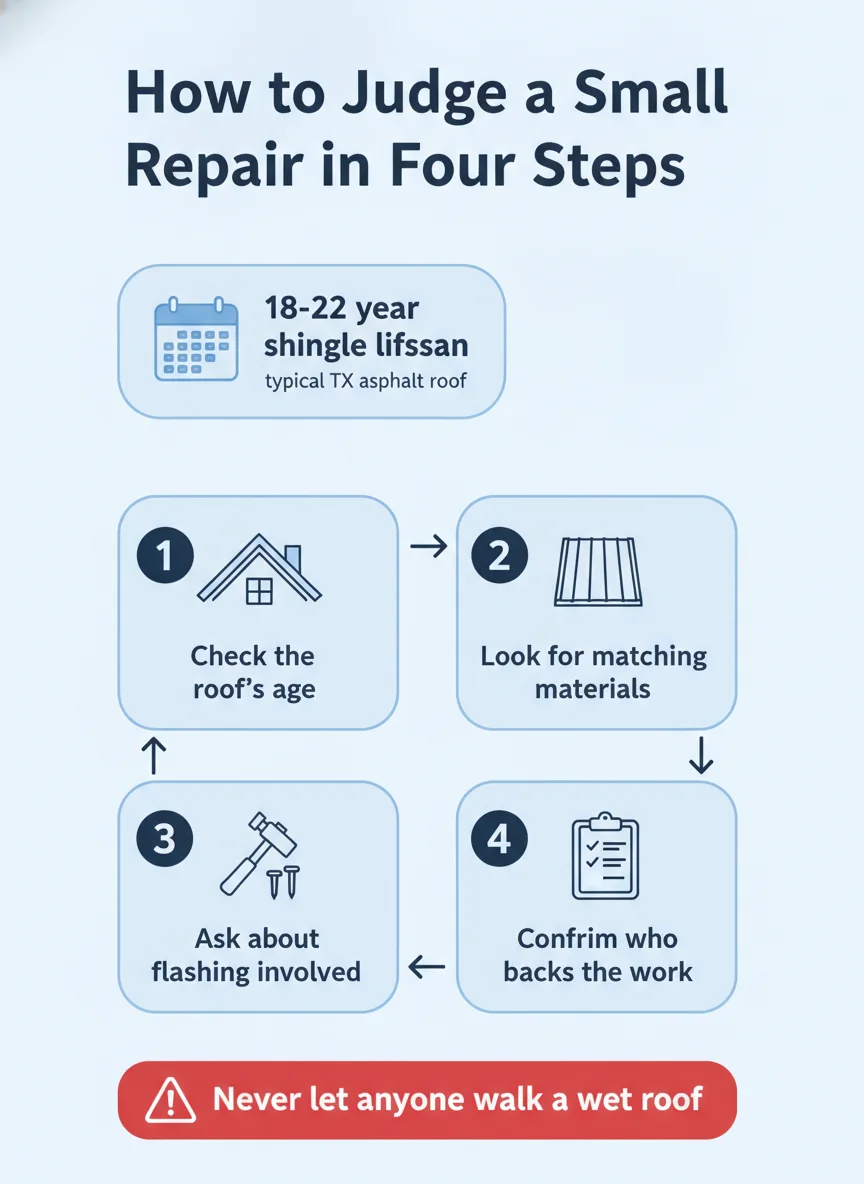
Step-by-Step: How to Evaluate a Small Roof Repair Before You Call Anyone
Before picking up the phone, a short walkthrough from the ground and, if it's safe, from inside the attic can tell you a lot about which category your repair falls into.
- Check the roof's age: If the roof is near or past the 18-22 year mark typical for asphalt shingles in Texas, a repair may be a stopgap rather than a long-term fix.
- Look at the damage location: Note whether it's on open roof field or within a few feet of a chimney, skylight, valley, or vent pipe.
- Inspect the attic below: Look for water staining, dark spots on the decking, or damp insulation directly under the damaged area.
- Check for matching materials: See if the shingle style and color are still available or closely matched, since mismatched repairs stand out and sometimes affect resale appeal.
- Ask what the scope includes: A repair quote should specify whether underlayment or flashing will be checked, not just whether the visible shingle will be replaced.
- Confirm who backs the work: Ask directly what happens if the same spot leaks again within the first year, and get that answer in writing.
What You'll Typically Find Once You Look Closer
The Repair Really Is Small
If the attic below is dry, the damage is isolated to open roof field, and the roof itself isn't near the end of its service life, you're likely looking at a genuinely minor fix. These are the repairs where getting multiple opinions or waiting a season rarely makes the situation worse, and a capable handyman willing to match materials carefully can be a reasonable, lower-cost option.
Even in these cases, it's worth asking any contractor, handyman or roofer, what they'll do if the fix doesn't hold. A verbal "it'll be fine" isn't the same as a written commitment to come back.
The Repair Is Bigger Than It Looks
If there's attic staining, the damage sits near a flashing point, or the roof is already aging out, the visible shingle is rarely the whole story. What looks like a single bad shingle can be the surface symptom of a flashing seal that failed months earlier, or underlayment that's been wet and drying out in cycles. These situations call for someone who can open up the area, assess what's underneath, and repair the full system, not just patch the top layer.
This is also the point where a second roofer's opinion, or a full inspection rather than a single-spot patch, tends to save money over time by catching a developing problem before it spreads to decking or interior finishes.
What a Homeowner Can Handle vs. What Needs a Licensed Pro
Ground-level tasks are reasonable for most homeowners: clearing debris from valleys and gutters, visually checking for obviously curled or missing shingles with binoculars, and checking the attic for staining after a hard rain. None of that requires getting on the roof or touching the roofing materials themselves.
Anything that requires walking the roof surface, lifting shingles, or working near flashing should go to a professional, and ideally a licensed roofer rather than a general handyman. Walking a roof without the right footwear and experience is a real fall risk, and disturbing shingles or flashing incorrectly can turn a contained issue into a wider leak. Texas building codes and manufacturer installation guidelines also assume the person doing the work understands shingle and flashing systems, which is part of why workmanship warranties typically require a qualified installer.
The in-between category, like replacing a single easily accessible shingle on a low, walkable roof, is where homeowner judgment and risk tolerance come into play. If there's any doubt about the roof's condition, age, or the presence of flashing nearby, it's worth the extra step of having it looked at by someone who repairs roofs for a living.
Making the Right Call for Your Roof
The size of the visible damage is a poor predictor of how complicated the actual fix will be. A single missing shingle in open roof field is often a quick, low-risk repair, while a seemingly similar patch near a valley or chimney can involve layered flashing work that needs real roofing experience to get right the first time.
When the damage sits anywhere near a transition point, or the roof is getting older, it's worth having it checked by a crew that handles roof repair regularly rather than gambling on a quick fix. Homeowners in Plano and surrounding North Texas communities dealing with a small repair that doesn't feel so small anymore can read more on when a roof is past simple repair before deciding, and Absolute Professional Roofing Contractors is available to take a look when it's time for a second opinion.
Frequently asked questions
Can a handyman fix a small roof leak?
A handyman can sometimes patch a minor, surface-level issue like a loose shingle tab or a small caulk gap around a vent boot. The risk is that many leaks that look small actually start at flashing or underlayment, areas that require roofing-specific know-how to diagnose and seal correctly.
What can go wrong if a handyman repairs a roof?
The most common problems are mismatched materials that don't seal properly, nails driven at the wrong angle or location, and flashing that gets caulked instead of properly integrated with the shingle layers. These shortcuts often hide the real problem instead of fixing it, so the leak returns later and can cause interior damage in the meantime.
Do I need a licensed roofer for a small repair?
For anything involving flashing, valleys, or penetrations like vent pipes and chimneys, yes, a licensed roofer is the safer call because those areas require specific techniques to stay watertight. For cosmetic fixes with no flashing or water history involved, a skilled handyman can sometimes handle it.
Will insurance cover a handyman's roof repair?
Insurance coverage generally depends on the cause of damage and the documentation provided, not who performed the repair, but most insurers want to see work done to code by a licensed contractor. If a repair is tied to a storm or covered peril, a [licensed roofer](/services/roof-repair) is typically better positioned to document the damage and support a claim.
How do I know if my roof repair is actually small?
A repair is genuinely small if it's isolated to one shingle, one fastener, or a small section with no sign of water staining inside the attic or ceiling below. If there's any evidence of water intrusion, soft decking, or the issue sits near a flashing point, it's bigger than it looks and worth a professional look.