A roof doesn't fail all at once
Across the DFW metro, roofs take a beating from summer heat, afternoon downpours, and the occasional hailstorm, all in the same calendar year. Asphalt shingles handle that punishment well for a long time, but they don't fail on a single bad day. They wear down gradually, and most homeowners end up calling a roofer for the second or third repair in a few years before anyone asks the bigger question: is this roof actually worth fixing again?
That question matters because a repair only fixes what's visible. If the underlying material has reached the end of its service life, a patch buys a little time and not much else. This guide walks through the signs a roofer actually looks for when deciding whether a repair will hold or whether it's time to talk about roof replacement.
Why repairs stop working as a roof ages
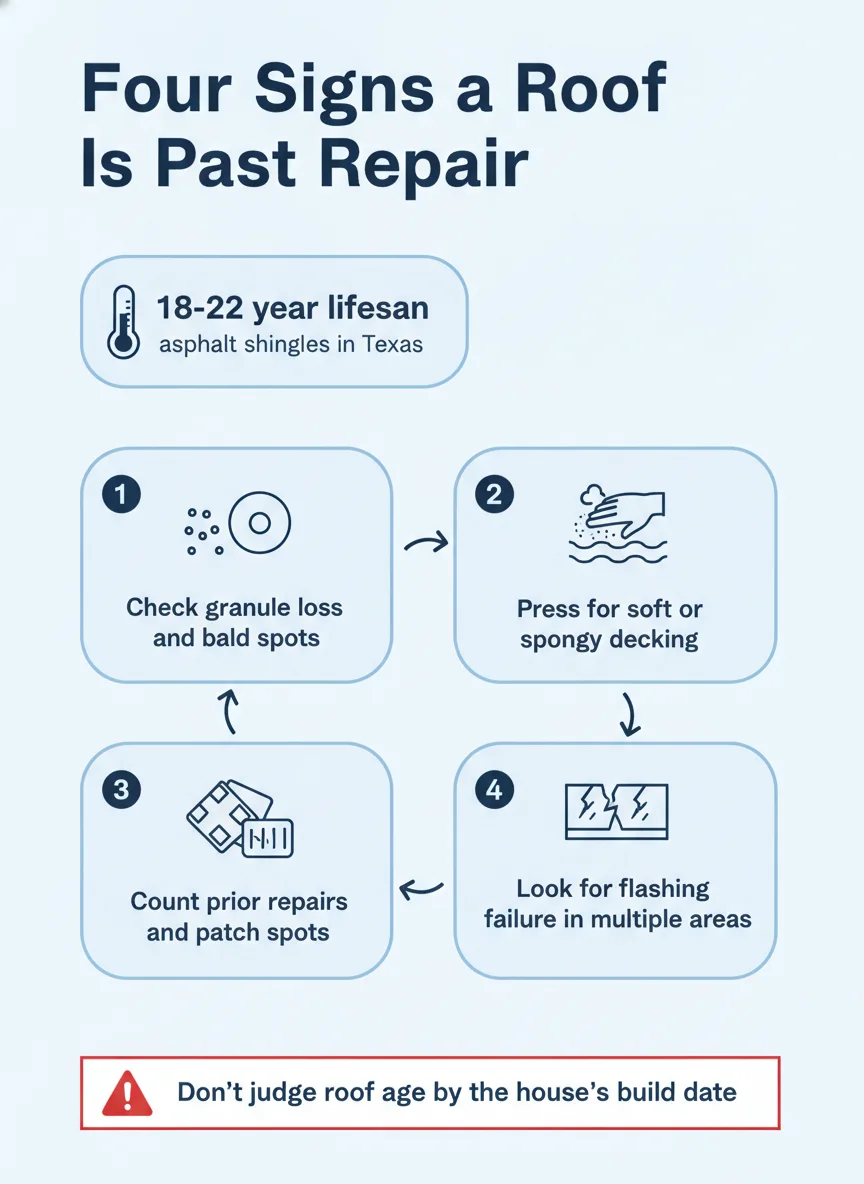
Every roofing material has a working life. Asphalt shingles in Texas typically last somewhere in the 18-22 year range across the industry, depending on the product, the slope, and how much direct sun the roof takes on. Early in that life, a torn shingle or a cracked seal is an isolated problem and a repair fixes it cleanly. Late in that life, the same kind of damage is often a symptom of the whole surface wearing thin at once.
Granule loss and material wear
Asphalt shingles are coated in granules that shield the asphalt layer from UV light. As a roof ages, those granules wash off in the gutters and collect at downspouts. A little granule loss is normal. Heavy, widespread loss that leaves bald patches across multiple shingles means the material underneath is exposed and brittle, and a single-shingle repair won't address a surface that's uniformly worn.
Curling or cupping shingle edges tell a similar story. Once the asphalt starts to dry out and lose flexibility, shingles lift at the corners and let wind and water get underneath. A roofer checking for this will usually find it across several sections of the roof, not just where the current leak is, which is the clue that points toward replacement rather than another patch.
Repeat leaks and a pattern of repair calls
One leak after a storm is a normal, fixable event. A string of repair calls over a couple of years, especially in different spots each time, is a pattern. It usually means the roof's overall material condition has degraded to the point where new weak spots keep opening up faster than individual repairs can keep ahead of them.
A homeowner who has called a roofer three or four times in recent memory for separate issues is often better served stepping back and asking for a full assessment rather than scheduling a fifth roof repair. At that point the running cost of repeated fixes starts to approach what a full system replacement would have run, without resetting the roof's remaining lifespan.
| Sign | Usually still repairable | Usually points to replacement |
|---|---|---|
| Granule loss | Light, localized to one area | Heavy, spread across multiple slopes |
| Leaks | One leak, one clear cause | Leaks in several spots or recurring over time |
| Decking | Firm underfoot, no give | Soft or spongy when walked or pressed |
| Flashing | One failed seal or joint | Failures at valleys, chimneys, and vents all at once |
The decking underneath matters as much as the shingles
The roof deck is the wood sheathing that every other layer is fastened to. It's hidden under the shingles and underlayment, so most homeowners never think about it until a roofer points it out. Moisture that gets past worn shingles or failed flashing eventually reaches the deck, and plywood or OSB that stays damp over time starts to soften and lose its structural integrity.
A soft spot in the decking changes the conversation entirely. Shingles can be replaced on their own, but decking that's gone soft has to be cut out and replaced before any new material goes down, and if the soft spots are scattered across the roof rather than confined to one small area, that's usually the clearest sign a repair isn't going to be enough on its own.
Step-by-step: how a roofer evaluates a roof for repair versus replacement
A thorough evaluation walks the whole roof surface rather than just the spot where the leak showed up inside the house. Here's generally how that assessment goes.
- Walk the full surface: A roofer gets on the roof and checks every slope, not just the area near the reported leak, to see whether wear is isolated or widespread.
- Check granule condition: Bald patches, cracking, and curling shingles across multiple areas signal the material is nearing the end of its life.
- Test the decking: Pressing or walking suspect areas reveals soft spots where moisture has already reached the wood sheathing underneath.
- Inspect flashing points: Valleys, chimneys, and vent boots get checked individually since these are common spots for water to work its way in.
- Review repair history: A roof that's had several separate repairs in recent years gets weighed differently than one with a single clean issue.
- Compare the cost picture: The roofer lays out what another repair covers versus what's likely to come up again, so the homeowner can decide with the full picture.
What the findings usually mean
Once the evaluation is done, the results tend to fall into one of two general categories, and each points toward a different next step.
Localized damage with a sound roof around it
If the wear is confined to one section (a tree limb strike, one failed flashing seal, a handful of missing shingles) and the rest of the roof checks out firm and intact, a repair is the right call. The surrounding material still has useful life left, and there's no reason to replace a roof that's otherwise sound.
This is the scenario most homeowners picture when they call about a leak, and it's often exactly what they get. A clean, isolated repair restores the roof to full function without disturbing material that's still doing its job.
Widespread wear with soft decking or repeat failures
If granule loss, curling, or leaks show up in multiple places and the decking has started to soften in more than one spot, that points to a roof nearing the end of its service life as a whole. At that stage, a repair addresses today's symptom but leaves the next one waiting to happen somewhere else on the same roof.
This is the point where it's worth comparing repair against replacement directly rather than scheduling another one-off fix. A full replacement resets the clock on the whole system instead of extending a roof that's already past the point of reliable patching.
What a homeowner can check, and what needs a licensed roofer
From the ground, a homeowner can spot a few early warning signs without climbing anything. Granules collecting heavily in gutters or at the base of downspouts, shingles that look curled or lifted when viewed with binoculars, and daylight visible through the attic where there shouldn't be any are all things worth noting and reporting when scheduling a professional look.
What a homeowner shouldn't do is get on the roof to check decking firmness or flashing condition directly. That evaluation requires walking the surface safely, knowing where the structural members sit underneath, and recognizing which kinds of wear are cosmetic versus which point to a real problem. It's also easy to cause additional damage walking on a roof that's already compromised.
A licensed roofer brings the experience to read these signs accurately and the equipment to check areas like valleys and chimney flashing safely. That evaluation is worth getting before committing to either path, since a misread can mean paying for a repair that doesn't last or replacing a roof section that didn't need it.
Getting an honest read before you decide
The honest answer to whether a roof is past repair almost never comes from a single symptom. It comes from walking the whole surface, checking the decking, and looking at how many separate issues have come up over time. Homeowners in McKinney and across the surrounding area are often surprised to learn their roof has more wear than the one visible leak suggested, or less than they feared.
Absolute Professional Roofing Contractors walks that full evaluation with every roof we're asked to look at, so the repair-versus-replace decision is based on what's actually there rather than a guess.
Frequently asked questions
How do I know if my roof needs to be replaced instead of repaired?
A roof usually needs replacement rather than another repair when the damage shows up in more than one or two spots, when the material itself is worn thin (heavy granule loss, cracking, curling), or when the decking underneath has gone soft. One isolated leak is often a repair. Leaks in several areas, or a roof that's needed several repairs in recent years, usually points to the whole system wearing out.
Does the age of my house tell me the age of my roof?
No, and this trips up a lot of homeowners. The roof may have been replaced once or twice since the house was built, or it could still be the original roof from construction. The only reliable way to know a roof's real age is a receipt from the last replacement or an inspection that reads the material's wear pattern.
What does soft decking mean and why does it matter?
Soft or spongy decking means the wood sheathing under the shingles has absorbed moisture over time and started to weaken. It matters because a repair only addresses the surface layer. If the deck underneath is compromised, a new patch has nothing solid to anchor to, and the problem comes back.
Can a roof with multiple small leaks still be repaired?
Sometimes, but it depends on whether the leaks are isolated incidents or symptoms of broader wear. A roofer who's walked the whole surface can usually tell the difference between a few unrelated trouble spots and a material that's failing across the board.
Is it cheaper in the long run to keep repairing an old roof?
Not usually. Each repair costs money and labor on its own, and an aging roof tends to generate repair calls more often as it nears the end of its service life. At some point the running total of repairs starts to rival what a full replacement would have cost, with a shorter remaining lifespan to show for it.