
Why Downspout Spacing Matters More Than It Looks
Gutters get most of the attention, but downspouts are what actually move water off the roof and away from the house. A gutter system with too few downspouts, or downspouts spaced too far apart, can overflow during heavy Texas downpours even if the gutters themselves are in good condition.
North Texas sees intense rain events that dump a lot of water in a short window. A drainage system sized for light, steady rain can get overwhelmed fast when several inches fall in an hour, which is exactly the scenario downspout spacing needs to account for.
How Downspout Coverage Gets Calculated
The basic idea is straightforward: match the number and size of downspouts to the volume of water a given roof section can generate during a heavy rain event.
The Coverage Rule of Thumb
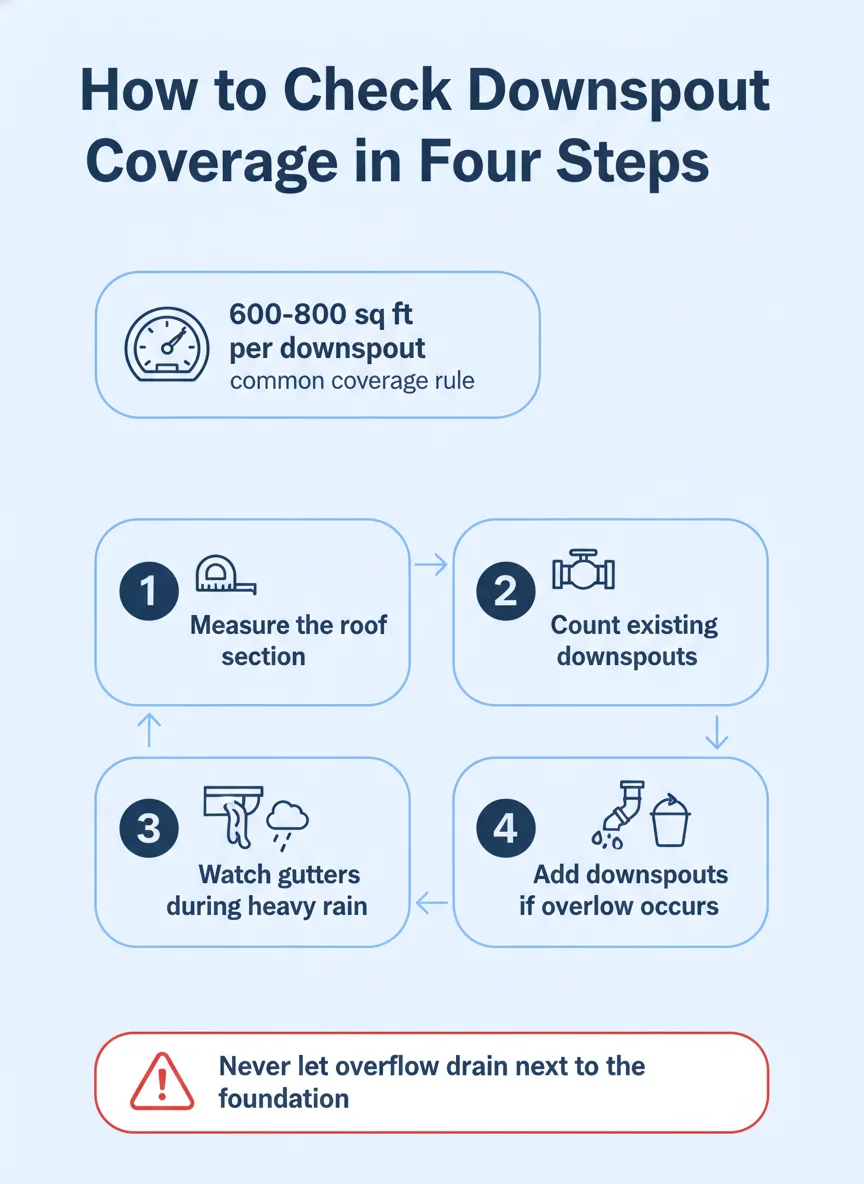
A widely used guideline is one downspout for roughly every 600 to 800 square feet of roof area draining into a given gutter run. A roof section feeding 1,500 square feet of drainage area would typically call for two downspouts under this rule, rather than relying on a single one to handle the whole load.
This is a starting point, not a strict formula. Roof pitch, local rainfall intensity, and gutter size all shift the ideal number in either direction, which is why a physical evaluation of the roof and gutter system gives a more reliable answer than a generic calculation.
Gutter Size and Capacity
Standard residential gutters come in 5-inch and 6-inch seamless profiles. A 6-inch gutter system moves noticeably more water volume than a 5-inch system, which can extend the effective coverage area per downspout on larger or steeper roofs.
Homes with large, continuous roof planes, common on many newer builds across the DFW metro, sometimes benefit from upsizing to a 6-inch system rather than simply adding more downspouts to a 5-inch system that's already at capacity.
| Gutter Size | Typical Capacity | Best Fit |
|---|---|---|
| 5-inch gutter | Standard residential flow | Most typical single-story homes |
| 6-inch gutter | Higher flow capacity | Larger roofs, steep pitches, heavy rain areas |
| Extra downspout | Reduces load per spout | Long gutter runs or valleys concentrating water |
Where Water Concentrates on a Roof
Not all roof area drains evenly. Valleys where two roof planes meet concentrate a lot of water into a single stream, and that stream often needs a downspout positioned close by to handle the volume. Roof sections that funnel water from multiple planes into one gutter run need more downspout capacity than a simple, single-plane section of the same square footage.
This is why a good gutter layout considers the roof's actual water flow pattern, not just its total square footage, when deciding downspout placement and count.
Step-by-Step: Checking Your Home's Downspout Coverage
The best way to evaluate your current setup is to watch it in action during a real rain event, then follow up with some basic measurements.
- Watch gutters during rain: During a heavy rain, watch for water sheeting over the gutter edge instead of flowing down through the downspouts.
- Note overflow locations: Mark which sections of gutter overflow so you know exactly where additional drainage is needed.
- Measure the roof section: Estimate the square footage of roof draining into each gutter run using your roof's footprint and pitch.
- Count existing downspouts: Compare your downspout count against the 600 to 800 square foot per downspout guideline for each section.
- Check downspout discharge points: Confirm water is draining several feet from the foundation rather than pooling right against the house.
- Get a professional gutter assessment: A gutters evaluation can confirm the right downspout count and size for your specific roof.
What Overflow and Poor Drainage Look Like
Around the Foundation
Water pooling near the foundation, soil erosion trenches below downspouts, or damp basement or crawlspace areas are common signs that drainage isn't moving water far enough away from the house. In clay-heavy North Texas soil, repeated saturation near the foundation can contribute to shifting over time.
If you notice these signs, it's worth checking both the downspout count and where the water actually discharges, since a downspout that's technically working but draining right next to the house isn't solving the problem.
On the Gutters Themselves
Gutters sagging under the weight of standing water, water marks staining the fascia below the gutter, or visible overflow streaks on the siding all point to a drainage system that's undersized for the roof feeding it. These signs tend to show up first in the sections farthest from an existing downspout.
Left unaddressed, chronic overflow can damage fascia boards and eventually affect the roof edge itself, turning a drainage fix into a larger repair.
What You Can Check Yourself vs. What Needs a Pro
Watching your gutters during rain and noting where overflow happens is something any homeowner can observe without special tools. It gives you concrete evidence to bring to a gutter contractor.
Calculating precise drainage area, sizing gutters and downspouts correctly, and installing new downspouts with proper slope and discharge points is best left to a professional. Improperly installed downspouts can create new problems, like directing water toward rather than away from the foundation.
A licensed contractor can also evaluate whether your roof's valleys and roof planes need dedicated downspouts beyond what a simple square footage calculation would suggest.
Getting Your Drainage Sized Right
Downspout coverage is one of those details that's easy to overlook until a heavy rain exposes the gap. Matching downspout count and gutter size to your roof's actual drainage area protects your foundation, siding, and fascia over the long run.
Absolute Professional Roofing Contractors evaluates gutter and downspout coverage as part of every gutter installation across Plano and the surrounding DFW metro.
Frequently asked questions
How much roof area can one downspout handle?
A common industry rule of thumb is one downspout for every 600 to 800 square feet of roof area, though this can vary with gutter size and local rainfall intensity. Larger roof sections or areas with heavier seasonal rainfall often benefit from downspouts on the tighter end of that range.
How do I know if my gutters need another downspout?
The clearest sign is gutters overflowing over the front edge during heavy rain instead of draining through the downspouts. If you see water sheeting off the gutter itself rather than flowing down through the spout, that section likely needs additional drainage capacity.
Does gutter size affect how much roof area a downspout can handle?
Yes, larger gutters and downspouts, such as 6-inch systems versus standard 5-inch systems, move more water volume and can cover more roof area per downspout. Homes with larger roof planes or steep pitches sometimes benefit from upsizing to a 6-inch system rather than simply adding more downspouts.
Can too many downspouts be unnecessary?
It's possible to add more than a roof section needs, though extra downspouts rarely cause problems beyond added material cost. The bigger risk is having too few, which leads to overflow, water damage, and erosion around the foundation.
Where should downspouts drain to be effective?
Downspouts should discharge water at least several feet away from the foundation, ideally toward a slope that carries water away from the house or into a drainage system. A downspout that dumps water right next to the foundation can contribute to the same problems it's meant to prevent.