
Why Roof Age Matters More Than You'd Think
In the DFW metro, roof age comes up more often than most homeowners expect. Insurance companies ask for it when writing or renewing a policy, buyers ask for it before closing, and it's the single biggest factor in deciding whether a problem area calls for a patch or a full tear-off. Yet a huge number of homeowners in Plano, Dallas, Frisco, and the surrounding towns genuinely have no idea when their current roof went on.
That gap usually isn't carelessness. Roofs get replaced by a previous owner, a flipper, or an insurance claim years before the current resident ever moved in, and the paperwork doesn't always follow the house. The good news is that the real installation date is almost always recoverable if you know where to look, and the visible condition of the roof itself fills in the rest.
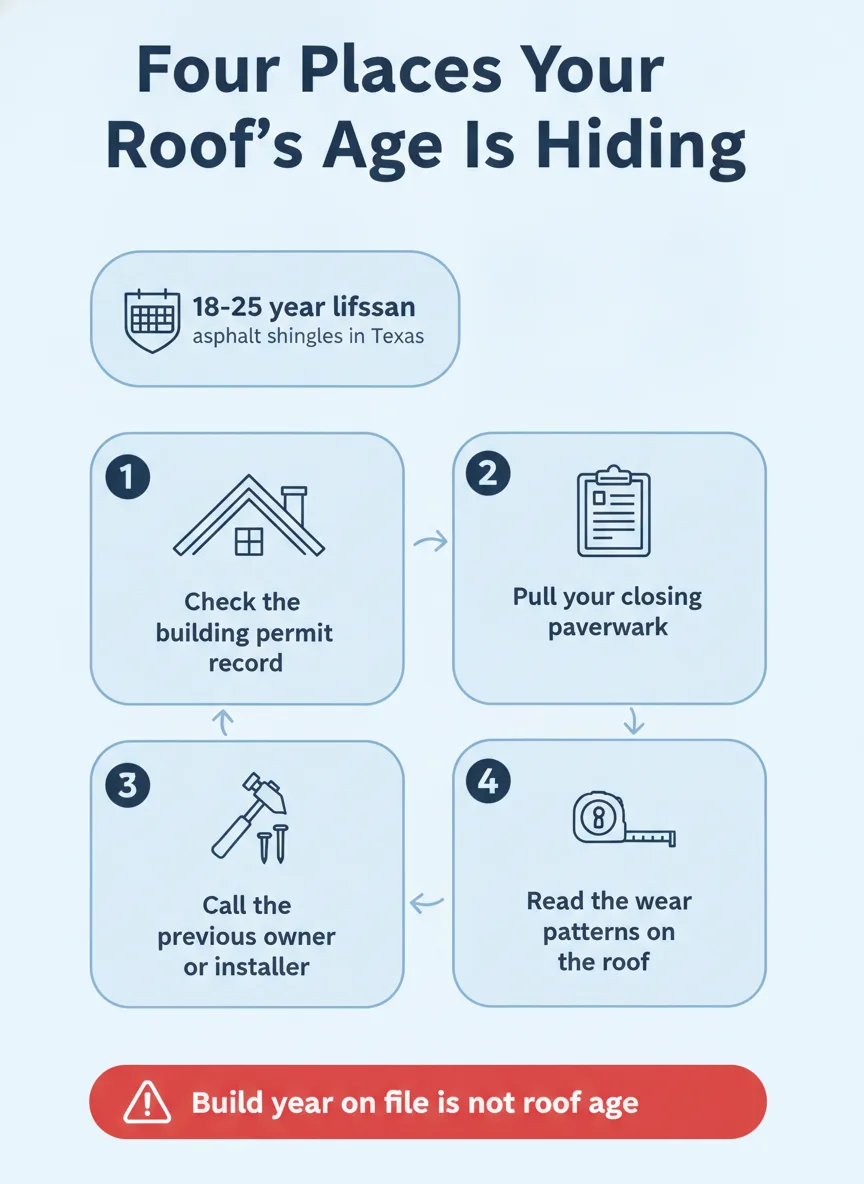
Why the Build Year on File Isn't the Roof's Age
Tax records, appraisal district listings, and even some real estate sites display a 'year built' field for the house, and it's tempting to assume that's also the roof's age. It almost never is. Shingle roofs in North Texas typically last somewhere in the 18 to 25 year range depending on material, installation quality, and sun exposure, which means a 1980s house could be on its third or fourth roof by now.
What the Build Year Actually Tells You
The build year reflects when the foundation and framing went up, not any individual component's maintenance history. Windows, water heaters, HVAC systems, and roofs all get replaced on their own timelines over the decades, often by different owners for different reasons, whether that's routine wear, storm damage, or a cosmetic upgrade before a sale.
Treat the build year as a ceiling, not an answer. The roof can be no older than the house, but it's frequently much younger, and assuming otherwise can lead you to underestimate how much life is actually left in it.
Why This Confusion Happens So Often
Real estate listings and online home-value tools pull their data from county assessor records, which track structural details but rarely update for component-level work like a new roof unless a permit specifically flagged it. Unless someone manually corrects the listing, the roof's true age stays invisible to anyone just browsing public records online.
This is exactly why a direct records search, rather than a quick online lookup, is the move if you actually need a reliable number instead of a rough guess.
| Source | Reliability | Typical Effort |
|---|---|---|
| Building permit record | High, if a permit was pulled | Low, one records search |
| Closing/seller disclosure docs | Moderate to high | Low, if you kept paperwork |
| Previous owner or installer | High, if reachable | Moderate |
| Visual wear inspection | Estimate only | Low, one visit |
The Four Places Your Roof's Age Actually Lives
Roof replacements are a significant home improvement, and like most significant work, they tend to leave a paper trail in a handful of predictable places. Checking these in order, from most reliable to least, is the fastest path to a real answer instead of a guess.
The permit record sits at the top of that list because it's tied to an official filing date rather than someone's memory. From there, closing paperwork and direct contact with a previous owner or the installer fill in details the permit alone might not cover, like the specific material used.
Step-by-Step: Tracking Down Your Roof's Installation Date
Work through these in order. Most homeowners find a usable answer within the first two or three steps without needing to climb a ladder.
- Search the permit database: Most Texas cities and counties post building permits online, searchable by address. A roofing permit, if one was pulled, usually shows the filing date within a few months of the actual installation.
- Pull your closing documents: Seller disclosures often list the age or replacement date of major systems including the roof, and these forms are legally meant to be as accurate as the seller knows.
- Check your home inspection report: If you had an inspection done when you bought the house, look for any notes on roof condition or estimated remaining life, which can help narrow the range.
- Contact the previous owner: If you're on good terms or can track them down through the listing agent, a direct question about when the roof was replaced often gets a fast, accurate answer.
- Call the installer if known: If a company name or invoice sticker is visible in the attic or on a permit, that business may still have the job on file even years later.
- Review your insurance file: Insurers sometimes request or log roof age at the time a policy was written, and your agent may have that number on record from underwriting.
- Get a visual read from a roofer: When none of the paper trail turns up anything, a roofer can estimate age from granule wear, flashing condition, and attic decking during a roof repair visit or standalone inspection.
What the Roof Itself Tells You When the Paperwork Doesn't
Signs of an Aging Roof From the Ground
Even without climbing up, you can spot some age indicators from the driveway. Shingles that look faded, curled at the edges, or uneven in color from one section to another are common signs of a roof well into its service life. Granules collecting in gutters or at downspout outlets are another clue, since shingles shed more granules as the asphalt layer underneath starts to break down.
Dark streaking across the shingles, moss or algae growth in shaded sections, and visibly sagging rooflines all point toward an older system too, though none of these alone pin down an exact year. They're useful as supporting evidence once you've narrowed things down through records.
What a Roofer Checks Up Close
Up on the roof, a trained eye looks at things a homeowner on the ground can't easily see, like the brittleness of the shingles when gently flexed, the condition of the flashing around vents and chimneys, and how the decking underneath feels when walked. These details, combined with any attic-side markings or leftover material scraps, usually let a roofer put a number on the roof's remaining useful life even without a paper trail.
This kind of hands-on read is also a chance to catch small issues, like a lifting shingle near a valley, before they become bigger repairs.
What You Can Check Yourself vs. What Needs a Roofer
The records search is entirely a homeowner task. Pulling permit history, digging through closing documents, and making a phone call to a previous owner or an old installer don't require any special tools or training, just a bit of persistence and knowing where to look first.
The visual estimate is where a professional earns their keep. Judging shingle brittleness, decking condition, and flashing wear accurately takes experience, and getting on the roof itself is a safety call best left to someone with the right equipment and footing.
If your search through records comes up empty and you want a real number instead of a guess, that's a reasonable reason to schedule a visual assessment rather than continuing to dig through old files.
Getting a Straight Answer on Your Roof's Age
Between permit records, closing paperwork, and a conversation with a previous owner, most homeowners can land on a reliable installation date without ever touching a ladder. When that trail runs cold, the roof's own wear patterns usually fill in the rest of the story.
Once you know roughly how old your roof is, you're in a much better position to plan ahead, whether that means budgeting for a future roof replacement or simply having an accurate answer ready for your insurance company. Absolute Professional Roofing Contractors LLC can help put a real number on your roof's condition when the paperwork runs out.
Frequently asked questions
Does the year my house was built tell me the age of my roof?
No, and this is the single most common mix-up homeowners run into. A roof is replaced on its own schedule, often multiple times over a home's life, so a house built in 1995 could easily have a roof installed in 2018.
Where can I find the permit record for a roof replacement?
Most cities and counties keep roofing permits on file with the local building department, searchable by address. If a permit was pulled for the replacement, which is standard practice for a licensed job, the issue date is usually within a few months of the actual install.
What if I can't find any paperwork at all?
You can still get a reasonable estimate from a visual inspection. A roofer can look at granule loss, shingle curling, flashing condition, and attic decking to put the roof's age into a rough range even with zero records.
Does my home inspection report from when I bought the house help?
It can, since many inspectors note visible roof age or condition, but it's rarely an exact installation date. Treat it as a helpful data point to cross-check against permit records or seller disclosures.
Why does knowing my roof's age even matter?
Age drives decisions on insurance, resale, and whether a repair or a full [roof replacement](/services/roof-replacement) makes more financial sense. An insurer or buyer will often ask for it directly, so having a real answer instead of a guess works in your favor.