Why This Decision Matters for Dallas-Fort Worth Homes
North Texas roofs deal with triple-digit summer heat, sudden hailstorms, and strong straight-line winds, sometimes all in the same season. Whatever material goes on the deck has to survive UV exposure for years without curling, hold up to hail impact without cracking, and stay fastened down when gusts pick up. That's why the asphalt versus metal question comes up so often for homeowners planning a replacement.
Both materials are proven choices across the region, and plenty of good roofs exist in both categories. The decision usually comes down to budget, how long you plan to stay in the home, and how much you value a longer-lasting system over a lower upfront cost. There isn't a universally right answer, only the right fit for your situation.
What Actually Separates the Two Materials
Asphalt shingles are layered mineral-coated strips fastened in overlapping rows, while metal roofing comes as either large interlocking panels (standing seam) or shingle-style metal pieces. The manufacturing difference drives almost every performance gap between them, from how they shed water to how they respond to a hailstone.
Asphalt Shingles: The Familiar Standard
Asphalt shingles remain the most common roofing material in Texas because they're budget-friendly to install, easy to repair in sections, and available in a wide range of colors and styles that match almost any home's exterior. Architectural shingles, which have more layering than basic three-tab versions, hold up better to wind and give a more dimensional look.
The tradeoff is service life. Under Texas sun, asphalt shingles typically last in the range of 18 to 22 years industry-wide before granule loss and brittleness set in, and hail impact can shorten that window if the shingles take a direct hit during a storm.
Metal Roofing: Built for the Long Haul
Metal roofing is installed as either standing seam panels with raised interlocking seams or metal shingles shaped to mimic traditional roofing. Either way, metal sheds water fast, handles wind uplift well when properly fastened, and resists the kind of granule degradation that eventually wears out asphalt.
Metal roofs commonly carry service lives of several decades, far outpacing asphalt, which is the main reason homeowners choose it despite a higher install cost. It's also a strong match for homes with lower-slope sections or additions where water needs to move off the roof quickly.
| Factor | Asphalt Shingles | Metal Roofing |
|---|---|---|
| Typical lifespan | Roughly 18-22 years in TX sun | Often several decades |
| Upfront cost | Lower material and install cost | Higher material and install cost |
| Hail performance | Varies by impact rating of product | Generally dents before it fails |
| Heat reflectivity | Absorbs more heat, darker colors more so | Reflects more, especially light colors |
How Each System Is Built
An asphalt shingle roof system includes the deck, underlayment, starter strips, the shingles themselves, and flashing at valleys, vents, and roof-to-wall transitions. The system depends on overlapping layers to shed water, which is why proper nailing pattern and exposure matter as much as the shingle quality itself.
A metal roof system swaps the shingle layer for panels or interlocking metal pieces, fastened either through exposed screws with washers or hidden clips depending on the style. Underlayment still matters underneath metal, and proper flashing at penetrations is arguably even more critical since metal doesn't self-seal the way asphalt granules can around a nail.
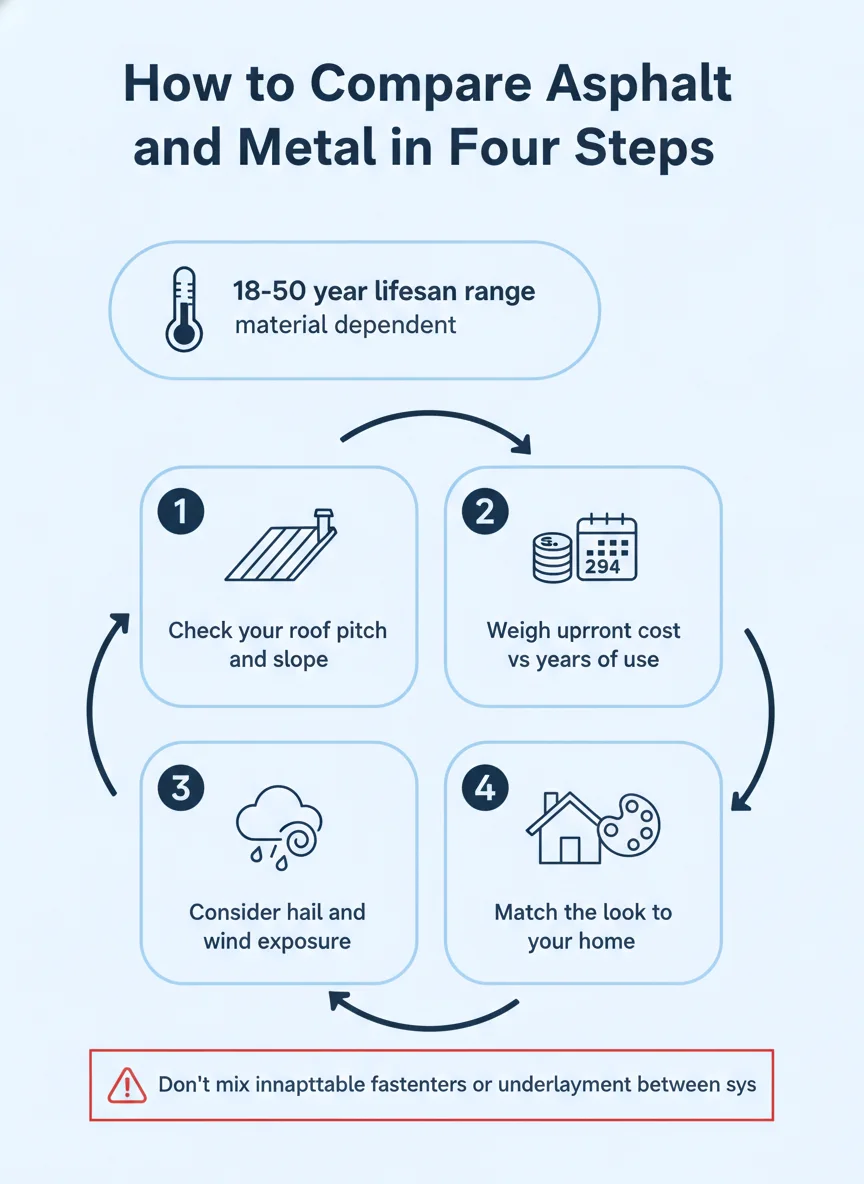
Step-by-Step: How to Decide Between the Two
Working through these questions in order helps narrow the decision down to what actually fits your home and plans.
- How long will you stay?: If you plan to sell within a decade, the lower upfront cost of asphalt may make more financial sense than paying for decades of metal life you won't use.
- What's your roof's slope?: Steeper slopes work well with either material, but low-slope sections often benefit more from metal's superior water-shedding.
- How exposed is the home to hail?: Homes in open areas with a history of hail activity may want to compare impact ratings within each material category, not just asphalt versus metal broadly.
- What's the budget ceiling?: Set a realistic range before getting quotes so the material conversation doesn't derail the project.
- Does HOA or style matter?: Some neighborhoods have aesthetic guidelines that favor traditional shingle profiles, which is worth checking before committing to metal.
- Get a [roof replacement](/services/roof-replacement) quote: A written scope comparing both materials for your specific roof gives you real numbers to weigh instead of general averages.
What Homeowners Notice After Living With Each Roof
Life With an Asphalt Roof
Most homeowners with asphalt shingles don't think about the roof much until a storm rolls through or granules start showing up in the gutters. Spot repairs after missing shingles following wind are usually straightforward, and matching shingle color for a repair is easier the newer the roof is.
The attention shifts in the later years, when curling edges, bald patches, and recurring leaks become more common. That's typically the signal that a roof replacement is closer than a repair.
Life With a Metal Roof
Metal roof owners tend to report fewer surprises over the years, since the panels don't lose granules or curl with age. Routine maintenance is lighter, though fastener checks and coating inspections on exposed-fastener systems matter over time.
Hail impact on metal usually shows up as cosmetic denting rather than functional failure, which can factor differently into an insurance claim than a shingle roof with cracked mat exposure. Either way, a professional assessment after a significant storm is the right move.
What a Homeowner Can Handle vs What Needs a Pro
Homeowners can reasonably handle visual checks from the ground, clearing debris from valleys they can safely reach, and watching for obvious warning signs like granule buildup in gutters or visible dents after a storm. Keeping an eye on attic temperature and moisture is also something most people can monitor themselves.
Material selection, deck inspection, and the actual installation belong with a licensed roofer. Both asphalt and metal systems depend on correct underlayment, flashing, and fastening to perform as designed, and a mistake in any of those steps shortens the life of either material regardless of its quality.
Getting quotes for both materials side by side, with the same scope of work described for each, is the clearest way to compare real numbers instead of general cost ranges. A roofer who installs both systems can walk through tradeoffs specific to your roof's pitch, sun exposure, and structure.
Making the Call for Your Home
There's no single right answer between asphalt and metal for a Texas home. Asphalt remains a dependable, budget-conscious choice that performs well when installed correctly, while metal offers a longer runway and strong resistance to the elements for homeowners ready to invest more upfront.
Whichever direction fits your plans, getting the install done right matters more than the material label on the invoice. Absolute Professional Roofing Contractors works with homeowners across the Dallas area to compare both options and install the one that fits the home.
Frequently asked questions
Is metal roofing worth it in Texas?
For homeowners planning to stay long-term, metal roofing can be worth it because of its longer service life and strong wind and hail performance. The tradeoff is a higher upfront cost than asphalt shingles, so the right answer depends on how long you plan to own the home and your budget.
Does metal roofing make a house hotter or cooler?
Metal roofing generally reflects more solar heat than asphalt and can reduce attic temperatures, especially with a light color and proper venting. Asphalt shingles absorb more heat, though dark or light shingle colors and good attic ventilation narrow the gap.
Is metal roofing noisier than shingles in rain or hail?
Metal can sound louder during heavy rain or hail if it's installed directly over open framing, but a solid deck and underlayment, which is standard install practice, muffle most of that sound. Most homeowners report it's not noticeably louder than a shingle roof once insulation and decking are in place.
Which lasts longer in Texas heat and hail, shingles or metal?
Metal roofing typically outlasts asphalt shingles by a wide margin in terms of material life, often reaching several decades versus roughly 18-22 years for asphalt under Texas UV exposure. Hail performance depends more on the specific product's impact rating than the material category alone.
Can you install metal roofing over existing shingles?
In many cases a metal roof can go over an existing shingle layer if the deck and structure are in good condition, though a full tear-off is often recommended for the best long-term result. A roofer can inspect the deck and advise which approach fits your home.