
What a Windstorm Does to a Roof in the DFW Metro
North Texas gets its share of spring and summer wind events, and a roof doesn't need a named storm to lose shingles. Straight-line gusts moving through Plano, Frisco, McKinney, and the rest of the metro can pop tabs loose on roofs that are otherwise in decent shape, especially if the shingles are already a few years into their service life.
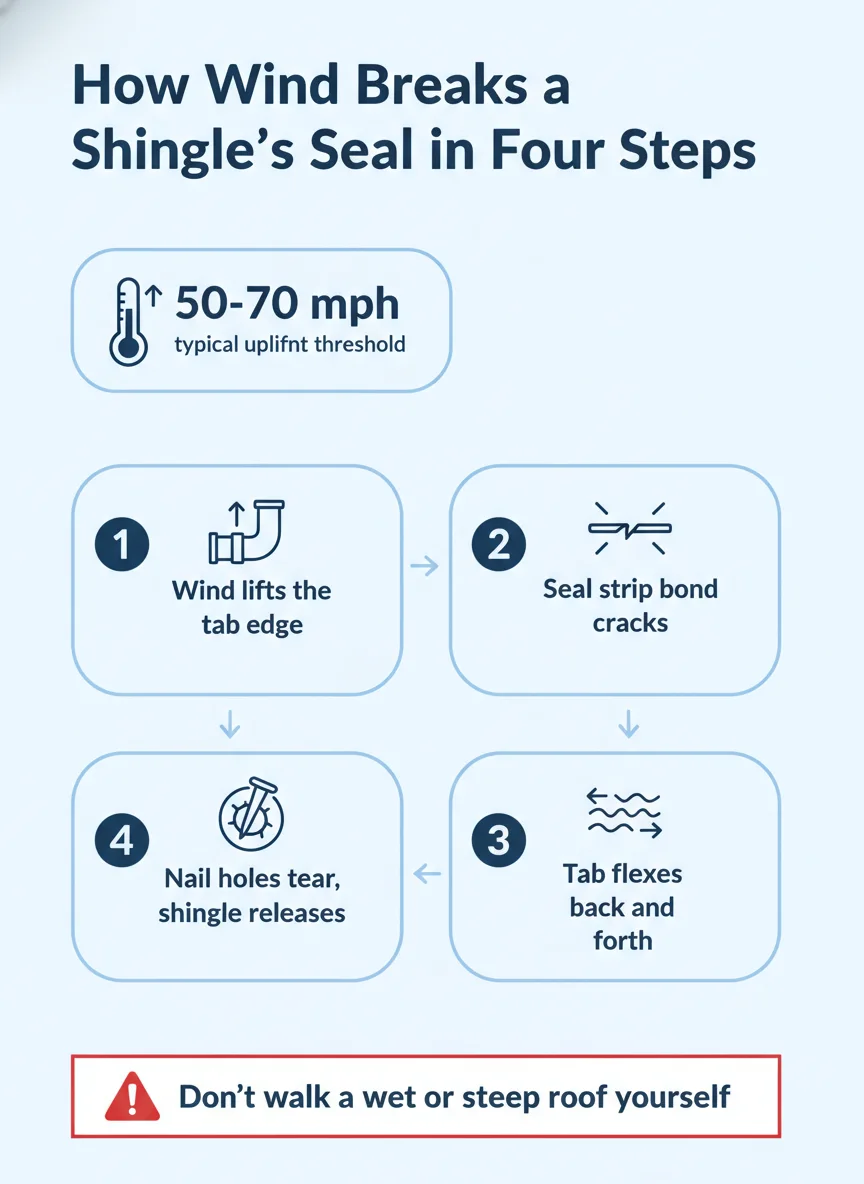
The tricky part is that a missing shingle is only the damage you can see. Wind works on a roof the same way it works on a loose shutter: it finds the weakest point first, flexes it, and keeps flexing until something gives. By the time a shingle actually blows off, the shingles around it have usually been through the same stress without fully failing yet.
Why a Few Missing Shingles Can Mean Many Broken Seals
Every shingle has a factory-applied seal strip, a band of adhesive that bonds to the shingle below it once the sun warms the roof after installation. That bond is what keeps shingles flat against the deck in wind. Once a seal strip cracks, the shingle above it can flutter in every gust after that, even if it never actually blows away.
Seal Strips and Why They Fail
A seal strip is a strip of asphalt adhesive near the bottom of each shingle that bonds to the shingle beneath it once heat from the sun sets it. On an older roof, that bond has been through years of expansion and contraction cycles from Texas heat, which makes it more brittle and more likely to crack under a sudden gust rather than flex with it.
On a newer roof, seals are more pliable, which is part of why a storm can take a few shingles off a brand-new roof while leaving an older one next door untouched. Age isn't the only variable. Slope, exposure, and how well the original installation was nailed all play a role too.
Creases and Lifted Tabs You Can't See From the Ground
A shingle that doesn't fully detach but gets bent back by wind develops a crease along its seal line. That crease is a permanent weak point. The shingle may lay back down and look fine from the street, but the bond underneath is broken, and the next wind event is more likely to finish the job.
Lifted tabs are the other tell. A tab that's popped up even slightly at one corner has lost its nail hold or its seal, and it'll keep working loose with every gust until it's either resealed, replaced, or blown off entirely.
| Sign | What it usually means | Typical response |
|---|---|---|
| A handful of shingles missing in one spot | Localized wind uplift, nailing or seal issue in that area | Targeted repair of the affected section |
| Missing shingles scattered across multiple slopes | Widespread seal failure across the whole roof | Often points toward replacement |
| Creased or lifted tabs with no shingles missing yet | Seal strips cracked but shingles still attached | Repair now to prevent future blow-offs |
| Missing shingles plus granule loss and curling nearby | Roof nearing the end of its service life | Replacement usually makes more sense than repeated repairs |
What's Actually Under a Missing Shingle
Lift one missing shingle and you're looking at the underlayment, the water-resistant layer installed directly on the roof deck before shingles go down. Underlayment is built to shed water temporarily, but it's not meant to be a long-term roof surface exposed to UV and rain on its own.
If enough time passes with underlayment exposed, sun and moisture start to break it down too, and water can eventually find its way to the decking itself. That's the real cost of waiting on a missing-shingle repair: it's not just the shingle, it's everything the shingle was protecting.
Step-by-Step: How a Roofer Evaluates Wind Damage
A thorough evaluation after a windstorm goes well beyond counting the shingles that are obviously gone. Here's generally how that inspection plays out.
- Walk the full roof: A roofer checks every slope, not just the side where shingles are visibly missing, since wind damage is rarely confined to one area.
- Check seal strips nearby: Shingles surrounding the missing ones get checked by hand for lifted edges or cracked seals that haven't failed yet.
- Inspect exposed underlayment: Any exposed underlayment gets checked for how long it's likely been uncovered and whether moisture has already reached it.
- Look at overall shingle condition: Granule loss, curling, and brittleness across the roof factor into whether a repair will hold or just delay a bigger job.
- Document everything with photos: Photos of each affected area support both the repair plan and any insurance claim you decide to file.
- Give you a clear recommendation: You get an honest read on whether a targeted patch is enough or whether the damage points toward full replacement.
What You'll Typically Find: Isolated Damage vs. Roof-Wide Wear
When It's Isolated
If the missing shingles are confined to one ridge line or one corner and the rest of the roof's seals check out solid on inspection, that's a strong sign the roof is otherwise healthy and the wind just found one weak spot. These cases are usually a straightforward matching repair.
Matching matters here. Shingle color fades with UV exposure over time, so a repair crew pulls shingles that are as close a match as possible, sometimes sourcing from a less visible slope of the same roof to keep the front-facing area uniform.
When It Points to Replacement
If the inspection turns up cracked seals on multiple slopes, granule loss that's advanced past what's typical for the shingle's age, or shingles that crumble rather than flex when checked by hand, that's a roof telling you the wind damage is a symptom, not the whole story.
In that situation, a roof replacement tends to be the more cost-effective path over time, since repeated repairs on a roof that's already failing broadly rarely hold up through the next wind event.
DIY vs. Calling a Licensed Roofer
A homeowner can safely do some of the groundwork here: checking gutters and the ground around the house for shingle pieces, taking photos from the ground with a zoom lens, and keeping a record of the storm date for insurance purposes. None of that requires getting on the roof.
Getting on the roof itself is where this becomes a job for a licensed roofer. Walking a roof to check seal strips and underlayment condition requires knowing where it's safe to step, how to avoid causing additional damage to shingles that are still intact, and what normal wear looks like versus storm damage.
A professional inspection also carries more weight with an insurance adjuster than a homeowner's photos alone, since it comes with documented findings and a clear scope of work. That documentation is often the difference in how smoothly a claim moves.
Getting a Straight Answer on Your Roof
Missing shingles after a wind event are easy to see and hard to diagnose on your own, which is exactly why an on-roof inspection matters more than guessing from the driveway. The difference between a quick patch and a full tear-off usually comes down to what the seal strips and underlayment look like once someone's actually up there checking them.
If you're weighing your options after a recent windstorm, it helps to read through Roof Replacement: Repair or Replace? for more on how that decision gets made, and homeowners from Plano to the surrounding metro can reach out to Absolute Professional Roofing Contractors LLC for a straight read on which one your roof needs.
Frequently asked questions
Why did only a few shingles blow off my roof?
Wind doesn't hit a roof evenly. Edges, ridges, and corners take the brunt of the uplift, so shingles there fail first even when the rest of the field looks fine. Those few missing shingles are often the visible tip of a wider pattern of broken seals you can't see from the ground.
Can I just replace the missing shingles myself?
You can buy matching shingles and nail them down, but matching color and granule wear exactly is tough once shingles have aged in the sun. A mismatched patch is a cosmetic issue at best and a sign of an amateur repair that can affect resale, so most homeowners call a roofer to get a clean match.
How do I know if it's a repair or a full replacement?
It comes down to how widespread the seal damage is, not just how many shingles are visibly gone. A roofer gets on the roof, checks the surrounding shingles for lifted or cracked seal strips, and gives you a count of how much of the roof is actually compromised.
Will my homeowners insurance cover wind damage shingles?
Many wind damage claims are covered under standard homeowners policies, but coverage depends on your specific policy terms and the cause of loss determination. Check your policy or talk with your insurance company, and a roofer can document the damage to support your claim either way.
How fast do I need to deal with missing shingles?
Faster than it looks, because an exposed section of underlayment or deck is one more rain event away from a leak. Getting a [roof repair](/services/roof-repair) scheduled quickly limits how much water gets under the roof system while you wait.