Why Does a North Texas Roof Need a Seasonal Calendar?
A roof in the DFW metro lives through more weather swings in a single year than most building materials are designed to shrug off without some attention. Spring brings the region's heaviest hail and straight-line wind events, summer pushes attic temperatures well past what the living space ever sees, fall dries everything out and drops leaves into valleys and gutters, and winter delivers hard freezes that can open small gaps a roof shrugged off all summer. Each season stresses a different part of the system.
Homes across Plano, Frisco, McKinney, Allen, and the rest of North Texas face this same cycle every year, which is why a seasonal calendar works better than waiting for a leak to show up inside. Checking the roof at the start of each season, even briefly, catches small issues while they're still small and gives you a record of how the roof is aging over time.
Why Do Seasonal Temperature Swings Wear on a Roof?
Roofing materials expand and contract with heat and cold, and North Texas asks them to do that across a wider range than most parts of the country. Shingles, flashing, sealants, and even the decking underneath all move slightly with temperature, and repeated movement over years is what eventually loosens nails, cracks sealant lines, and curls shingle edges. Understanding which season stresses which part of the roof helps you know what to check and when.
Summer Heat and UV Exposure
Texas summers put roofing material through sustained high heat and intense UV exposure for months at a time, which is the steady, cumulative kind of wear rather than a single dramatic event. UV rays break down the oils in asphalt shingles over years, leading to granule loss and brittleness, while trapped attic heat can push temperatures under the decking high enough to accelerate that aging from underneath as well.
Good attic airflow matters more in summer than any other season, since it's the difference between a roof system that sheds heat and one that cooks from the inside out. A quick summer check includes looking at attic ventilation and watching for shingle curling or granule buildup in gutters, both signs that heat and UV are taking their toll.
Winter Freeze and Flashing Movement
Winter in North Texas is shorter than summer but the freeze-thaw cycles it brings can be just as hard on a roof in a different way. Water that works into a small gap around flashing or a seal line can freeze, expand, and widen that gap, and it often takes more than one freeze cycle before the damage shows up as a leak.
A winter check is mostly about flashing around chimneys, vents, and valleys, since those are the spots most likely to open up after a hard freeze. It's also worth a quick look at any area that saw ice buildup, since standing ice can sit on a roof surface longer than snow and add weight the system wasn't built to hold for extended periods.
| Season | What to Check | What It Tends to Reveal |
|---|---|---|
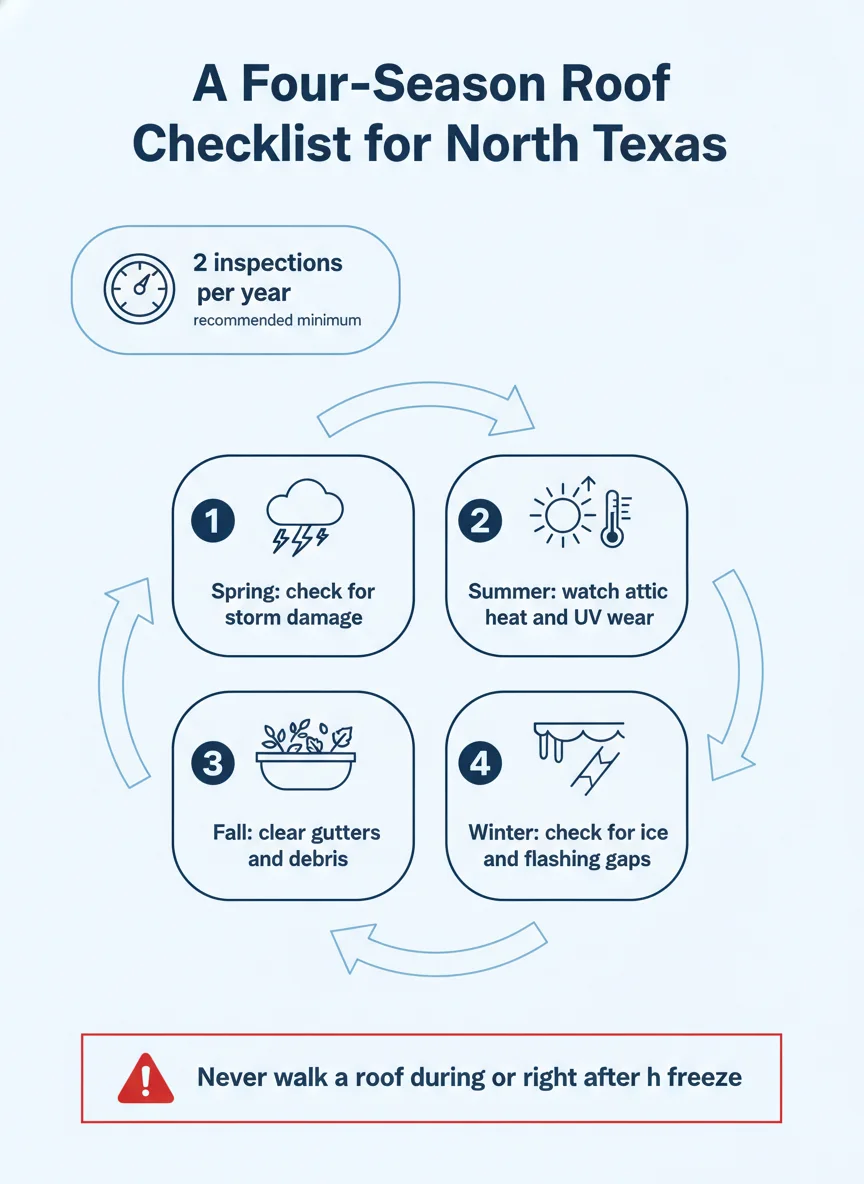
| Spring | Shingles, gutters, and AC units for hail or wind damage | Storm damage from the season's heaviest weather |
| Summer | Attic ventilation and shingle surface wear | Heat and UV aging building up over months |
| Fall | Gutters, valleys, and debris buildup | Clogged drainage before winter rain and freeze arrive |
| Winter | Flashing, seal lines, and ice buildup | Small gaps opened by freeze-thaw movement |
What Is Actually Being Checked During a Seasonal Inspection?
A full roof system is more than the shingles on top. It includes the decking underneath, the underlayment that acts as a second layer of water protection, flashing around any roof penetration like chimneys and vents, and the attic ventilation system that keeps heat and moisture from building up below the surface. A seasonal check looks at how each of these parts is holding up given what that season just put them through.
Gutters and downspouts round out the system since they're responsible for moving water off the roof and away from the foundation. A clogged or damaged gutter system can send water back under the roof edge instead of away from the house, which is why Gutters, Downspouts and Gutter Guards: What to Check Twice a Year is worth reading alongside this calendar.
Step-by-step: How to Walk Your Own Roof Calendar
You don't need to get on the roof to run through most of this checklist. A pair of binoculars, a walk around the exterior, and a flashlight for the attic cover the majority of what a seasonal check calls for.
- Walk the perimeter: Look at the roofline from the ground on all four sides, checking for obviously missing, curled, or damaged shingles.
- Check gutters and downspouts: Clear leaves and debris, and look for granules collecting in the gutter, which signals shingle wear.
- Scan metal and vents: Look at flashing, vent boots, and any metal trim for rust, gaps, or visible separation from the roof surface.
- Check the attic: Look for daylight coming through the decking, damp insulation, or signs of poor airflow near the ridge and soffit vents.
- Note any storm events: After any hail or high wind event, add an extra check for dented gutters, AC units, or soft spots on the roof.
- Log what you find: Keep a simple record of each seasonal check so you can track how the roof is aging year over year.
- Call for anything uncertain: If anything looks questionable from the ground, a roofer can get on the roof safely and confirm what's going on.
What Do Spring and Summer Checks Usually Find?
Spring checks in North Texas most often turn up storm-related issues since the season brings the region's heaviest hail and wind. Bruised or missing shingles, dented metal, and granule loss in the gutters are common findings, and they're worth documenting with photos in case an insurance claim becomes relevant later.
Summer checks tend to find the slower kind of wear rather than sudden damage. Curling shingle edges, hot spots in the attic, and sun-faded or brittle sealant around flashing are typical summer discoveries, and they're a good early signal that a section of roof may be approaching the end of its useful life.
Fall Checks
Fall checks are mostly about preparation rather than damage discovery. Clearing leaves and debris from gutters and valleys before winter rain and freeze arrive prevents a clogged system from backing water up under the roof edge, which is one of the more common causes of a winter leak that didn't need to happen.
Winter Checks
Winter checks after a hard freeze often reveal small gaps around flashing or seal lines that weren't visible before the cold snap. These are usually minor on their own, but they're worth addressing before spring storms test the roof again, since a small gap left alone tends to become a bigger one.
DIY vs Calling a Pro for Seasonal Checks
Ground-level and attic checks are reasonable for most homeowners to handle themselves. Clearing gutters, scanning the roofline with binoculars, and looking for daylight or damp spots in the attic don't require special equipment and can be done safely a few times a year.
Anything that requires walking the roof surface itself is a different story. Roofing material isn't designed to be walked on repeatedly by anyone other than a trained professional, and the risk of causing accidental damage, or of a fall, goes up significantly without the right footwear, harness, and experience reading a roof surface.
This is especially true after storms or during temperature extremes, when the roof surface is either slick with ice or softened by heat. A Roof Repair visit after a seasonal check flags something uncertain is usually the safer and more cost-effective move than guessing at the problem from the ground or risking a climb.
Building the Calendar Into Your Year
The easiest way to keep up with a seasonal roof calendar is to tie it to something you already do twice a year, like changing HVAC filters or checking smoke detectors. Pick a spring date after the region's typical storm season starts to wind down, and a fall date before the first hard freeze, and the rest of the calendar follows naturally from there.
Homes throughout Plano and the surrounding DFW metro all face the same four-season cycle, so the calendar works whether the roof is five years old or twenty. Absolute Professional Roofing Contractors LLC is available to help with any seasonal check that turns up something worth a closer look.
Frequently asked questions
How often should I have my roof inspected in Texas?
Most roofing professionals recommend two inspections a year in North Texas, one in spring after storm season and one in fall before winter. Homes near mature trees or with low-slope sections may benefit from an extra check after any major wind or hail event.
What time of year is hardest on a roof in North Texas?
Spring is usually the hardest season because it brings the region's heaviest hail and wind events, but summer heat and UV exposure cause steady wear over months rather than one dramatic event. Both seasons matter, just in different ways.
Do North Texas roofs need winter maintenance?
Yes, winter freeze-thaw cycles can open small gaps in flashing and seal lines that summer heat had kept pliable. A quick visual check after a hard freeze, done from the ground or by a professional, can catch problems before spring rain finds them.
Can I do a seasonal roof check myself?
You can handle a lot of it yourself, including ground-level visual checks, gutter clearing, and looking for obvious shingle damage with binoculars. Anything that requires getting on the roof itself, especially after storms or during freezing weather, is safer left to a licensed roofer.
What should I look for after a hailstorm in Texas?
Look for dented gutters, downspouts, or AC units first since those are easier to spot from the ground and often match roof damage. Granule loss, bruised or missing shingles, and soft spots on the roof surface are signs that call for a closer professional look.