
Why Gutters Matter More Than Most Homeowners Think
Across the DFW Metro, gutters do a job that's easy to forget about until it fails: they carry rainwater off the roof edge and away from the house in a controlled path. When that path works, water never gets the chance to pool against the fascia, run down the siding, or collect next to the foundation. When it doesn't, the damage shows up slowly, in rotted trim boards, stained brick, or soft soil along one side of the house that nobody connects back to the gutter until a contractor points it out.
Texas weather makes the stakes a little higher than in milder climates. Heavy spring downpours can dump more rain in an hour than a clogged gutter can move in a day, and the summer heat that follows dries out wood trim fast enough that any moisture damage gets baked in before anyone notices it. A twice-a-year check, timed around spring and fall, catches the small problems while they're still small.
How Water Moves Through a Gutter System
A gutter system only has three jobs: catch the water coming off the roof edge, carry it along a slight pitch toward a downspout, and move it away from the house through that downspout. Each of those jobs depends on a different part holding up, and each part fails in its own way.
The Gutters and Hangers
The trough itself is held to the fascia board by hangers spaced every couple of feet. Those hangers are doing more work than they look like; a full gutter in a hard rain is heavy, and over years of expansion and contraction in the Texas heat, hangers can loosen, pull away from softened wood, or bend out of alignment. Once a few hangers go, the gutter section between them sags, and that sag is where pooling starts.
Seams between gutter sections are the other common weak point. Sealant at the seams and end caps dries out and shrinks with UV exposure over time, and once it cracks, water finds the gap and drips straight down the exterior wall instead of continuing toward the downspout. It's a small leak that's easy to miss from the ground, but it's one of the first things worth checking twice a year.
Downspouts and Where the Water Goes
Downspouts take whatever volume of water reaches them and drop it to ground level, usually onto a splash block or into a buried extension pipe. The elbow joints near the top are a frequent clog point, especially on homes with mature trees nearby, since leaves and seed pods collect right where the horizontal gutter turns into the vertical downspout.
Where the downspout empties matters just as much as whether it's clear. A downspout that dumps water two feet from the foundation is working against the house, not for it. Extensions that carry discharge several feet away, with a grade that slopes down and out, are what actually keep water from working its way back toward a slab or crawlspace over a wet season.
| Situation | With Guards Installed | Without Guards |
|---|---|---|
| Heavy leaf drop season | Most debris sheds off the top, less buildup in the trough | Leaves pack the trough and need manual clearing |
| Fine grit and shingle granules | Can still settle on top of the guard over time | Collects directly in the gutter bottom |
| Downspout clogging | Reduced, but elbow joints still need a periodic check | More frequent clogging at bends and joints |
| Maintenance frequency | Still needs a twice-a-year visual check | Benefits from more frequent cleaning |
What Gutter Guards Actually Do (and Don't Do)
Gutter guards are a mesh or solid cover that sits over the top of the trough, letting water in while keeping most leaves and larger debris out. For homes with trees close to the roofline, they cut down significantly on how often the gutters need to be physically cleared out by hand, which is the main reason homeowners add them.
What they don't do is make a gutter system maintenance-free. Fine debris like shingle granules, pine needles, and wind-blown grit can still build up on top of a guard or find its way through small gaps at seams and corners. Guards also don't fix an existing pitch or hanger problem; they protect whatever system is already in place, for better or worse. A twice-a-year check still matters with guards installed, it just tends to be quicker.
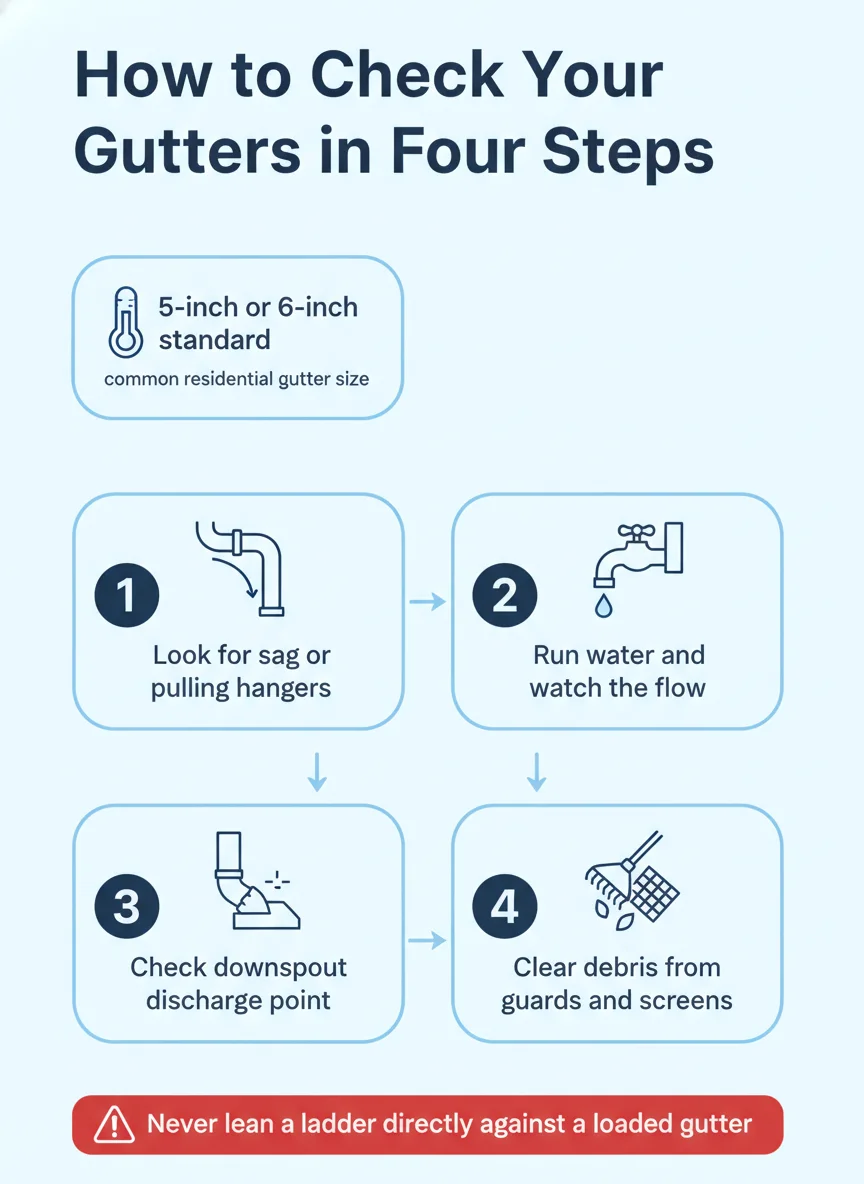
Step-by-step: A Twice-a-Year Gutter Check
This routine takes most homeowners under an hour from the ground and a ladder, and it's worth doing once in spring before the heavy rain season and once in fall after leaves have mostly come down.
- Walk the perimeter: Look along the fascia line for sagging sections, visible gaps between the gutter and the house, or hangers that look pulled loose.
- Check for standing water: After a rain, look for pooled water sitting in the trough instead of draining, which usually means a low spot or pitch problem.
- Clear visible debris: Remove leaves, seed pods, and grit from the trough and from the tops of any guards before they compact into a solid clog.
- Run a hose test: Run water from the far end of each gutter run and watch whether it reaches the downspout smoothly or backs up anywhere along the way.
- Check downspout discharge: Confirm extensions are still attached, pointed away from the foundation, and not crushed or disconnected from mowing or yard work.
- Inspect seams and end caps: Look for dried, cracked sealant or small drip marks on the siding below a seam, both signs the joint needs resealing.
- Note any fascia staining: Dark streaks or soft spots on the fascia board behind the gutter usually mean water has been getting behind it for a while.
What You'll Find When Something's Wrong
Signs of a Pitch or Hanger Problem
A gutter that's lost its pitch usually shows itself during rain, with water pooling and overflowing at one low point instead of draining steadily toward the downspout. From the ground, you'll often see a visible dip or wave in the line of the gutter along the roofline, especially when the sun casts a shadow along the edge.
Loose or failed hangers show up as a gutter pulling slightly away from the fascia, sometimes just an inch or two, sometimes enough that you can see daylight behind it. Left alone, more hangers tend to fail in the same section as the extra weight shifts, so a sagging stretch rarely stays small on its own.
Signs of a Clog or Overflow
Water sheeting over the front edge of the gutter during a rainstorm, rather than disappearing into the downspout, is the clearest sign of a clog somewhere in the system. It's often visible from inside the house too, as a waterfall effect just outside a window during heavy rain.
Dirt or mulch washed out in a line below a downspout extension is a quieter version of the same problem, usually meaning the extension itself is disconnected or the elbow above it is partially blocked. Mold or dark staining on siding below a gutter seam points to a slow leak rather than a full clog, but it's worth checking either way.
DIY vs Calling a Pro
Clearing debris, running a hose test, and doing a visual walk-around are all reasonable DIY tasks for a homeowner comfortable on a ladder. These are the twice-a-year basics and they don't require special tools, just a stable ladder, gloves, and a clear view of the roofline.
Resealing seams, replacing bent or pulled hangers, and correcting a pitch problem are a different category. These repairs need the gutter section taken down or carefully adjusted while it's still attached near the roof edge, and getting the pitch wrong in the process just moves the pooling problem somewhere else. Anything that involves working near the roof edge or the drip edge underneath it is worth handing to a licensed contractor.
It's also worth having a professional take a look if gutter problems keep showing up in the same spot season after season. That pattern usually means the issue isn't the gutter itself but something above it, like a sagging roof deck or a damaged drip edge, and that's a roof repair conversation rather than a gutter one.
Keeping the System Working Year-Round
A gutter system that's checked twice a year rarely surprises anyone. Most of the failures described here, pitch loss, pulled hangers, cracked seams, and clogged downspouts, give warning signs for months before they turn into fascia rot or water pooling near a foundation. Homeowners in Frisco and across the surrounding metro who build the spring and fall check into their routine tend to catch these early, while they're still a quick fix instead of a bigger repair.
If a storm has already come through and you're not sure what shape your gutters are in, it's worth pairing this routine with the broader walk-around described in After the Storm: A Roof and Gutter Checklist for the Next Morning. For a closer look at gutter installation, repair, or replacement, Absolute Professional Roofing Contractors LLC offers seamless gutter installation and repair across the DFW Metro.
Frequently asked questions
How often should gutters be cleaned or checked?
Most homes in North Texas do fine with a check in spring and again in fall, before and after the seasons that bring the most debris and the heaviest rain. Homes under heavy tree cover may need a mid-season look as well.
Do gutter guards mean I never have to clean my gutters again?
No, guards reduce the amount of debris that gets into the trough but they do not eliminate maintenance entirely. Fine grit, seed pods, and shingle granules can still collect on top of guards or slip through seams, so a periodic check is still worth doing.
What happens if a downspout stays clogged for a long time?
Water backs up in the gutter, finds the lowest gap, and starts running down the fascia board or siding instead of through the downspout. Over time that steady moisture can rot wood trim and, near the foundation, contribute to soil movement under a slab.
Can I tell if my gutters are pitched wrong without climbing up?
You can get a good read from the ground. Watch the gutter during a heavy rain; if you see water pooling and spilling over in one spot rather than draining toward the downspout, the pitch has likely shifted.
Are gutter problems ever connected to roof problems?
Yes, a gutter packed with granules or shingle fragments is often one of the first visible signs of aging roofing material, and a gutter hanging loose from the fascia can point to a deck or drip edge issue above it. If you notice either, it's worth having both looked at together.