Commercial Roofing Costs Across the DFW Metro
Business owners across the DFW Metro, from warehouse operators in Carrollton to retail plazas in Frisco, ask the same question before signing a contract: what's actually driving this number? Commercial roofing doesn't price out like a residential job. The membrane systems are different, the roof access is different, and the equipment sitting on top of the building changes the scope before a single panel goes down.
Texas heat and the occasional hailstorm both put real stress on flat and low-slope roofs, so getting the cost conversation right matters more here than in milder climates. Understanding the variables ahead of time helps building owners compare quotes apples to apples instead of just looking at the bottom line. This guide breaks down the pieces that actually move a commercial roofing estimate.
Why Commercial Roof Pricing Varies So Much
Two buildings the same size can land on very different quotes, and the reason almost always traces back to what's happening on top of and underneath the existing roof. Membrane type, insulation condition, and roof access each carry their own labor and material implications.
Membrane Type and Insulation
TPO, EPDM, and modified bitumen membranes all install differently and carry different material costs. TPO is heat-welded at the seams, EPDM is often adhered or ballasted, and modified bitumen is typically torch-applied or self-adhered. Each method takes a different amount of labor time and crew size, which shows up in the final number.
Insulation underneath the membrane matters just as much. If the existing insulation is wet or has degraded, it has to come out and get replaced before a new membrane goes down, and that tear-off work adds time and disposal costs that a straightforward recover job wouldn't need.
Roof Access and Rooftop Equipment
A single-story building with a clear staging area on the ground is a much simpler job than a multi-story building where materials have to be craned or hoisted up. Access constraints change equipment rental needs and the number of labor hours a crew burns just moving material into position.
HVAC units, exhaust vents, skylights, and satellite equipment sitting on the roof also add complexity. Crews have to work around or temporarily detach this equipment, flash it back in correctly, and make sure none of it interferes with drainage. More rooftop penetrations generally means more labor.
| Factor | Lower Cost Scenario | Higher Cost Scenario |
|---|---|---|
| Membrane condition | Existing membrane sound, recover possible | Full tear-off and insulation replacement needed |
| Roof access | Ground-level staging, clear path | Multi-story or crane access required |
| Rooftop equipment | Few penetrations, simple layout | Numerous HVAC units and skylights to flash around |
| Drainage | Roof slopes cleanly to drains | Ponding water requiring tapered insulation |
Understanding the Low-Slope Roofing System
A commercial low-slope roof is built in layers: the structural deck, a vapor barrier in some cases, insulation, and then the waterproofing membrane on top. Drainage is engineered into the slope of the insulation itself since there's no steep pitch to shed water naturally, which is why proper tapering matters so much on a flat roof.
Coatings can be applied over an existing membrane that's still structurally sound to extend its service life and improve reflectivity, which helps with attic and interior temperatures during Texas summers. Commercial roofing work covers all of this, from new membrane installs to coatings and targeted repair on aging systems.
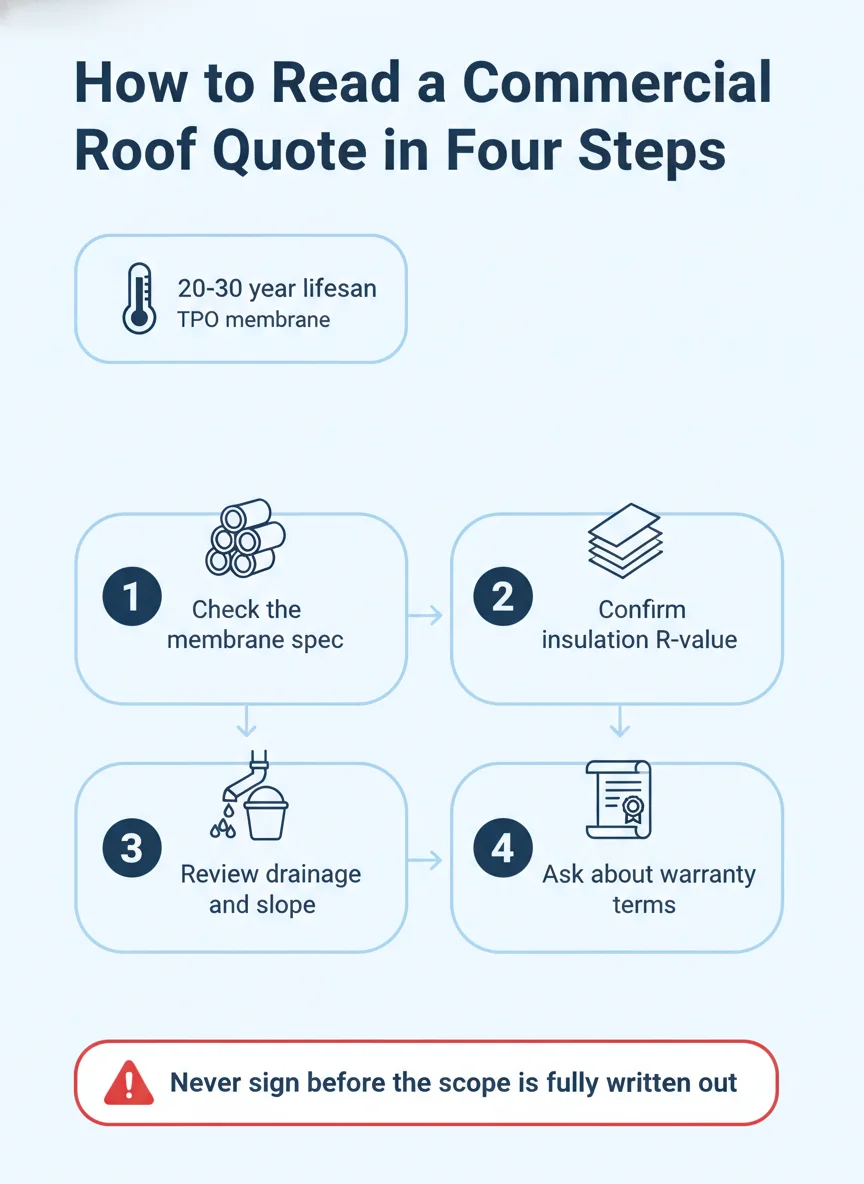
Step-by-Step: How a Commercial Roofing Quote Comes Together
A thorough commercial roofing estimate follows a consistent process regardless of building size. Here's what that typically looks like from first call to final number.
- Initial roof walk: A roofer walks the full roof surface, checking membrane condition, seams, drainage, and flashing around every penetration.
- Moisture check: Core samples or moisture scans identify whether insulation underneath the membrane has taken on water.
- Scope decision: Based on findings, the roofer determines whether the roof qualifies for a coating, recover, or full tear-off and replacement.
- Material selection: Membrane type is chosen based on building use, budget, and how the roof needs to perform long-term.
- Access planning: The crew plans staging, equipment needs, and how to work around rooftop HVAC and other fixtures.
- Written scope: A detailed scope of work is put in writing before any contract is signed, covering materials, warranty terms, and timeline.
What You'll Find During a Roof Assessment
Signs the Roof Still Has Life Left
A membrane with intact seams, no widespread ponding, and dry insulation underneath is often a good candidate for a coating or partial repair rather than full replacement. These roofs can often go several more years with the right maintenance plan in place.
Flashing that's still tight around rooftop penetrations and drains that are clear and functioning are both good signs. When these systems are working correctly, a targeted repair usually addresses the problem without needing to open up the whole roof.
Signs Pointing Toward Replacement
Widespread ponding water, wet insulation found in multiple locations, or seams that have separated in several places usually point toward a full tear-off rather than a patch job. Patching a roof that's failing structurally just delays the inevitable and adds cost over time.
If the building has had recurring interior leaks despite past repairs, that's usually a sign the membrane has reached the end of its service life rather than a sign of one bad spot that keeps failing.
DIY vs Calling a Licensed Commercial Roofer
Commercial roofing is not a do-it-yourself category in almost any scenario. Membrane welding, insulation tapering, and flashing detail work all require specialized training and equipment, and mistakes on a flat roof lead to leaks that are often harder to trace than on a pitched residential roof.
Building owners and property managers can help their own cause by staying on top of visible warning signs between professional inspections. Keeping an eye out for water stains on interior ceilings, standing water after rain that doesn't drain within a day or two, or debris buildup around rooftop drains gives a heads-up before small issues grow.
Anything beyond visual monitoring, including membrane repair, coating application, or replacement, needs a licensed roofing contractor with commercial experience. The materials and installation methods used on flat roofs are different enough from residential shingle work that general handyman skills don't transfer.
Getting an Honest Number for Your Building
The building owners who end up happiest with their commercial roofing project are the ones who understand what's driving their number before the crew shows up. Membrane type, roof access, and rooftop equipment all play a role, and none of them show up if you're only comparing the total price on two quotes.
Absolute Professional Roofing Contractors walks the full roof, checks for moisture, and puts the scope in writing before any work begins, so building owners across the DFW Metro know exactly what they're paying for.
Frequently asked questions
Why is commercial roofing more expensive than residential roofing?
Commercial roofs cover far more square footage and use different materials and equipment than a house roof. Flat and low-slope systems also require more precise drainage work and often need rooftop equipment like HVAC units worked around, which adds labor time.
Does the size of my building affect the price per square foot?
Yes, larger roofs often see a lower cost per square foot because setup, mobilization, and equipment costs get spread across more area. A small building can actually cost more per square foot than a large warehouse for this reason.
What roofing material is most cost-effective for a flat roof in Texas?
It depends on the building's use, budget, and how long you plan to own it. TPO, EPDM, and modified bitumen each have different upfront costs and different maintenance needs over their lifespan, so the right fit is building-specific.
Can I extend the life of my commercial roof instead of replacing it?
In many cases yes, a protective coating or targeted repair can add years to a roof that isn't past its structural life. This only works if the underlying membrane and insulation are still sound, which is why an inspection comes first.
How often should a commercial roof be inspected?
Most low-slope commercial roofs benefit from at least one inspection a year, plus a check after any major storm. Regular inspections catch small issues like seam separation or ponding water before they turn into interior leaks.