Why This Question Comes Up So Often in North Texas
Between UV exposure, hail, and high wind, roofs across the DFW Metro take a beating from more than one direction at once. That's part of why the question of how much roof actually needs replacing comes up so often, whether it's after a storm, during a home sale inspection, or just from noticing shingles curling in one spot.
The honest answer is that it depends on the roof's age, how widespread the wear is, and what's happening underneath the shingles at the decking level. Sometimes a full tear-off is the only responsible option. Other times, a section replacement handles it without touching the rest of the roof.
What Actually Drives the Full vs. Partial Decision?
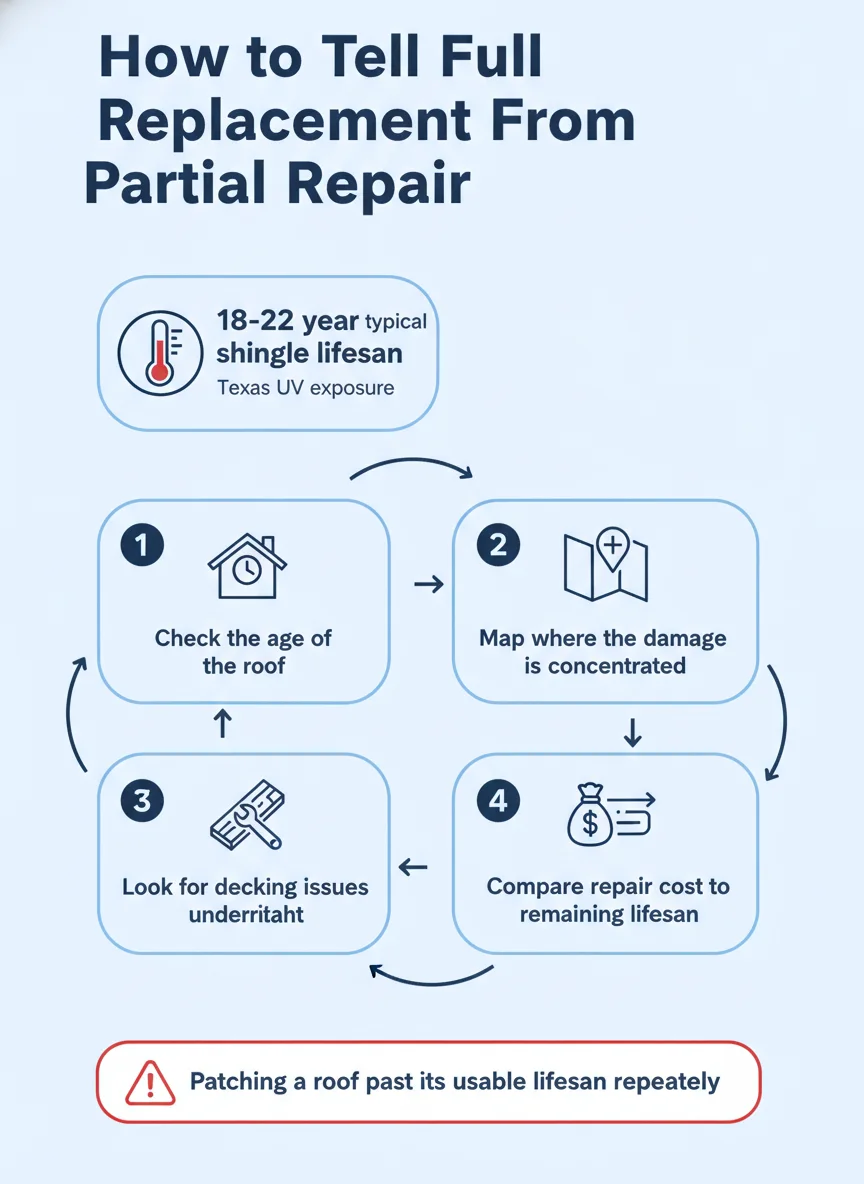
Three things drive this decision more than anything else: the roof's overall age relative to its expected lifespan, how concentrated or spread out the damage is, and the condition of the decking underneath. Asphalt shingles in Texas UV typically run somewhere in the 18-22 year range before wear becomes widespread, and a roof already near that mark usually isn't worth patching piecemeal.
Roof age and remaining lifespan
A roof at year 5 with isolated hail damage on one slope is a very different situation than a roof at year 20 with granule loss showing across every elevation. In the first case, a targeted repair or partial section replacement makes sense since most of the roof still has plenty of life left. In the second, spending money on repairs just delays an inevitable full replacement.
This is why a free inspection usually starts with confirming the roof's approximate age and material type before even looking at the damage itself. Age sets the context for every other decision that follows.
How concentrated the damage is
Damage isolated to one slope, like wind damage from a storm that hit predominantly from one direction, can sometimes be addressed with a partial replacement of just that section. Damage spread evenly across all slopes, which is common after a significant hail event, usually means the whole roof took the hit and needs to be addressed as one project.
Insurance adjusters look at this same distribution pattern when evaluating a storm and hail restoration claim, since documented damage across the whole roof supports a full replacement determination differently than damage found on one slope alone.
| Situation | Damage Pattern | Typical Approach |
|---|---|---|
| Newer roof, isolated damage | One slope or a small section | Partial repair or section replacement |
| Older roof, isolated damage | One slope, but roof near end of lifespan | Often full replacement to avoid repeat repairs |
| Any age, widespread damage | Damage across multiple slopes | Full replacement usually the sound option |
What's Happening Under the Shingles Matters Just as Much
The decking underneath the shingles, usually plywood or OSB sheathing, is what the whole roof system is fastened to. If that decking has soft spots, delamination, or rot from long-term moisture, no amount of new shingles on top solves the underlying problem. Decking condition is one of the biggest factors in whether a repair actually holds.
This is why a proper inspection includes checking for soft spots by walking the roof, not just a visual scan from the ground. Decking damage found during a partial repair project sometimes expands the scope, since compromised sheathing has to be replaced before new material goes down regardless of how much of the roof it affects.
Step-by-step: Figuring Out How Much of Your Roof to Replace
This is the general process a roofing contractor works through when scoping a replacement project, whether it ends up being partial or full.
- Confirm roof age: Determine the roof's installation date and material type to establish where it sits relative to typical lifespan expectations.
- Map the damage: Walk every slope and document where damage is concentrated versus where the roof still looks sound.
- Check the decking: Inspect the sheathing underneath for soft spots, delamination, or moisture damage that would affect any repair.
- Review with an adjuster if applicable: For storm-related damage, coordinate documentation with the insurance adjuster to establish the approved scope.
- Compare repair cost to remaining life: Weigh the cost of a partial fix against how many years of service the rest of the roof realistically has left.
- Choose the scope: Decide between a full tear-off, a partial section replacement, or a targeted repair based on all of the above.
Reading the Signs Before You Call Anyone
Signs that point toward a full replacement
Granule loss visible across multiple slopes, shingles curling or cracking uniformly across the roof, and daylight visible through the decking in the attic are all signs the whole system is aging out together. A roof showing these signs on every elevation is rarely a good candidate for partial repair.
Multiple past repairs in different spots over the years is another signal, since it usually means the roof is failing gradually across its whole surface rather than in one isolated area, and each new patch is buying diminishing time.
Signs that point toward a partial or targeted fix
Damage limited to one slope, a chimney flashing failure, or a section that took a direct hit from a fallen limb are all classic partial-repair situations, especially on a roof that's otherwise well within its expected lifespan. The rest of the roof continuing to perform well is the deciding factor here.
Matching new material to existing shingles is the main challenge with a partial approach, since color and texture can shift slightly between manufacturing runs, which is worth discussing honestly before committing to a section-only repair.
What a Homeowner Can Assess vs. What Needs a Professional Look
A homeowner can reasonably check the roof's approximate age from purchase records, look for obvious signs like curling shingles or granule buildup in gutters, and note whether one area looks worse than the rest. This gives a rough starting point before calling anyone out.
Walking the roof itself, checking decking condition, and mapping exactly how far damage extends requires someone trained to spot it safely and accurately. Attic soft spots and hidden moisture damage rarely show up from a ground-level look.
A roof replacement quote should always start with this kind of full evaluation rather than an estimate based on a quick look from the driveway, since the scope of the project depends entirely on what's actually found.
Making the Call With Real Information
The right amount of roof replacement is whatever amount the roof's condition actually supports, not a default to the biggest project or the smallest patch. Getting an honest read on age, damage spread, and decking condition is what makes that call defensible rather than a guess.
Absolute Professional Roofing Contractors documents all of this during every inspection across North Texas, so homeowners see exactly what's driving the recommendation before deciding between a full replacement and a targeted repair.
Frequently asked questions
How do I know if I need a full roof replacement or a repair?
It comes down to the roof's age, how widespread the damage is, and what condition the decking underneath is in. A roof nearing the end of its expected lifespan with damage spread across multiple sections usually points to full replacement, while isolated damage on a newer roof is often a repair.
Can just one section of a roof be replaced?
Yes, a partial replacement is possible when damage is isolated to one slope or section and the rest of the roof is in good shape and reasonably close in age. Matching materials and blending the transition is the main challenge with this approach.
Does insurance pay for a full roof replacement?
It depends on the cause and extent of the damage as documented by an adjuster, along with the specific policy terms. A [roof repair](/services/roof-repair) or [storm and hail restoration](/services/storm-hail-restoration) claim is evaluated based on documented damage, not the homeowner's preference for full versus partial work.
How long does a full roof replacement take?
Timeline depends on the size and complexity of the roof, the material chosen, and weather during the project window. A straightforward residential tear-off and reroof is generally completed in a matter of days once work begins, weather permitting.
Is it worth replacing a roof before it fails completely?
In many cases yes, replacing a roof that's showing widespread wear before it actively leaks avoids interior damage and gives you more control over timing and material choice rather than reacting to an emergency.