Why Class 4 Shingles Come Up So Often in North Texas
If you've gotten a quote for a Roof Replacement anywhere in North Texas, odds are good someone mentioned Class 4 shingles at some point in the conversation. The region sees enough severe weather over a given year that insurers, contractors, and homeowners all talk about impact resistance more than they would in a milder climate. It's become a standard line item on a lot of estimates, right alongside the usual choice between shingle grades.
The trouble is the term gets used loosely. Some homeowners hear 'Class 4' and assume it means the roof can't be damaged, full stop. Others assume it's a marketing label with no real testing behind it. Neither is accurate. The rating is tied to a specific, standardized test, and understanding what that test actually measures is the difference between making an informed upgrade decision and just paying more because a salesperson said to.
What Does the Class 4 Rating Actually Test?
The rating comes from UL 2218, a standard developed by Underwriters Laboratories to evaluate how shingles hold up under simulated impact. It's an industry-wide testing method, not something any single manufacturer invented, which is why you'll see the same four-tier scale referenced across different shingle brands and product lines.
The Steel Ball Drop Test
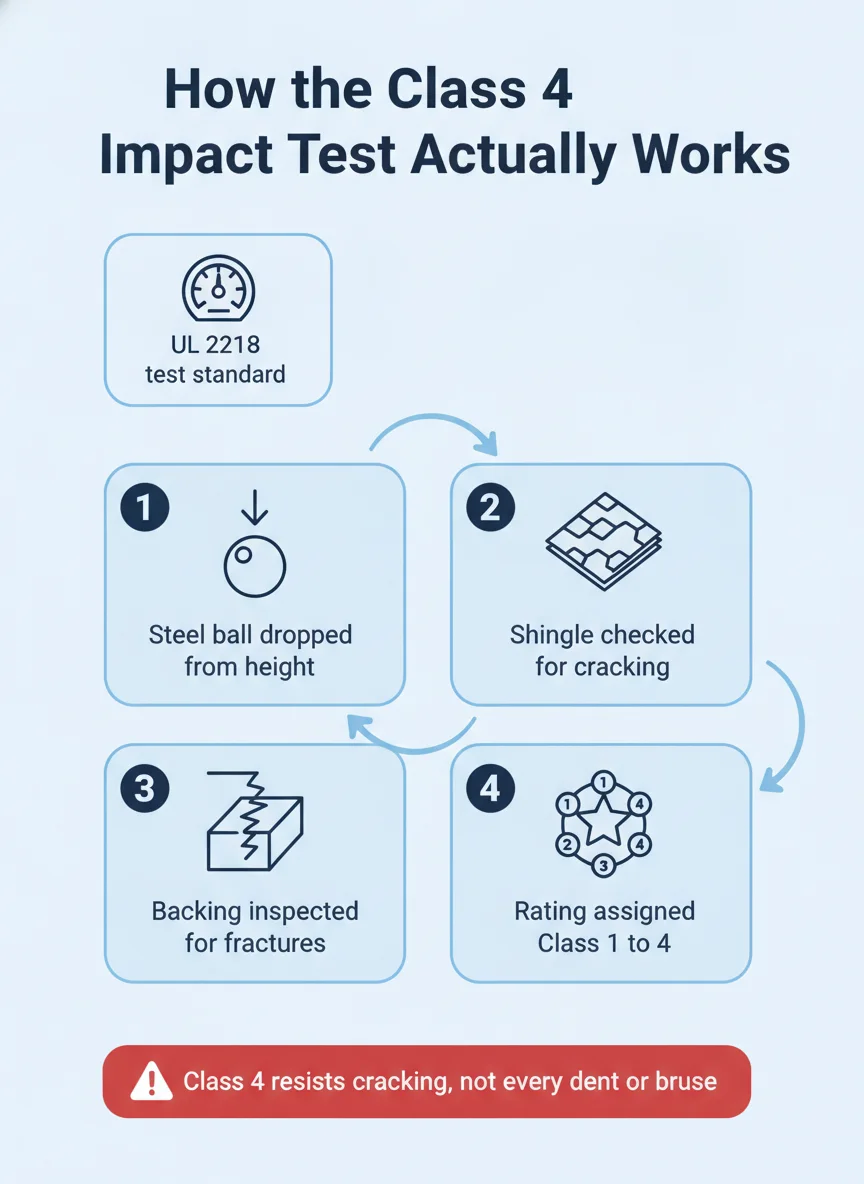
Testers drop a steel ball of a specific size onto a shingle sample from a measured height, then examine the sample for cracking or fracturing. The size of the ball and the drop height increase as the test moves up through the classes, with Class 4 requiring the sample to withstand the largest ball dropped from the greatest height without a crack forming through the shingle's protective layers.
This is a pass or fail test on structural integrity. It doesn't measure how the shingle looks afterward, how much granule loss occurs, or how it performs against anything other than a blunt, round impact. That distinction matters because real-world impact events don't always behave the same way as a steel ball in a lab.
What Gets Checked on the Shingle's Backing
After the drop, testers also inspect the back of the shingle for fractures that might not be visible from the front. A shingle can look fine on the surface but still have compromised backing, which is why the testing protocol checks both sides before assigning a final class.
This is also why the rating is tied to the shingle's full construction, reinforced mat, modified asphalt layer, and surface granules together, rather than to any single component. A shingle rated Class 4 earned it as a complete product, which is part of why swapping in cheaper underlayment or fasteners elsewhere in the system can undercut the benefit you're paying for.
| Rating Class | Steel Ball Size Tested | What It Signals |
|---|---|---|
| Class 1 | Smallest ball, lowest drop | Minimum impact resistance threshold |
| Class 2 | Mid-size ball | Moderate resistance to cracking |
| Class 3 | Larger ball | Above-average resistance |
| Class 4 | Largest ball, highest drop | Highest resistance level in the standard |
What's Actually Different Inside a Class 4 Shingle
Class 4 shingles typically use a reinforced fiberglass mat and a modified asphalt formulation designed to flex rather than crack under impact. That flexibility is the core engineering difference from a standard three-tab or lower-grade architectural shingle, which tends to be more rigid and more prone to fracturing when struck hard enough.
Granule adhesion is usually improved as well, since loose granules are one of the first visible signs of impact wear on any shingle. None of this changes the basic installation process. A Class 4 product still gets installed with the same underlayment, flashing, and ventilation principles that apply to any quality Roof Replacement, so the rating is a material choice layered on top of sound installation practices, not a substitute for them.
Step-by-Step: How to Confirm Your Roof's Impact Rating
If you're not sure whether your current roof carries a Class 4 rating, or you're trying to verify a quote before signing, here's how to track it down without guessing.
- Pull your contract: Check the original installation paperwork or invoice, since the product name and class rating are typically listed as part of the material specification.
- Check the shingle wrapper: If you have any leftover bundles from the original install, the UL 2218 classification is printed directly on the wrapper.
- Look at a spare shingle: Manufacturers often stamp the class rating on the back of the shingle itself, visible if you can access a ridge cap or loose piece.
- Contact the manufacturer: If you know the product line but not the rating, most manufacturers list the class for each shingle series on their product data sheets.
- Ask your contractor: A reputable roofing contractor can identify the product from a photo or sample and confirm its rated class before any work begins.
- Call your insurer: Your insurance provider may have the rating on file if you've previously submitted documentation for a discount or claim.
What You'll Find When Comparing Class 4 to Standard Shingles
Appearance and Options
Class 4 products are available in architectural and, in some product lines, designer profiles, so choosing the rating doesn't typically mean sacrificing style. Most major manufacturers offer a Class 4 version within several of their standard color and texture lines, which makes it easier to match the upgrade to the rest of a home's exterior.
The visible difference between a Class 4 shingle and a standard architectural shingle is usually minimal once installed. The distinction lives in the materials under the surface, not in curb appeal, so homeowners aren't typically choosing between looks and protection.
Longevity and Wear Patterns
Because Class 4 shingles are built to resist cracking and granule loss, many homeowners see less visible wear over time even outside of major impact events, simply from normal exposure to debris and temperature swings. That can translate to a cleaner-looking roof later in its service life, though overall lifespan still depends heavily on installation quality, attic ventilation, and general maintenance, topics covered in more depth in How Long Does a Roof Last in Texas?
It's worth noting that impact resistance and UV resistance are separate properties. A Class 4 rating says nothing about how a shingle handles sun exposure over 15 to 20 years, so the two factors should be evaluated independently when comparing products.
Is This a DIY Decision or One for a Licensed Roofer?
Choosing whether to upgrade to Class 4 shingles is a decision a homeowner can research and weigh on their own, since it mostly comes down to budget, how long you plan to stay in the home, and whether your insurer offers a meaningful discount for the rating. None of that requires a ladder.
The installation itself is a different story. Verifying that a product is genuinely Class 4 rated, confirming it's paired with compatible underlayment and ventilation, and making sure the manufacturer's installation specifications are followed to keep any warranty intact all call for a licensed roofing contractor. Installation shortcuts can undercut the protection the rating is supposed to provide, even with the right shingle on the truck.
Towns across the McKinney area and the broader DFW metro see enough severe weather that this upgrade decision comes up regularly, which is also why it pays to get the material specifics in writing before work starts rather than relying on a verbal description of what's being installed.
Weighing the Upgrade for Your Home
Class 4 shingles aren't a magic shield, but they are a genuinely different product under the surface, built and tested to resist cracking better than standard options. Whether the upgrade pencils out depends on your insurer's discount policy, your long-term plans for the home, and how much weight you put on reduced wear over the life of the roof.
If you're weighing the upgrade as part of an upcoming project, Absolute Professional Roofing Contractors LLC can walk through which rated products fit your home and budget before any work begins.
Frequently asked questions
What does Class 4 impact resistant mean on a shingle?
Class 4 is the highest rating in a four-tier scale that measures how well a shingle resists cracking when struck by a steel ball dropped from a set height, simulating impact. It's a test of structural integrity, not a promise that the shingle will show zero marks after an impact event.
Are Class 4 shingles hail proof?
No, Class 4 shingles are impact resistant, not impact proof. They're built to resist cracking and granule loss better than standard shingles, but a large enough impact can still cause cosmetic damage or, rarely, structural failure.
Do Class 4 shingles lower my insurance premium?
Some insurers offer a discount for Class 4 roofing, but policies and discount programs vary by carrier and by state. The only way to know for certain is to ask your insurance provider directly what their current policy offers.
How can I tell if my roof already has Class 4 shingles?
Check your original installation invoice or roofing contract for the product name and class rating, since manufacturers print the UL 2218 classification on the shingle wrapper at the time of installation. You can also look for a stamp on the back of a spare or ridge shingle if one is available.
Are Class 4 shingles worth the extra cost in Texas?
For homes in areas with frequent severe weather, many homeowners find the added durability and potential insurance discount make the upgrade worthwhile over the life of the roof. The right call depends on your specific insurer's discount policy, how long you plan to stay in the home, and your budget for the initial install.