Why North Texas Roofs Develop Dark Streaking
If you've noticed dark, almost sooty streaks running down the shaded side of your shingles, you're looking at a very common and very misunderstood roofing issue. It shows up across Plano, Dallas, and every town in between, usually on the north-facing slope where sunlight hits least and moisture lingers longest after a storm. Homeowners often assume it's dirt, mold, or exhaust residue, but it's almost always algae.
This matters more than it might seem, because the instinct is to either ignore it or attack it with a pressure washer, and both responses can create problems down the road. Understanding what's actually growing on your shingles, and what does and doesn't work to treat it, keeps your roof looking good and keeps you from accidentally shortening its life trying to clean it.
What Is Actually Growing on the Shingles?
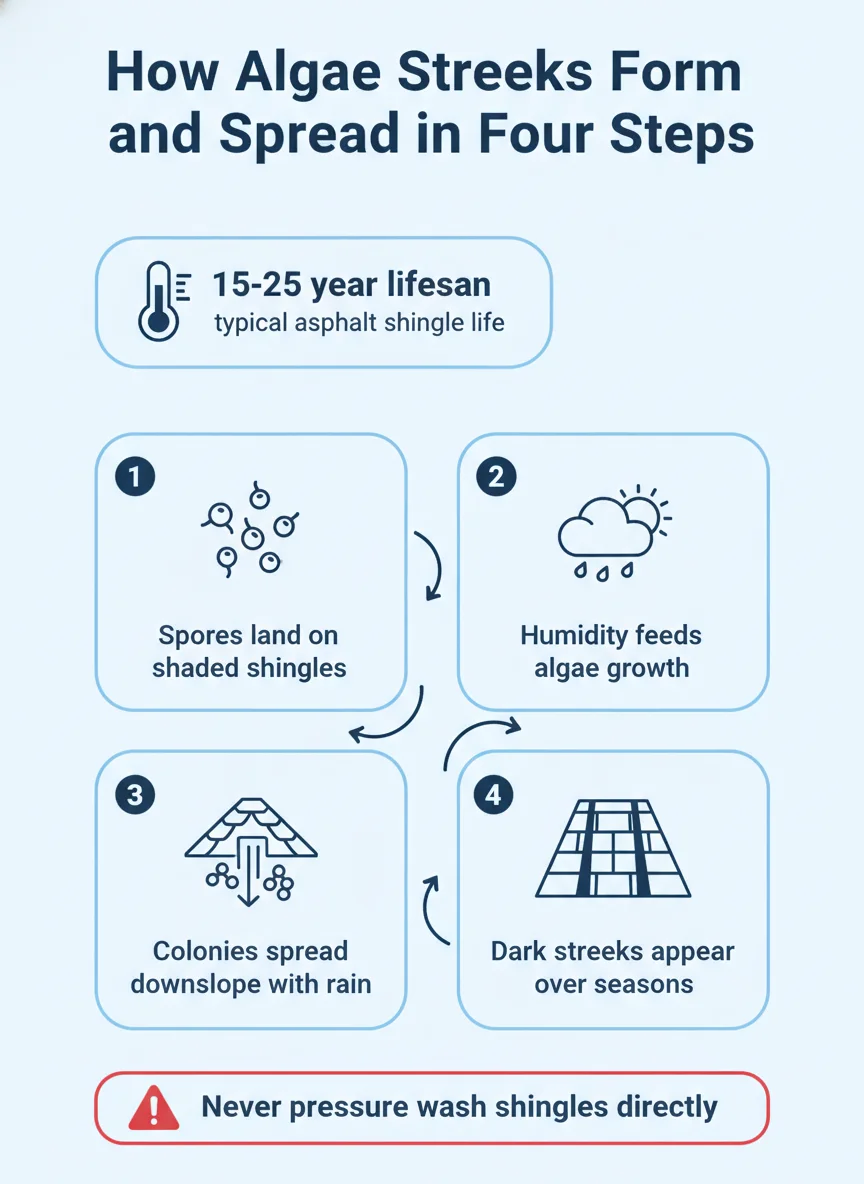
The organism responsible for those streaks is a blue-green algae species that spreads by airborne spores, landing on rooftops and feeding on the limestone filler used in many asphalt shingles. It thrives in warm, humid conditions, which is exactly what North Texas summers deliver, and it spreads downslope as rainwater washes spores from one area of the roof to another.
Why It Shows Up on Shaded Slopes First
North-facing slopes and areas shaded by trees or neighboring structures stay damp longer after rain, and that extended moisture is exactly what algae needs to establish a colony. South-facing slopes that get more direct sun dry out faster and tend to stay cleaner for longer, even on the same roof.
This is why streaking often looks uneven, heavy on one slope and barely visible on another, even though both sides are the same age and the same shingle. It's not a sign of a defect, it's simply a reflection of which parts of the roof hold moisture the longest.
Why It Looks Worse Over Time
Algae colonies grow gradually, so a roof that looked clean three years ago can develop noticeable streaking without any single dramatic event. As the colony matures it develops a dark protective coating, which is what gives the streaks their black or brown appearance rather than a green tint most people expect from algae.
Once established, the colony can continue producing spores that spread to other parts of the roof or even to a neighbor's roof nearby. That's part of why algae staining tends to show up in clusters across a neighborhood where homes were built around the same time with similar shingle products.
| Factor | Algae-Prone Conditions | Lower-Risk Conditions |
|---|---|---|
| Sun exposure | Shaded, north-facing slopes | Full sun, south-facing slopes |
| Humidity | Prolonged dampness after rain | Fast drying after rain |
| Shingle type | Standard asphalt shingles | Algae-resistant shingles with copper or zinc granules |
| Tree coverage | Overhanging branches, heavy shade | Open sky, trimmed back trees |
What's Actually Happening to the Shingle Underneath
Shingle granules serve two jobs: they protect the asphalt layer from UV breakdown and they give the shingle its color and texture. Algae doesn't eat through the asphalt itself, but a thick, long-standing colony can trap moisture against the granule layer and interfere with how well those granules shed water and reflect heat.
On their own, streaks rarely cause leaks. The bigger concern is what heavy, untreated growth signals: an area of the roof that stays wet longer than it should, which is the same condition that eventually contributes to granule loss and reduced shingle performance over the roof's life. That's why a roof with persistent, heavy streaking is worth a visual check even if nothing looks urgent.
Step-by-Step: Treating Algae Streaks Safely
Treating algae on a shingle roof is less about scrubbing and more about controlled chemistry and gentle rinsing. Here's the general approach used for safe, low-impact algae treatment on asphalt shingles.
- Identify the growth: Confirm the staining is algae and not moss or lichen, since moss and lichen call for a different removal approach and can indicate a damper roof surface.
- Protect landscaping first: Wet down plants and shrubs below the roofline before applying any cleaning solution to reduce runoff damage to grass and flower beds.
- Apply a shingle-safe cleaner: Use a cleaning solution labeled safe for asphalt shingles, applied with a low-pressure sprayer rather than a pressure washer wand.
- Let it dwell: Allow the solution time to break down the algae colony before rinsing, following the product's recommended dwell time.
- Rinse from the top down: Rinse with a garden hose at normal household pressure, working from the ridge down to avoid forcing water under the shingle edges.
- Check gutters and downspouts: Flush gutters and downspouts afterward since algae and cleaning runoff can collect there.
- Reassess after drying: Give the roof a day or two to dry fully before deciding whether a second treatment or a professional inspection is needed.
What Different Levels of Streaking Tell You
Not all streaking means the same thing, and reading the pattern helps you decide whether this is a weekend project or something to have looked at by a professional.
Light, Surface-Level Streaking
Thin, faint streaks that haven't spread far are usually an early-stage colony that responds well to a gentle cleaning treatment. This is the easiest case to manage and typically doesn't indicate any underlying issue with the shingle itself.
If you catch it at this stage, a single treatment often restores most of the shingle's original appearance. It's also a good time to consider whether algae-resistant shingles make sense for your next roof replacement, since they're designed specifically to slow this early growth stage.
Heavy, Widespread, or Returning Streaking
Thick black streaking that covers large sections of the roof, especially if it returns quickly after cleaning, points to a mature colony and possibly a roof surface that's holding moisture longer than it should. This is worth a professional look, not because the algae itself is dangerous, but because it can be a marker of a slope that never fully dries out.
If the shingles underneath are also older or showing granule loss alongside the staining, that combination is a better reason to schedule an inspection than the streaking alone. A trained eye can tell the difference between cosmetic algae and a shingle layer that's genuinely wearing out.
DIY Cleaning vs. Calling a Professional
Light algae staining on a single-story home with easy roof access is a reasonable DIY project for a homeowner comfortable on a ladder, as long as the right cleaning product and low-pressure technique are used. The risk isn't the algae, it's the method, since a pressure washer or an overly aggressive scrub brush can do more damage than the streaks ever would.
Steep slopes, two-story homes, or roofs with heavy, long-standing growth are a different story. Working at height on a wet, algae-covered surface is genuinely dangerous, and a professional crew has the harnesses, ladders, and experience to do it safely while using the right dwell time and rinse pressure for your specific shingle type.
There's also value in having a professional take a look at the roof while they're up there. If the algae has been established for years, a quick visual check of granule condition and flashing nearby can catch a developing issue before it turns into a bigger roof repair down the line.
Keeping Streaks From Coming Back
Algae will always find its way back to a humid climate like North Texas, but a few habits slow it down considerably. Trimming back overhanging branches lets more sun and airflow reach the roof surface, and keeping gutters clear prevents standing water from feeding growth near the roofline. If a replacement is on the horizon, asking about algae-resistant shingle options is worth the conversation, since they're built specifically to resist this kind of growth longer than standard shingles.
For homeowners weighing whether their current shingles are nearing the end of their service life anyway, it's worth reading up on how long a roof typically lasts in Texas alongside any staining concerns. Homeowners across Plano dealing with persistent streaking can reach out to Absolute Professional Roofing Contractors LLC for a closer look at what's happening on their roof and whether it's cosmetic or something more.
Frequently asked questions
What causes black streaks on a roof?
The streaks are caused by a blue-green algae called Gloeocapsa magma that feeds on the limestone filler in asphalt shingles. It travels by airborne spores, lands on shaded or north-facing slopes, and grows more easily in the humidity common across North Texas.
Are black streaks on shingles harmful?
In most cases the streaks are cosmetic and don't threaten the shingle's performance right away, but left untouched for years the algae can hold moisture against the granule surface and shorten the shingle's lifespan. A roof with heavy, long-term staining is worth a closer look rather than an assumption that it's purely cosmetic.
Can I remove roof algae myself?
Light staining can sometimes be treated with a gentle, low-pressure rinse using a cleaner labeled safe for asphalt shingles, applied from the ground or a stable ladder position. Heavier growth, steep slopes, or two-story homes are better left to a professional who knows which products and pressure levels won't strip granules.
Does pressure washing damage shingles?
Yes, a direct high-pressure wash can strip the protective granules right off the shingle surface, which accelerates wear and can void a manufacturer's warranty. Any cleaning approach for shingles should rely on low pressure and a soft, controlled rinse rather than a pressure washer wand.
Will new shingles stop algae streaks from coming back?
Algae-resistant shingles contain copper or zinc granules blended in during manufacturing that make it harder for algae to take hold, and many manufacturers back this feature with its own limited warranty. They reduce how fast streaking returns but don't make a roof completely immune in a humid climate.