
What a Hailstorm Leaves Behind in North Texas
The DFW metro sees its share of spring and early summer hailstorms, and the aftermath isn't always obvious. A storm can roll through, drop hail for ten minutes, and leave a yard that looks completely normal the next morning. Homeowners often assume no damage happened because nothing looks broken from the driveway, but roofing damage from hail is frequently subtle rather than dramatic.
That's the trap. Hail doesn't need to punch a hole in your roof to cause a real problem. It bruises the mat underneath the shingle surface, knocks granules loose, and dents anything made of soft metal. None of that is visible unless you know exactly where to look, and even then, a full picture usually requires someone on the roof with a trained eye.
Why Hail Damages Shingles the Way It Does
Asphalt shingles are built with a fiberglass mat coated in asphalt and covered in protective granules. Hail impacts compress that mat in a small circular spot, which is why inspectors call the result a bruise. The granules on top can stay intact even when the mat underneath is cracked, which is exactly why hail damage is so often invisible until it's much worse.
What Happens to the Shingle Surface
A direct hail strike can knock granules loose on impact, leaving a shiny or darker spot where the asphalt mat is now exposed to UV light. Without that granule layer, the exposed asphalt breaks down faster in the Texas sun, and what starts as a cosmetic mark becomes a thin spot that lets water through over time.
Softer, older shingles bruise more easily than newer ones, and the angle of impact matters too. Hail that lands straight down does different damage than hail driven sideways by wind, which is part of why storm damage can look patchy, heavier on one slope of the roof than another depending on which way the wind was blowing that day.
What Happens to Soft Metal Components
Hail dents soft metal before it dents hard materials, which is why vent caps, gutter aprons, and AC condenser fins are some of the most reliable ground-level clues a homeowner has. If you see small round dings in a gutter or a dented roof vent, that's a strong sign the hail that fell was large enough and hard enough to also affect the shingles above it.
Window screens, mailboxes, and wooden fence caps tell a similar story. None of them are roofing material, but they take the same hail at the same intensity, so checking them is a quick and reliable way to gauge how hard your property actually got hit before you ever look at the roof itself.
| Ground-Level Clue | What It Suggests | Where to Look |
|---|---|---|
| Dented gutters or downspouts | Hail large enough to affect soft metal, likely affected shingles too | Front and side gutter runs, especially facing the storm direction |
| Granules collecting in downspouts or splash blocks | Granule loss from shingle impact, a precursor to leaks | Base of downspouts after a rain following the storm |
| Dinged AC fins or dented vent caps | Confirms hail size and force on your property | Condenser unit, roof vents, plumbing stacks |
| New ceiling stains or a musty smell indoors | Possible active leak from storm-damaged roofing | Ceilings under valleys, around chimneys, near vents |
The Roof System Most Affected by Hail
Asphalt shingle roofs make up the vast majority of homes across the DFW metro, and they're also the system most sensitive to hail bruising. The shingle's job is to shed water, and that only works if the mat underneath stays intact. Once hail compromises that layer, water finds the weak spot eventually, even if it takes a few seasons of sun and rain to work its way through.
Flashing around chimneys, skylights, and vent pipes is another area worth watching, since hail can loosen or crack sealant at these transition points even when the surrounding shingles look fine. These are small details, but they're exactly the kind of thing a trained inspector checks first because they're common leak points after any kind of impact damage.
Step-by-Step: Checking Your Property After a Hailstorm
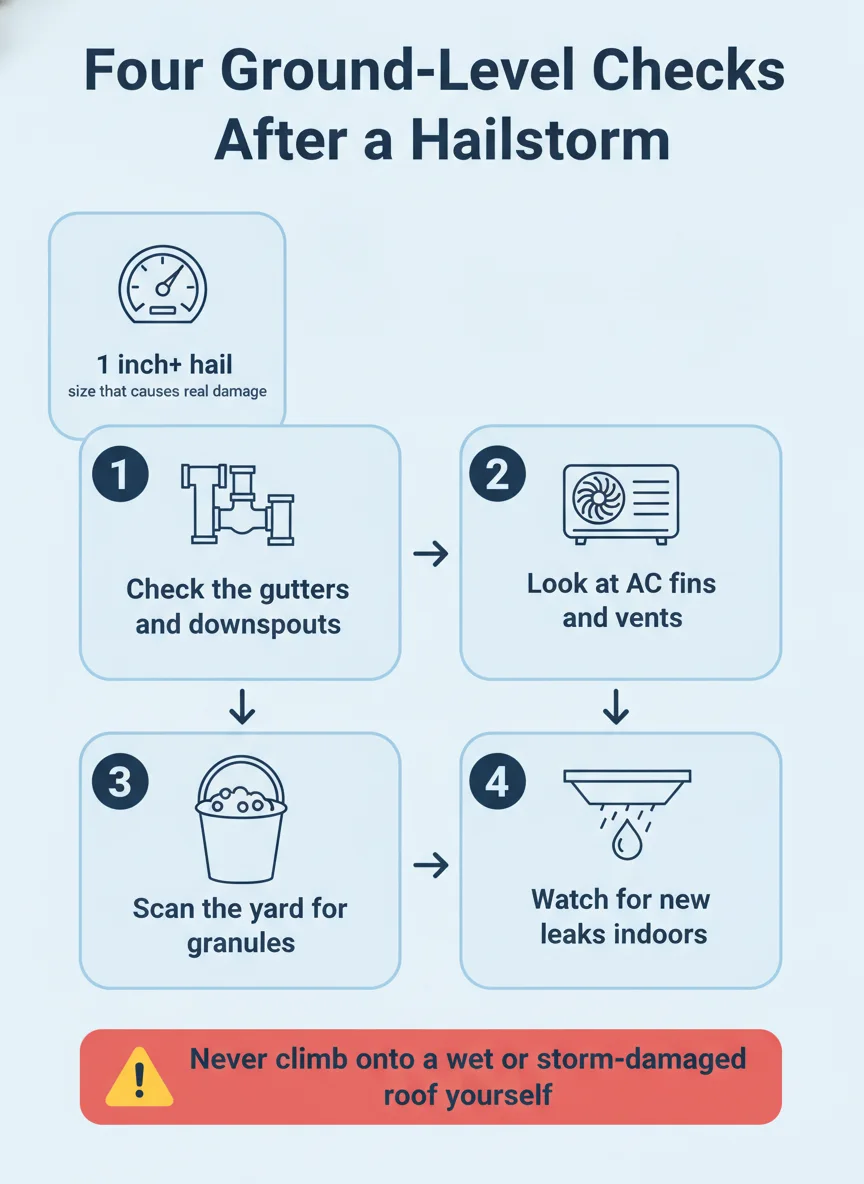
You don't need special tools for a ground-level check, just a slow walk around the exterior with a few specific things in mind. Here's the order that catches the most reliable clues before you ever call anyone out.
- Walk the perimeter: Circle the house and look at gutters, downspouts, and any exposed metal trim for small round dents or scuff marks.
- Check the AC unit: Look at the condenser fins facing the direction the storm came from. Bent or flattened fins mean real hail force hit your property.
- Inspect vent caps and flashing: Binoculars help here. Look for dented metal vent covers and loosened flashing around any roof penetrations you can see.
- Look at downspout outlets: Granules washed down from damaged shingles often collect at the base of downspouts after the next rain.
- Scan the yard and driveway: Hailstones leave marks on soft wood, screens, and even vehicles. Heavier marks mean the hail was large enough to matter.
- Check ceilings indoors: Walk through the house and look for new stains, especially under valleys or near chimneys, in the days after a storm.
- Document everything: Photograph anything unusual with a timestamp. This record matters if you end up filing an insurance claim later.
What You'll Actually Find When Damage Is Present
Minor Impact, No Immediate Leak
Many hail events leave bruising without breaking through to an active leak right away. In these cases, the roof may look completely normal from the yard and even from a quick walk across it. This is the scenario where a storm and hail inspection earns its keep, because the damage is real but not yet visible without someone checking each shingle by hand.
Left alone, this kind of damage tends to get worse rather than better. UV exposure keeps breaking down the exposed mat, and the next hard rain or windstorm can turn a bruise into a crack. Catching it early, even when there's no leak yet, is what keeps a repair job small instead of turning into a full roof replacement down the road.
Visible Damage With an Active Leak
Sometimes the signs are unmistakable: missing granules in large patches, cracked shingle tabs, or a water stain spreading across a bedroom ceiling. At this point the roof needs attention regardless of insurance timelines, because an active leak damages insulation, drywall, and framing the longer it sits.
If you're seeing this level of damage, a same-week inspection is worth prioritizing over waiting to see if it gets worse. It usually does. For homeowners dealing with active water intrusion, roof repair addresses the immediate problem while a fuller storm assessment documents everything else the hail affected.
What You Can Check Yourself vs. What Needs a Professional
The ground-level checks in this guide are things any homeowner can and should do after a hailstorm. Looking at gutters, AC fins, and vent caps takes ten minutes and gives you a real sense of whether the storm was strong enough to matter. If none of those show damage, your roof is less likely to have taken a significant hit, though it's never a guarantee.
What a homeowner can't safely do is walk the roof slopes themselves, especially after a storm when surfaces are wet and shingles may already be compromised. A trained inspector knows the difference between normal shingle wear and actual hail bruising, and they can check flashing, valleys, and penetrations that are impossible to evaluate from a ladder at the eave.
If your ground-level check turns up even one or two of the signs above, dented metal, granules in the downspout, or a new stain on a ceiling, that's reason enough to request a closer look rather than wait and see. Catching hail damage early is almost always the cheaper and simpler path compared to dealing with a leak that's had months to spread.
Getting a Closer Look After the Storm Passes
A ground-level check is a good first step, but it's a screening tool, not a diagnosis. Hail damage hides in places only a roof-level inspection can confirm, and the gap between what you can see from the yard and what's actually happening up top is exactly where small problems turn into expensive ones. If the storm hit your neighborhood hard enough to dent a gutter, it's worth finding out what it did to the roof itself.
Homeowners throughout Plano, Frisco, and the rest of the DFW metro deal with this same decision after every hail season, and the answer is almost always the same: get it looked at before you decide it's nothing. Absolute Professional Roofing Contractors LLC offers a free inspection that puts someone on the roof and gives you real answers, not guesswork from the driveway.
Frequently asked questions
Can you tell if your roof has hail damage without climbing up there?
You can spot early warning signs from the ground, like dented gutters, dinged vent caps, and granules collecting in downspouts, but you can't fully confirm hail damage without a close inspection. Soft metal damage you can see is often a sign that the shingles above took a hit too.
What size hail actually damages a roof?
Hail around an inch in diameter, roughly the size of a quarter, is generally the point where roofing material starts to show real damage. Smaller hail can still bruise shingles if it falls with enough wind-driven force, so size alone isn't the whole story.
Why does hail damage sometimes not show up right away?
Hail bruises the shingle mat without always breaking the surface granules, so the damage can be invisible to the eye for weeks or months. The weak spot is still there and tends to turn into a leak once sun and rain keep working on it.
Do I need to file an insurance claim the same day a storm hits?
No, but it helps to document the damage and get an inspection soon after the storm while the evidence (granules, dented metal, debris) is still fresh. Most policies give you a reasonable window to file, but check your own policy for specifics.
What happens during a professional hail damage inspection?
A roofer gets on the roof itself and checks each slope for bruising, cracked shingles, and exposed mat, then photographs everything for documentation. That visual record is what supports an insurance claim if the damage turns out to be significant.