Why "best roofing company near me" is the wrong first search
Typing that phrase into a search engine hands you a list ranked by ad spend and review volume, not by who actually does good work on homes like yours. Across the DFW metro, from Plano and Frisco down through Dallas, Irving, and Garland, dozens of companies show up for that exact search, and most homeowners have no way to tell them apart from the results page alone.
The towns in this region see a wide mix of roofing ages, pitches, and styles, from newer builds in Prosper and McKinney to older neighborhoods in Richardson and University Park. A roofer who knows how local weather, from summer heat to spring wind and hail, affects different roofing materials over time is worth more than one who simply ranks highest in search results.
What actually separates a strong roofing company from the rest
The difference usually comes down to a handful of concrete things you can verify before you ever sign a contract. License status, insurance coverage, how long the business has operated in your specific service area, and whether the warranty terms are written down clearly instead of promised verbally.
Licensing and insurance
A legitimate roofing contractor should be able to produce a license number without hesitation, and that license should be active and in good standing. Insurance matters just as much, because if a worker is injured on your property or a tool damages your siding, you want that liability resting with the contractor's policy, not yours.
Ask to see proof of both before work starts, not after. A contractor who hedges on this question, or who claims insurance is "not necessary" for a small job, is a red flag worth walking away from, regardless of how good their price looks.
Experience with your specific roof type
Asphalt shingle installation, metal roofing, and low-slope commercial membrane systems like TPO or EPDM each require different skills and different attention to detail. A crew that's spent years installing residential shingles isn't automatically equipped to handle a flat commercial roof, and vice versa.
When you're comparing contractors, ask directly what portion of their recent work matches your project type. A company that does roof replacement and commercial roofing under one roof, so to speak, usually has crews trained specifically for each.
| What to Check | Good Sign | Red Flag |
|---|---|---|
| License | Active number, verifiable, offered without hesitation | Vague answer or refusal to provide it |
| Insurance | Current liability and workers' comp proof | "We don't need that for small jobs" |
| Estimate | Detailed, itemized, in writing | One-line price with no scope breakdown |
| Warranty | Specific terms, written into the contract | Verbal promise only, nothing in writing |
How written estimates work, and why that matters
A strong estimate spells out the materials being used, the scope of tear-off and decking repair if needed, and the labor involved, rather than just handing you a total dollar figure. That breakdown is what lets you compare two contractors honestly, since the cheapest number on paper can hide a thinner scope of work underneath.
Replacement pricing is shaped by the size of the roof, its pitch and complexity, the material chosen, and the condition of the decking once the old roof comes off. Roof repair pricing works similarly on a smaller scale, driven by how much of the roof is affected and how accessible the damage is.
Step-by-step: narrowing your list of local roofing contractors
Once you have a handful of names, a structured process keeps you from picking based on price alone or on whoever answers the phone fastest.
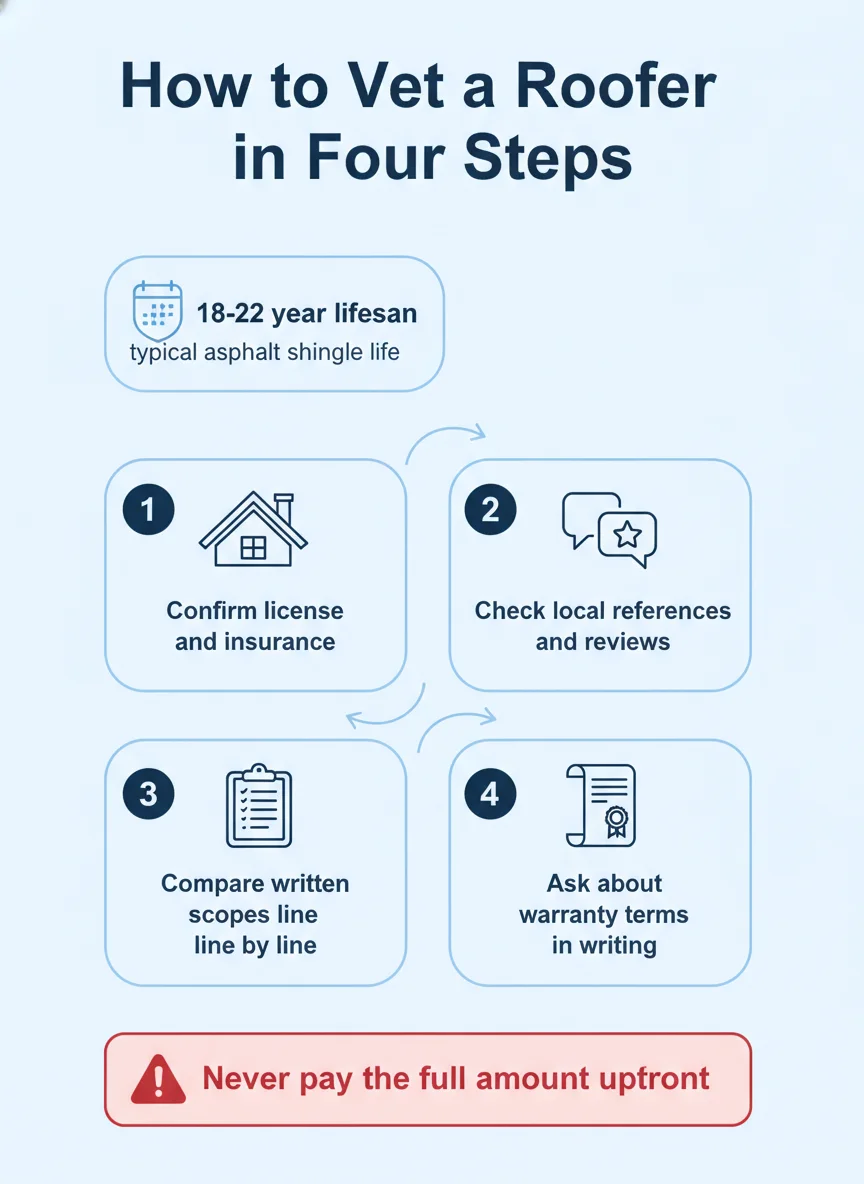
- Verify license and insurance: Ask for the license number and insurance certificates directly, and confirm the license is active before you go any further.
- Check local reviews and references: Look for reviews specific to your town or nearby cities, and ask for references from recent jobs similar in scope to yours.
- Request a written, itemized estimate: Compare materials, labor, and scope line by line across contractors rather than comparing bottom-line totals only.
- Ask about warranty terms in writing: Get workmanship and material warranty terms spelled out in the contract, not just described verbally during the sales visit.
- Confirm the timeline and communication plan: Ask how you'll be updated during the project and who your point of contact is if something comes up mid-job.
- Review the contract before signing: Read the full scope of work, payment schedule, and warranty language before you commit to anything in writing.
Does a new roof actually raise your home's value?
Yes, in most cases a roof in good condition adds measurable value, because it removes one of the biggest red flags a home inspector or appraiser looks for. An aging roof nearing the end of its life, or one with visible damage, tends to get flagged during a sale and can slow down negotiations or lower offers.
What buyers and appraisers actually notice
Buyers in this market tend to ask directly how old the roof is and whether any work has been done recently. A documented replacement with a clear warranty, especially one still active and transferable, is a selling point you can point to during negotiations rather than a question mark you have to explain away.
Curb appeal plays a role too. A roof with visible wear, streaking, or missing shingles is one of the first things a potential buyer notices driving up, well before they step inside.
When replacement makes more sense than repair before selling
If a roof is already past the point where patch repairs are holding, or if an inspection during the listing process turns up structural issues, replacement before selling usually pays off more than trying to repair around the problem. Buyers and their inspectors tend to dig deeper on anything that looks like a workaround rather than a fix.
On the other hand, a roof with several years of life left and only minor, isolated damage is often better served by a targeted repair rather than a full tear-off, since replacing a roof that doesn't need it yet rarely returns the investment at resale.
What you can evaluate yourself vs. what needs a licensed contractor
You can and should do a fair amount of homework on your own before hiring anyone. Checking license status, reading reviews, calling references, and comparing written estimates are all things a homeowner can and should handle without any special training.
Climbing onto the roof itself to assess damage, diagnosing the extent of decking rot, or evaluating ventilation and attic airflow are jobs for a trained, licensed professional. Misjudging the extent of damage from the ground, or missing a ventilation issue tied to energy efficiency, can lead to a repair that doesn't actually solve the underlying problem.
The safest approach is to let a licensed contractor do the physical inspection and give you a written assessment, while you handle the vetting and comparison work on your end. That division keeps you in control of the decision without putting you on a ladder you don't need to be on.
Putting it all together
Finding the best roofing company near you isn't about who shows up first in a search result, it's about who can show you a license, back their work with a written warranty, and walk you through an honest, itemized scope before any work starts. Towns across the metro, from Allen and Wylie to Flower Mound and Grapevine, each have their own mix of roof ages and styles, and a contractor familiar with that variety is worth the extra bit of research.
If you're weighing a full roof replacement against a repair, it also helps to read up on related questions like what to do when your roof is leaking before you call anyone out. Absolute Professional Roofing Contractors LLC works across the region and is happy to walk through that written estimate with you before you decide.
Frequently asked questions
How do I choose a roofer?
Start by confirming the contractor holds an active license and carries liability and workers' compensation insurance, then check how long they've been working in your specific area. From there, compare written estimates line by line rather than just the bottom-line number, since the materials and scope of work matter as much as the price.
Does a new roof increase home value?
Yes, a roof in good condition is consistently one of the features buyers and appraisers weigh most heavily, since an aging or damaged roof is one of the first things a home inspector flags. A new installation with a clear warranty can also make a listing more attractive by removing that worry for a buyer.
Who is the number one roofing company in America?
There isn't a single nationally recognized "number one" roofing company, because roofing is a local trade and the best fit depends heavily on who actually services your town and knows your local codes and weather patterns. A better question to ask is which licensed, insured contractor has a strong track record in your specific city.
How much does it roughly cost to replace a roof?
Roof replacement cost depends on the size of the home, the pitch and complexity of the roof, the material chosen, and how much of the decking underneath needs repair. The most reliable way to get a real number is a written, itemized estimate from a licensed contractor rather than a rough average, since those vary widely by property.
What questions should I ask a roofing contractor before hiring?
Ask for proof of license and insurance, how long they've worked in your area, what warranty terms they offer in writing, and whether they'll provide a detailed scope of work rather than a one-line price. A contractor who answers these clearly and without hesitation is usually one who stands behind the work.