Why Two Warranties Exist on One Roof
Every new roof installed across the Dallas-Fort Worth metro comes with two separate promises attached to it, even though most homeowners only remember signing one contract. The first promise comes from the company that manufactures the shingles, membrane, or metal panels. The second comes from the contractor who installed them. They are not the same document, they are not backed by the same party, and they do not cover the same failures.
This distinction matters most the moment something goes wrong. A leak two years after installation might be a defective shingle batch, or it might be a nail driven at the wrong angle during install. One of those is the manufacturer's problem, the other is the installer's. Knowing which warranty applies before you need it saves weeks of back and forth when water is already coming through the ceiling.
How Each Warranty Actually Works
Both warranties exist to limit risk, but they limit different kinds of risk and they're triggered by different causes of failure. Understanding the mechanism behind each one makes it much easier to read a warranty document instead of just skimming it.
The Manufacturer Warranty
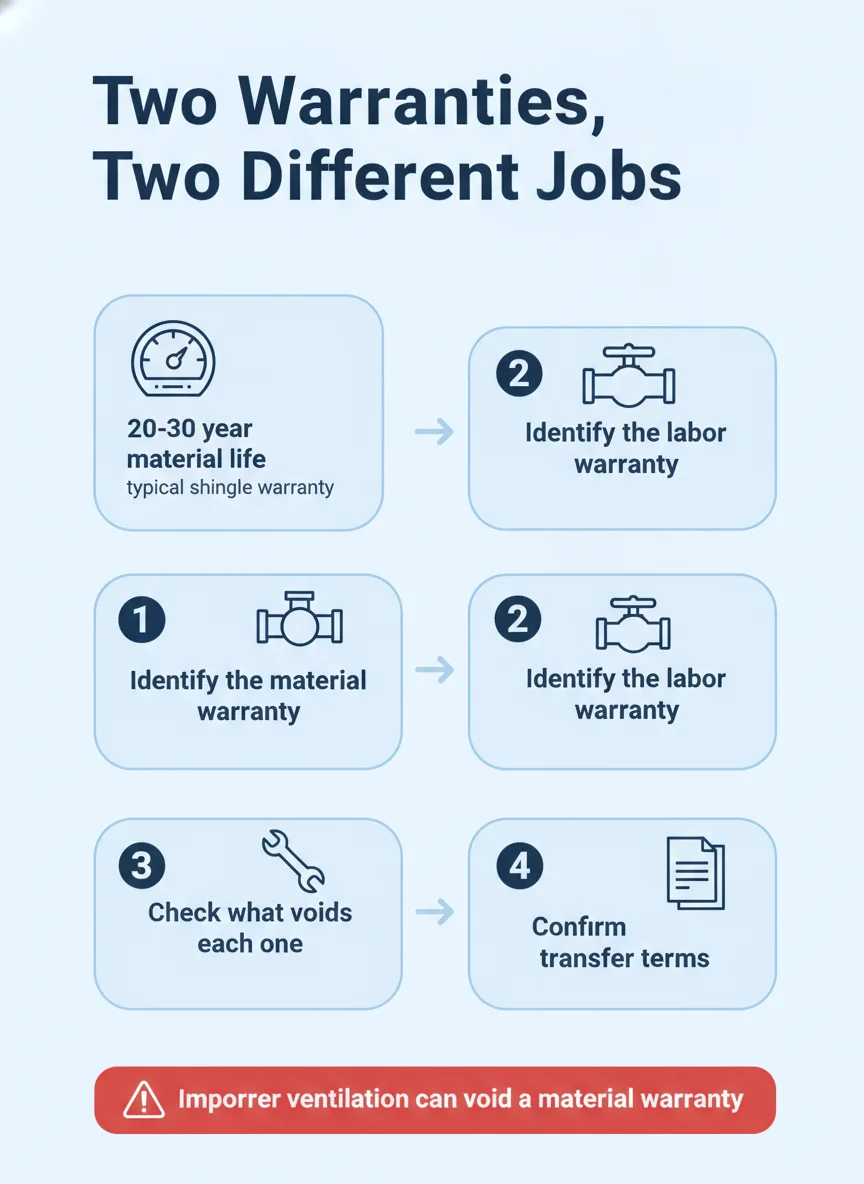
This warranty is issued by the company that made the shingles, underlayment, or other roofing material, and it covers defects in that product. If a batch of shingles cracks, curls, or loses granules well before the end of its expected service life due to a manufacturing flaw, that's a materials issue and the manufacturer warranty is what applies. Most standard shingle warranties run 20 to 30 years, though terms vary by product line.
These warranties almost always require the roof to be installed to the manufacturer's published specifications. That means correct nailing patterns, compatible underlayment, and proper attic ventilation. Stray from those specs and the manufacturer can deny a claim even if the shingles themselves are genuinely defective, because the installation conditions invalidated the coverage.
The Workmanship Warranty
This warranty comes from the roofing contractor, not the material maker, and it covers mistakes in how the roof was put together. Flashing that wasn't sealed, a valley that wasn't lapped correctly, or fasteners that missed the decking are all installation errors, and a solid roof replacement should come with a workmanship warranty that covers exactly these kinds of callbacks.
Workmanship warranty terms are set entirely by the contractor, so they vary widely from one company to the next. There's no industry standard length the way there often is on material coverage. That's exactly why it needs to be in writing, with a specific term in years, before any contract gets signed.
| Situation | Manufacturer Warranty | Workmanship Warranty |
|---|---|---|
| Shingles curling early from a product defect | Covers it | Does not apply |
| Leak at a flashing that was never sealed | Does not apply | Covers it |
| Granule loss from a bad manufacturing batch | Covers it | Does not apply |
| Nail pops from incorrect fastening | May be denied | Covers it |
What's Actually in Each Document
A manufacturer warranty packet usually spells out the covered defects, the length of full coverage versus prorated coverage, and the specific installation requirements that keep it active. Some manufacturers offer extended or enhanced warranty tiers to contractors who meet certification standards, which can include coverage for labor costs tied to a material defect, not just the material itself.
A workmanship warranty document should spell out exactly what's covered (leaks caused by installation error), the term length, and what the homeowner needs to do to make a claim. If a contractor can't produce this in writing, that's worth asking about directly before work starts, not after a leak shows up.
Step-by-Step: Reviewing a Roof Warranty Before You Sign
Going through both documents line by line before a contract is signed catches most problems before they become disputes later.
- Get both documents: Ask for the manufacturer's written warranty and the contractor's workmanship warranty as separate documents, not a verbal summary.
- Check the term length: Confirm how many years each warranty runs and whether coverage is full-term or prorated after a certain point.
- Read the void conditions: Look specifically for ventilation requirements, layover restrictions, and any rule about mixing products from different manufacturers.
- Confirm transfer rules: Ask whether either warranty transfers to a future buyer and what window or fee applies if it does.
- Ask about certification tiers: Some manufacturers offer enhanced warranties to certified installers, which can extend coverage to labor costs tied to material defects.
- Keep the paperwork: File both documents with your closing or project paperwork so they're easy to find if a claim ever comes up.
What Actually Voids These Warranties
Most warranty disputes trace back to one of a small handful of causes, and almost all of them are preventable with the right installation from the start.
Ventilation and Layover Problems
Poor attic ventilation traps heat and moisture against the underside of the roof deck, which accelerates shingle aging and is one of the most common reasons manufacturers deny material claims. Installing new shingles over an existing layer, sometimes called a layover, can also void coverage because it changes how the roof assembly performs compared to the manufacturer's tested specifications.
This is part of why a full tear-off with proper ventilation and energy efficiency upgrades tends to protect warranty coverage better than a quick overlay. It costs more up front but keeps both the material and workmanship warranties intact.
Mixed Products and Unregistered Systems
Manufacturers test their underlayment, starter strip, shingles, and ventilation components together as a system. Swapping in a different brand's component for even one part of that system can disqualify the enhanced or extended warranty tier, even if the shingles themselves are fine. Some manufacturers also require formal registration of the installation within a set window after the job to activate extended coverage, and skipping that step leaves a homeowner with only the base warranty instead.
The other quiet risk is storm damage mistaken for a defect. If hail or wind causes the failure, that's typically a storm & hail restoration and insurance matter, not a manufacturer or workmanship warranty claim, so getting the cause documented correctly up front matters.
What a Homeowner Can Check vs. What Needs a Pro
A homeowner can absolutely read through both warranty documents, confirm the term lengths, and ask direct questions about void conditions before signing anything. That part doesn't require a roofing background, just a willingness to read the fine print and ask the contractor to explain anything unclear in plain language.
Diagnosing whether an actual failure is a material defect or an installation error is a different matter. That takes someone who can get on the roof, identify the failure point, and trace it back to its cause, which usually means pulling back shingles or inspecting flashing details a homeowner can't safely access or correctly interpret from the ground.
Filing the actual warranty claim also benefits from a professional's involvement, since manufacturers often want documentation, photos, and sometimes a formal inspection report before honoring a claim. A contractor who installed the roof and kept good records makes that process considerably smoother than trying to file solo.
Getting the Paperwork Right From the Start
The easiest way to avoid a warranty dispute is to never end up in one, which means asking for both documents in writing before any contract is signed and confirming the installation plan matches the manufacturer's specifications for ventilation, layover, and compatible components. A homeowner who does this up front rarely has to revisit it for decades.
For more on how warranty terms are typically structured, see how long a roof warranty lasts. Homeowners in Plano and across the metro working with Absolute Professional Roofing Contractors LLC can ask for both warranty documents up front, before any work begins.
Frequently asked questions
What's the difference between a manufacturer warranty and a workmanship warranty?
The manufacturer warranty covers defects in the shingles or other materials themselves, while the workmanship warranty covers mistakes made during installation, like a flashing that was never sealed right. They come from two different parties, the material maker and the contractor, and a leak can be denied by one and covered by the other depending on the actual cause.
Does a manufacturer warranty cover a bad installation?
No, a manufacturer warranty only covers the product itself, not labor or installation errors. If a leak traces back to how the roof was installed rather than a defect in the shingles, that falls under the workmanship warranty instead, which is why both documents matter.
Can a manufacturer warranty be voided?
Yes, common causes include improper attic ventilation, installing over an existing layer of roofing, or using components from multiple manufacturers that were never tested together. Most material warranties require the roof to be installed to the manufacturer's written specifications to stay valid.
Do roof warranties transfer to a new homeowner?
It depends on the specific warranty and often requires a transfer within a set window after closing, sometimes with a transfer fee. Workmanship warranties vary by contractor, so ask for the transfer terms in writing before you buy a house with a roof under warranty.
How long does a workmanship warranty usually last?
It varies by contractor and is a separate commitment from the material warranty, so the length is only as good as what's written in your contract. Ask for the specific term in years and get it in the paperwork rather than relying on a verbal promise.