Why replacement quotes vary so much across the DFW Metro
Ask three roofing companies for a replacement quote on the same house and you'll often get three different numbers, sometimes far apart. That's not a sign that someone's overcharging or underbidding, it usually reflects real differences in material choice, scope of work, and what each contractor found once they actually looked closely at the roof.
For homeowners across Plano, Frisco, McKinney, Allen, and the rest of the region we cover, understanding what actually moves the price makes it much easier to compare quotes fairly. This isn't a pricing sheet, it's a breakdown of the real variables so you know what questions to ask when quotes start coming in.
The variables that actually move a replacement price
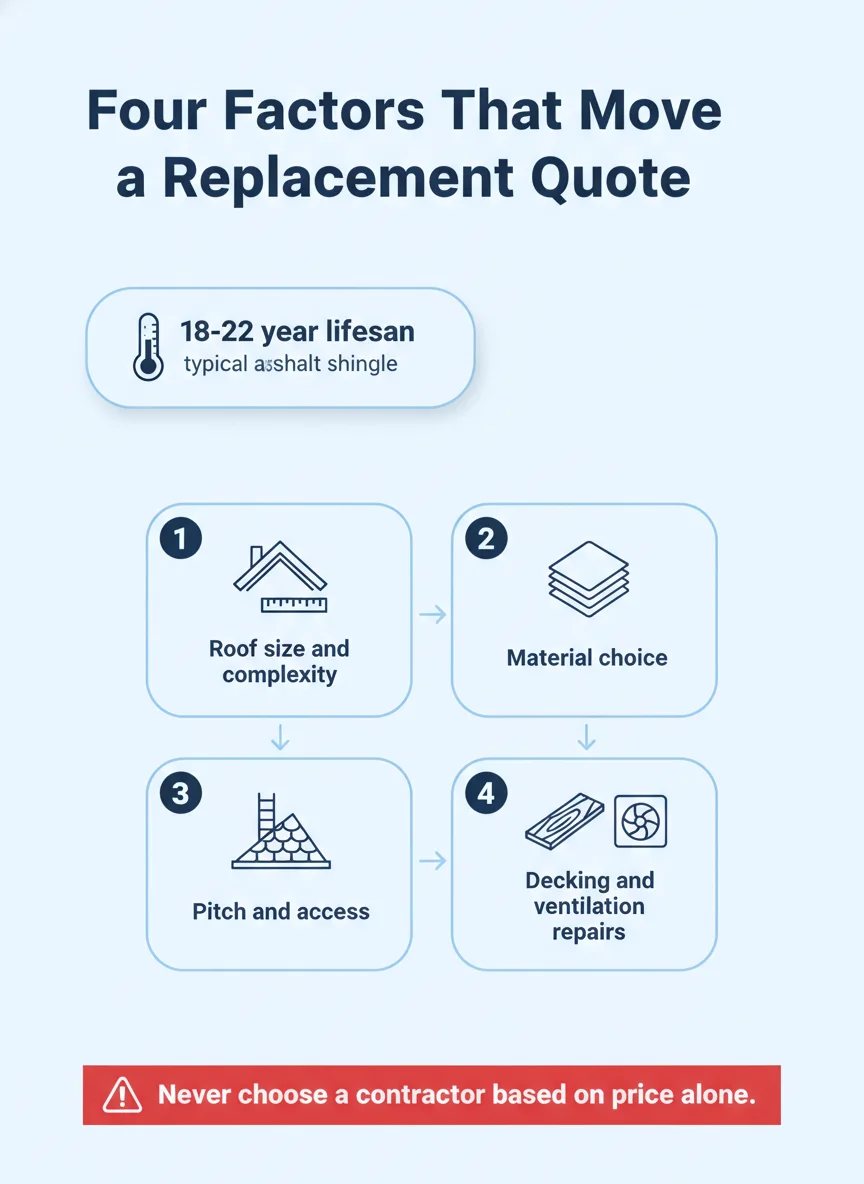
Every roof replacement quote is built from the same handful of ingredients: how big the roof is, what material goes on it, how hard it is to access and work on safely, and what condition the decking underneath is in. Understanding each one explains most of the spread between quotes.
Roof size and complexity
A larger roof simply requires more material and more labor hours, which is the most straightforward cost driver of all. But size alone isn't the whole story: a roof with multiple valleys, dormers, chimneys, and skylights takes considerably longer to flash and finish correctly than a simple rectangular roofline of the same square footage.
Complexity also affects material waste. Cutting shingles or panels to fit around lots of angles and penetrations uses more material than a straightforward gable roof, which shows up in the final quote even when the total square footage looks similar on paper.
Material choice
Standard three-tab asphalt, architectural asphalt, metal, and tile all sit at meaningfully different price points, and each comes with its own expected lifespan and appearance. Choosing a heavier or more durable material raises the upfront number but can also change the long-term value equation, since a longer-lasting roof is replaced less often.
Beyond the visible material, underlayment quality and ventilation components like ridge vents, turbines, or solar-powered attic vents also factor into the total. These aren't visible from the curb but they affect both performance and longevity, which is why two quotes with the same shingle brand can still differ.
| Cost factor | Raises cost | Lowers cost |
|---|---|---|
| Roof size | Larger square footage | Smaller, simpler footprint |
| Pitch and access | Steep, multi-story, hard to access | Low pitch, single story, easy access |
| Decking condition | Rot or damage found underneath | Solid decking with no repairs needed |
| Material | Metal, tile, upgraded shingles | Standard architectural shingles |
The layers involved in a full replacement
A full roof replacement is more than swapping out shingles. It involves stripping the old roofing down to the deck, inspecting and repairing that deck as needed, installing new underlayment, flashing around every penetration, and finishing with the chosen roofing material, all built to manufacturer specification.
Each of those layers has its own material and labor cost attached, which is why a quote built on a proper tear-off and inspection will naturally read differently than one that skips steps to hit a lower number. The layers you don't see from the ground are often where the real value of a quality installation lives.
Step-by-step: how a replacement quote gets built
Knowing the process behind a quote makes it easier to understand why the number lands where it does, and easier to spot a quote that's skipping important steps.
- Roof measurement: The contractor measures total square footage, pitch, and number of facets to calculate material needs accurately.
- Material selection: You choose the roofing material and any upgrades, like enhanced ventilation, which sets the material line of the quote.
- Access and safety review: Steep pitch, height, or difficult access can add labor time and safety equipment needs to the project.
- Tear-off and deck inspection: Old roofing comes off and the deck is checked for rot or damage before anything new goes down.
- Underlayment and flashing: New underlayment and flashing are installed around every valley, chimney, and vent penetration.
- Final installation: The chosen roofing material is installed to manufacturer specification, followed by a final walkthrough.
What drives the price up versus down on a real quote
Once you understand the individual factors, it helps to see how they combine into two ends of the spectrum: a straightforward, lower-cost project and a more involved, higher-cost one.
What keeps a quote on the lower end
A single-story home with a simple gable roofline, easy ground access, solid existing decking, and a standard architectural shingle sits toward the lower end of the range for most replacement projects. Fewer penetrations and a straightforward layout mean less labor time and less material waste.
Homes in this category often move through the roof replacement process fastest, since there are fewer surprises to plan around once the tear-off begins.
What pushes a quote higher
A steep, multi-plane roof with several valleys, chimneys, and skylights, combined with decking that needs repair once uncovered, sits at the higher end. Upgraded materials like metal or tile, along with added ventilation components, also raise the total.
None of these factors are red flags on their own, they're simply real costs tied to protecting a more complex or higher-value roof system correctly.
What a homeowner can evaluate versus what needs a pro
A homeowner can absolutely evaluate quotes on scope, ask about warranty terms, and compare material options before making a decision. Understanding the factors in this guide puts you in a strong position to ask sharp questions during that process.
What a homeowner can't safely do is measure their own roof's pitch and condition from a ladder, or judge how much deck repair a specific roof might need. That assessment requires someone who's walked hundreds of roofs and knows what hidden damage looks like before it's uncovered.
A licensed roofer, our own team included, GAF factory-certified for extended warranty options on qualifying installs, will walk the roof, document its condition, and build a quote around what's actually there rather than a rough guess from the ground.
Getting a quote you can actually compare
The factors that move a roof replacement quote are the same across the DFW Metro: size, material, pitch, access, and what's found underneath the old roofing. Once you understand those, comparing quotes becomes a much clearer exercise than just looking at the bottom line.
For homeowners who also want to understand how roof repair fits into the decision, or who are weighing replacement against a smaller fix, Absolute Professional Roofing Contractors LLC provides a free inspection and honest report before any decision has to be made.
Frequently asked questions
What makes roof replacement cost more in Texas?
The biggest cost drivers are roof size, material choice, pitch, and how many layers of existing roofing need to come off first. A larger, steeper roof with multiple layers to remove naturally takes more labor and material than a small, simple one.
Does the type of shingle affect the price a lot?
Yes, material is one of the largest factors in any replacement quote. Basic asphalt shingles, architectural shingles, metal panels, and tile all sit at different price points and each brings a different expected lifespan.
Does roof pitch change the cost?
It can, since steep or complex rooflines take longer to work on safely and often require additional safety equipment. A simple, low-pitch roof is generally quicker and less labor-intensive to replace than a steep, multi-plane design.
Will hidden deck damage raise the price?
It's possible, since rotted or damaged decking found once the old roofing is removed needs to be replaced before new material goes down. A thorough inspection before the project starts helps catch most of this ahead of time.
Is a cheaper replacement quote a red flag?
Not automatically, but a quote that's dramatically lower than others deserves questions about materials, warranty coverage, and what's actually included. The safest approach is comparing scope of work side by side, not just the bottom line number.