Why two repair quotes can look so different
A repair quote for a small leak near a vent pipe and one for a section of wind-damaged shingles on the same street can come back looking nothing alike, and that's normal. Repair pricing depends heavily on what's actually causing the problem, not just how big the visible damage looks from the driveway.
Homeowners across Richardson, Carrollton, Garland, Irving, and the rest of the DFW Metro we serve often assume repair is automatically the cheap option compared to replacement. That's usually true, but the range within repair pricing itself is wide, and knowing why helps set realistic expectations before a crew shows up.
What actually determines a repair's scope and cost
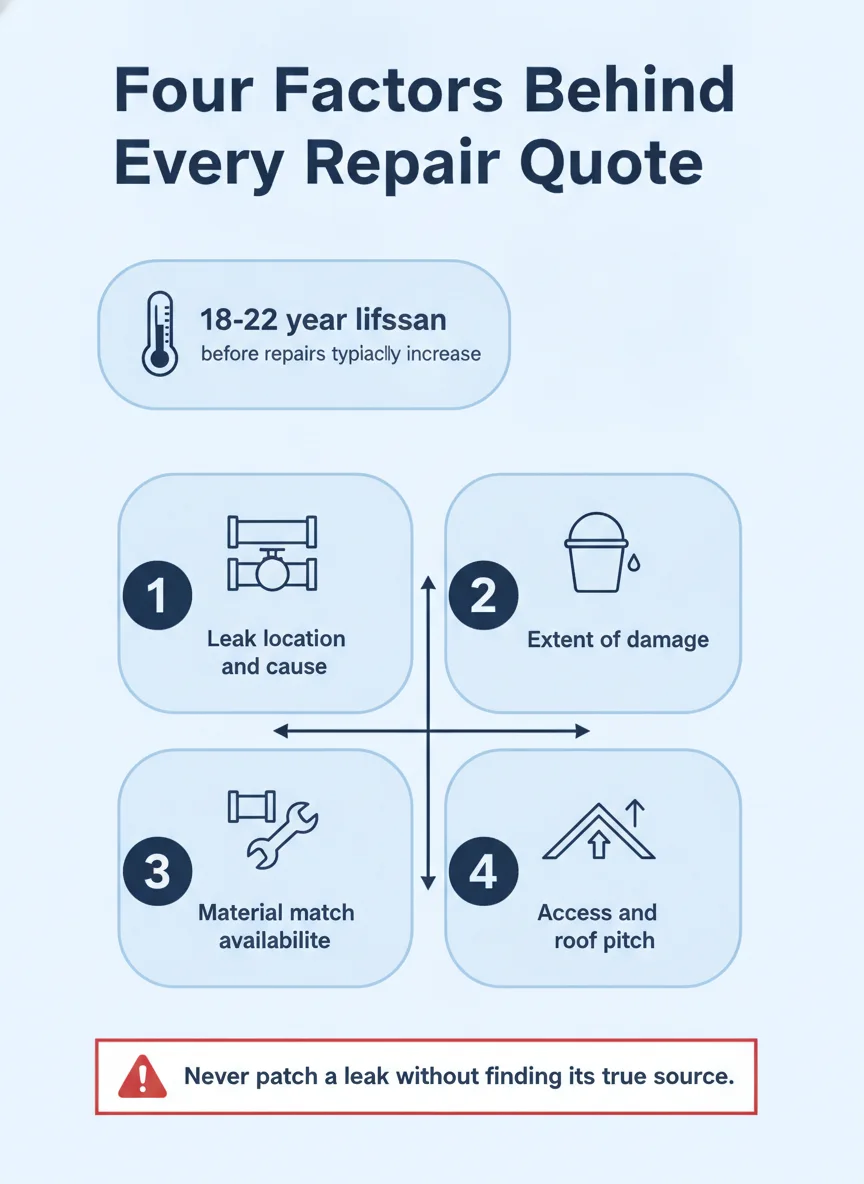
Repair pricing is built around finding the actual cause of a problem and fixing it correctly, not just patching the symptom. The location of the damage, how far it's spread, and what's needed to access it safely are the main variables that separate a quick fix from a more involved repair.
Leak location and root cause
A leak that traces back to a single cracked shingle is a very different job from one caused by failed flashing around a chimney or skylight. Flashing failures require careful removal and resealing to stop water intrusion for good, which takes more time than a simple shingle swap.
Tracing the real source matters too. Water often travels along the decking before it shows up as a stain inside the house, so the visible leak point and the actual damage point aren't always the same spot, which is part of what a proper roof repair inspection is meant to sort out.
Extent and age of the damage
Damage caught early, a handful of lifted or missing shingles, is quicker and less costly to fix than damage that's been sitting and spreading for a season or two. Water that's had time to soak into decking or insulation turns a surface-level repair into one that involves replacing wood underneath too.
Older roofs also complicate repairs in another way: brittle, sun-baked shingles nearby can crack during the repair process itself, sometimes widening the area that needs new material beyond the original damage.
| Repair scenario | Typical complexity | Main cost driver |
|---|---|---|
| Isolated missing shingles | Low | Material match and labor time |
| Flashing failure at chimney | Moderate | Careful resealing and access |
| Leak with decking damage | Higher | Wood replacement beneath roofing |
| Wind damage across a slope | Higher | Larger material area and inspection |
What's actually being repaired under the shingles
A visible shingle problem is often just the surface symptom of what's happening underneath. Underlayment, flashing, and decking all sit between the shingle and the framing of the house, and a repair that only addresses the top layer without checking what's beneath it tends to fail again.
That's why a proper repair involves lifting surrounding shingles to inspect the underlayment and decking condition before closing everything back up. Skipping that step is one of the most common reasons a homeowner ends up paying for the same leak twice.
Step-by-step: how a repair gets diagnosed and priced
Understanding the process behind a repair quote helps explain why the price lands where it does, and what you should expect a contractor to actually do before naming a number.
- Locate the damage: The crew inspects the roof surface and traces any leak back to its actual source, not just where water is showing up inside.
- Check surrounding area: Nearby shingles, flashing, and decking get checked, since damage often extends past the visible problem spot.
- Assess material match: Existing shingle color and style are checked for availability, since older roofs sometimes need extra sourcing time.
- Evaluate access needs: Roof pitch and the location of the damage determine what safety equipment and time the repair will take.
- Repair the layers: Damaged decking or underlayment is replaced first, then new shingles and flashing go on to match the surrounding roof.
- Final inspection: The repaired area is checked for a proper seal before the crew considers the job complete.
What you'll actually find once the repair starts
Repairs sometimes reveal more, or less, than expected once the crew is actually working on the roof. Knowing what typically shows up helps you understand why an initial estimate can shift once work begins.
When the repair stays simple
If the damage is caught early and the surrounding shingles and decking are in good shape, most repairs stay close to the original estimate. A single storm-damaged section repaired soon after the event, for example, usually doesn't reveal hidden surprises underneath.
This is the most common outcome for homeowners who address damage as soon as it's noticed rather than waiting through another season.
When the repair grows in scope
If water has been getting in for a while, the crew may find soft or rotted decking, damaged insulation, or staining that extends further than the visible shingle damage suggested. In these cases, the quote adjusts to reflect the actual work needed to fix the problem for good.
This is also where a leak tied to a recent storm sometimes shifts into storm and hail restoration territory, especially if an insurance claim ends up covering the broader repair.
What a homeowner can handle versus what needs a licensed roofer
Spotting a problem, missing shingles, a water stain on a ceiling, is something any homeowner can do from the ground or inside the attic, and doing it quickly is genuinely valuable. Getting up on the roof to diagnose or fix the issue is a different story.
Tracing a leak to its actual source, checking decking condition, and matching flashing details correctly takes training and experience most homeowners don't have, and getting it wrong means paying for the repair twice. Roof work also carries real fall risk that isn't worth taking on solo.
A licensed roofer can diagnose the full scope in one visit, document everything with photos, and repair it correctly the first time, which is almost always cheaper in the long run than a string of DIY patches.
Getting a repair quote that reflects the real problem
Repair costs in the DFW Metro come down to location, extent of damage, and what's found once the surrounding area gets checked, not a flat rate that applies to every leak the same way. Understanding those variables helps you ask better questions when a quote comes in.
Absolute Professional Roofing Contractors LLC offers a free, no-obligation inspection with a same-day report, so you know exactly what's driving the number before agreeing to any repair work.
Frequently asked questions
What makes a roof repair cost more?
Repair cost mostly comes down to how hard the damage is to reach, how far it's spread, and whether hidden decking or framing needs work too. A repair confined to one small, accessible area is naturally quicker than one involving multiple layers of damage.
Does leak location affect repair cost?
Yes, leaks around chimneys, skylights, or valleys usually take more time to trace and fix correctly than a leak on an open, flat section of roof. Flashing repairs in particular require careful work to seal properly.
Is it more expensive to repair an older roof?
It can be, since older roofs sometimes have brittle shingles that crack during repair work, or decking that's begun to deteriorate underneath. A newer roof usually repairs more cleanly and predictably.
Why does matching materials matter for repair cost?
If your existing shingles are discontinued or weathered to a different shade, finding a close match can take extra sourcing time, which affects both timeline and cost. This matters most on older roofs.
When does a repair stop making financial sense?
When damage is widespread across the roof rather than isolated, repeated repairs in the same spot start to add up compared to addressing the whole system at once. A professional inspection is the best way to know which side of that line your roof falls on.