Why Roof Measurement Confuses Most Homeowners
It's a fair question when a contractor tells you your roof is '24 squares' and you have no idea what that means relative to your home's 2,000 square foot floor plan. Roofers measure roof surface area differently than homeowners think about their house, and the two numbers rarely match.
Getting a rough handle on how roofing is measured helps you sanity-check a quote and understand why two homes of similar size can need very different amounts of material.
How Roofers Actually Calculate Material Needs
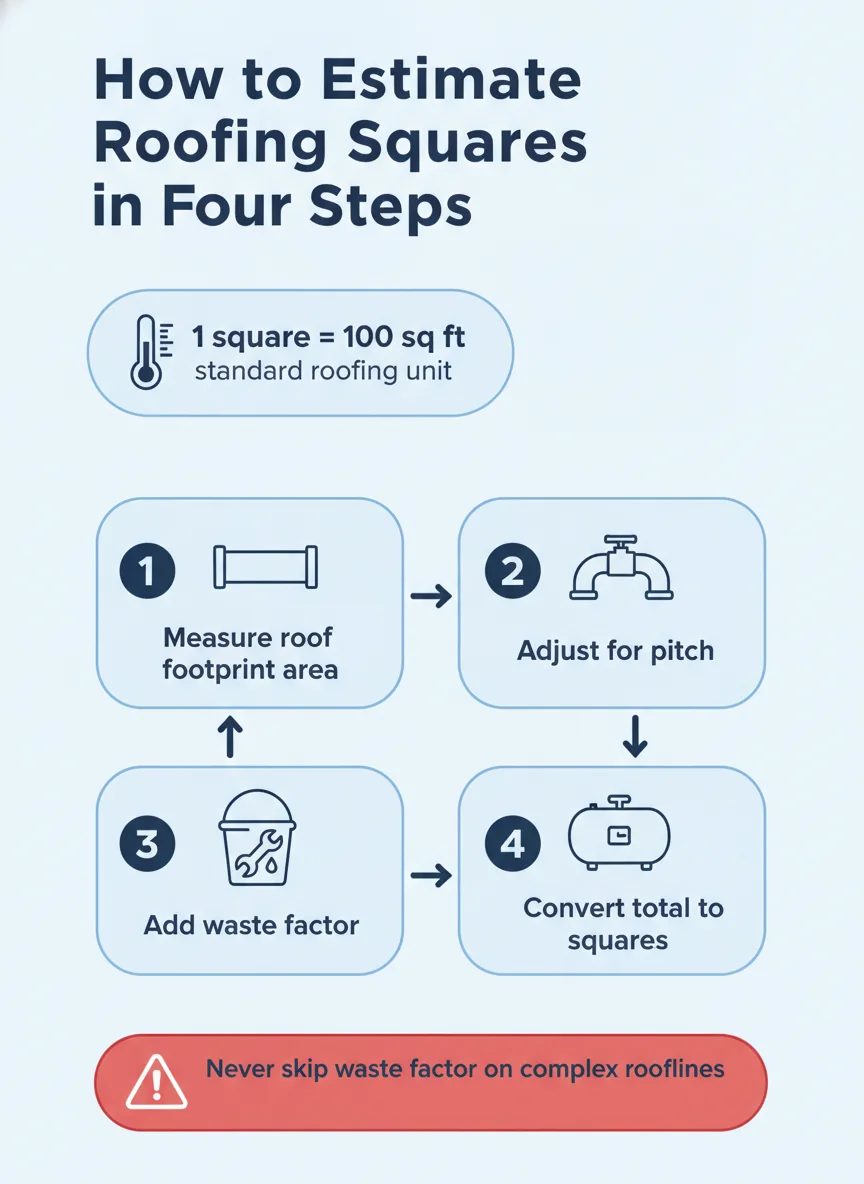
The process starts with the roof's footprint, adjusts for pitch, and then adds a waste factor for cutting and overlap. Each step changes the final number, sometimes significantly.
The Square: Roofing's Basic Unit
One roofing square equals 100 square feet of surface area. Material, especially shingles, is sold and estimated by the square, which is why a contractor will describe your roof in squares rather than square feet. A typical single-story home in North Texas often falls somewhere in the range of 15 to 30 squares, though larger or more complex homes can run higher.
Knowing your roof's square count helps you compare quotes on an apples-to-apples basis, since material cost scales directly with square count while labor cost scales with both square count and complexity.
Pitch Multipliers
A sloped roof has more actual surface area than the flat footprint underneath it, and pitch multipliers account for that difference. A steeper roof, like a 8/12 or 9/12 pitch, adds noticeably more surface area than a low 3/12 or 4/12 slope over the same footprint. Roofers use standard pitch multiplier tables to convert footprint area into actual roof surface area.
This is one reason a homeowner's rough ground-level estimate rarely matches the number a contractor arrives at after climbing on the roof and taking real measurements.
| Pitch | Multiplier | Effect on Total Squares |
|---|---|---|
| 3/12 (low slope) | 1.03 | Minimal increase over footprint |
| 6/12 (moderate) | 1.12 | Noticeable increase in surface area |
| 9/12 (steep) | 1.25 | Significant increase in surface area |
| 12/12 (very steep) | 1.41 | Roof area nearly 1.4x the footprint |
What Waste Factor Actually Covers
Waste factor accounts for shingles cut and discarded at hips, valleys, ridges, and edges, plus overlap built into every course of shingles. A simple gable roof with few penetrations might only need a 5 to 10 percent waste factor, while a roof with multiple valleys, dormers, and hips can need 15 to 20 percent or more.
Skipping waste factor in an estimate is a common way homeowners underestimate material needs, and it's also a spot where a lower quote can quietly be leaving out enough material to finish the job correctly.
Step-by-Step: Estimating Your Roof's Square Count
This process gives you a working estimate to bring into conversations with a contractor. It's not a substitute for an on-roof measurement, but it puts you in a better position when comparing quotes.
- Measure the footprint: Measure your home's length and width at the roofline, including any additions or extensions.
- Calculate footprint area: Multiply length by width for each section of the roof's footprint and add the sections together.
- Apply a pitch multiplier: Estimate your roof's pitch and apply the corresponding multiplier from a standard pitch chart.
- Add waste factor: Add 5 to 20 percent extra depending on how many valleys, hips, and penetrations your roof has.
- Convert to squares: Divide the total adjusted square footage by 100 to get your estimated number of roofing squares.
- Confirm with a measurement: Have a roof replacement estimate confirmed with an actual on-roof or satellite measurement before ordering material.
What Your Estimate Reveals About Your Project
If Your Square Count Is Lower Than Expected
A lower-than-expected square count usually means a simple, low-pitch roof with few valleys and penetrations. These roofs generally have lower material and labor costs since there's less cutting and detail work involved in the install.
It's still worth confirming the estimate with an actual measurement, since even simple-looking roofs can have hidden complexity around chimneys, skylights, or additions that add to the total.
If Your Square Count Is Higher Than Expected
A higher square count often points to a steep pitch, multiple roof planes, or a home with several dormers and valleys. These roofs need more waste factor and more careful flashing work, which shows up in both material and labor cost.
If your home falls into this category, it's worth asking your contractor specifically how they calculated waste factor, since an underestimated waste factor is a common source of mid-project material shortages.
What You Can Estimate Yourself vs. What Needs a Pro
Measuring your home's footprint, applying a rough pitch multiplier, and getting a ballpark square count is something any homeowner can do with a tape measure and a calculator. It's a reasonable way to sanity-check quotes.
Precisely measuring pitch, accounting for every valley and penetration, and calculating an accurate waste factor takes an on-roof measurement from a trained professional. Ordering material based on a rough estimate risks running short mid-project or over-ordering unnecessarily.
A licensed roofer will measure your specific roof and provide a material estimate that matches its actual geometry rather than a generic calculation.
Getting an Accurate Number for Your Roof
Understanding squares, pitch multipliers, and waste factor gives you a much clearer picture of what a roofing quote is actually built on, and why two homes of similar size can land on different material totals. It also helps you catch a quote that's missing something.
Absolute Professional Roofing Contractors measures every roof in person before quoting a project, so the number you get matches the roof you actually have.
Frequently asked questions
What is a roofing square?
A roofing square is a unit equal to 100 square feet of roof surface, used industry-wide to measure material and estimate labor. A 2,000 square foot roof surface, for example, is described as 20 squares.
How do I estimate the square footage of my roof from the ground?
Start with your home's footprint area and adjust it using a pitch multiplier, since a sloped roof has more actual surface area than the flat footprint below it. This gives a rough estimate, but an accurate measurement really requires either an on-roof measurement or satellite roof measurement software.
What is waste factor and why does it matter?
Waste factor is extra material ordered beyond the exact measured area to account for cuts, overlaps, valleys, and hips where shingles get trimmed and discarded. A simple rectangular roof might need a low waste factor, while a roof with many valleys and dormers needs considerably more extra material.
Does roof pitch change how much material I need?
Yes, a steeper roof has more actual surface area than a flat footprint of the same width and length, so the pitch multiplier increases the total squares needed. A 6/12 pitch roof, for example, has noticeably more surface area than a 3/12 pitch roof over the same footprint.
Can I just use my home's square footage to estimate roofing material?
Not accurately, since living space square footage doesn't account for roof pitch, overhangs, or roofline complexity. It's a reasonable ballpark for a rough sense of scale, but an actual quote should be based on a real roof measurement.