Why There's No One Answer for Shingle Pricing
Every roof in the DFW metro is a little different, and shingle pricing reflects that. Two homes on the same street with the same square footage can land on very different quotes once you factor in pitch, layers to remove, and the specific shingle line chosen.
Rather than chase a single number, it helps to understand the handful of variables that actually move pricing up or down. Once you know what to look for, comparing quotes gets a lot easier and you can spot the ones that are leaving something out.
The Variables That Actually Drive the Number
Shingle cost isn't just the price per bundle. Labor, roof geometry, and what's underneath the current shingles all factor into the final number a contractor gives you.
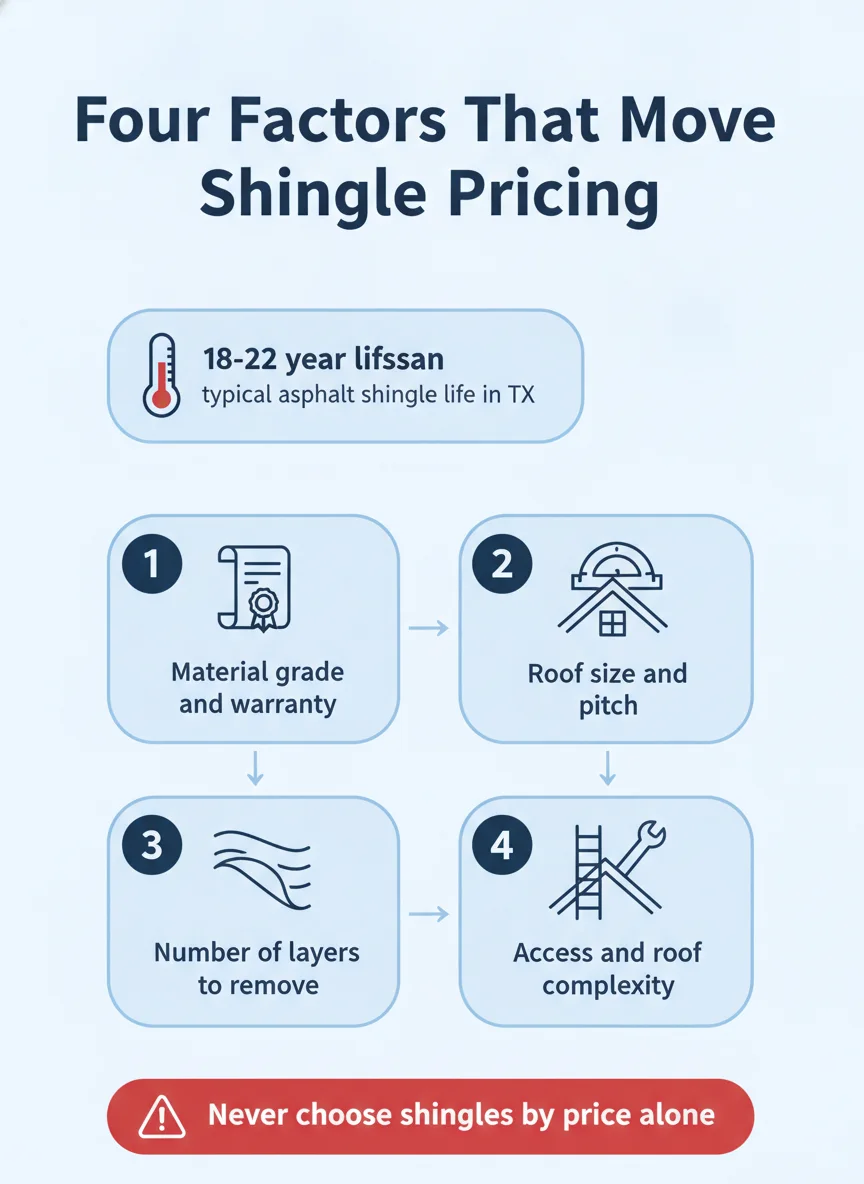
Material Grade and Warranty
Basic three-tab shingles sit at the entry level, while architectural (laminated) shingles cost more per square but generally last longer and hold up better to wind. Premium designer lines add another step up in both appearance and price. Manufacturer warranty length often tracks with material grade, so a longer warranty usually points to a heavier, more durable shingle.
GAF factory certification and similar manufacturer programs can also unlock extended warranty coverage on qualifying installs, which is worth asking about since it affects long-term value even if it doesn't change the sticker price much upfront.
Roof Size, Pitch, and Complexity
Roofers measure roofs in squares, where one square equals 100 square feet. A bigger roof simply needs more material and more labor hours. Pitch matters too: a steep roof requires more careful footing and safety equipment, which slows the work down even though the square footage might match a flatter roof.
Complexity adds up as well. Roofs with multiple valleys, dormers, chimneys, and skylights take longer to flash and detail correctly than a simple rectangular roof, and that additional labor shows up in the quote.
| Factor | Lower Cost Scenario | Higher Cost Scenario |
|---|---|---|
| Shingle grade | Three-tab shingles | Architectural or designer shingles |
| Roof pitch | Low-slope, walkable roof | Steep roof requiring extra safety measures |
| Tear-off | Single layer removal | Multiple layers or full deck replacement |
| Roofline | Simple rectangular roof | Multiple valleys, dormers, and penetrations |
What's Actually Included in a Shingle Roof System
Shingles are the visible layer, but a proper roof system includes underlayment, flashing, ridge caps, and ventilation components working together. Skipping or skimping on any of these can shorten the life of even a high-grade shingle.
Underlayment provides a secondary moisture barrier beneath the shingles. Flashing seals the roof at valleys, chimneys, and wall intersections where water is most likely to find its way in. Ridge caps finish the roofline and protect the ridge vent if one is present. A quote that only lists shingles without mentioning these components is worth asking more questions about.
Step-by-Step: What Happens During a Shingle Replacement
Understanding the sequence of a typical roof replacement helps explain where labor time, and therefore cost, actually goes.
- Tear-off and inspection: Old shingles are removed and the deck is inspected for rot or soft spots that need repair before new material goes down.
- Deck repair as needed: Any damaged decking is replaced to give the new shingles a solid, even surface to attach to.
- Underlayment install: A moisture barrier is rolled out across the entire deck before any shingles are laid.
- Flashing and drip edge: New flashing is installed at valleys, chimneys, and edges to direct water away from vulnerable points.
- Shingle installation: Shingles are laid course by course according to the manufacturer's nailing pattern and spacing requirements.
- Ridge cap and ventilation: Ridge caps are set last, tying in any ridge vent for proper attic airflow.
- Cleanup and final walk: Debris and nails are cleared from the property and the finished roof is reviewed with the homeowner.
Comparing Quotes Without Getting Confused
Reading Line Items
A detailed quote should specify the shingle brand and line, the underlayment type, whether tear-off and disposal are included, and what flashing work is planned. If a quote is just a lump sum with no breakdown, ask for the details before comparing it to a more itemized quote.
Two quotes that look similar on the surface can differ significantly once you see whether one includes deck repair allowances and the other doesn't. It's a common reason a lower number turns into change orders partway through the job.
Watching for Missing Scope
Some quotes leave out code-required upgrades like drip edge or ice-and-water shield in valleys, which can make a bid look lower than it should be. Ask specifically whether the quote meets current code requirements for your area rather than assuming it does.
If storm damage is involved, ask whether the quote accounts for insurance claim documentation and supplement work, since that process can affect both timeline and final scope.
What a Homeowner Can Evaluate vs. What Needs a Pro
You can absolutely research shingle brands, compare warranty terms, and get a rough sense of your roof's square footage from satellite measurements online. That homework makes conversations with contractors more productive.
Accurately measuring pitch, identifying deck damage that isn't visible from the ground, and matching a shingle system to your home's ventilation setup takes a trained eye. A licensed roofer walking the roof in person will catch things aerial measurements miss.
Getting a written, itemized quote from a licensed and insured contractor is the best way to know exactly what you're paying for before work starts.
Getting a Quote That Actually Matches Your Roof
Shingle pricing has more moving parts than a single dollar figure can capture, and the honest answer for any specific home depends on its size, pitch, and current condition. Understanding the factors above puts you in a much better position to evaluate what you're being quoted.
Absolute Professional Roofing Contractors provides a free, detailed inspection before quoting a shingle project, so you know exactly what your roof needs before any number gets written down.
Frequently asked questions
What's the difference between three-tab and architectural shingles?
Three-tab shingles are flat, single-layer, and generally the most economical option, while architectural shingles are laminated with multiple layers for a dimensional look and typically carry a longer expected lifespan. Most homes built or reroofed in Texas in recent years use architectural shingles as the standard.
Does roof pitch affect shingle cost?
Yes, steeper roofs take longer to work on safely and often require additional fall protection, which adds labor time even though the material cost per square stays the same. A low, walkable roof is generally quicker and less expensive to install than a steep one of the same size.
Why do some quotes vary so much for the same size roof?
Quotes vary based on shingle grade, whether old layers need to be torn off, the complexity of the roofline, and what underlayment and accessories are included. A quote that looks like a bargain may be leaving out tear-off, disposal, or code-required upgrades that a more complete quote includes.
Are metal or tile roofs always more expensive than shingles?
Generally yes, since metal and tile materials and installation labor cost more upfront, though they can last considerably longer than asphalt shingles. Asphalt shingles remain the most common choice in North Texas because they balance cost, performance, and appearance well.
Does the color of my shingles affect the price?
Typically not by much, since most manufacturers price a given shingle line the same across their color range. Availability of a specific color can occasionally affect lead time more than price.