Why Coating Comes Up on Flat and Low-Slope Roofs
Flat and low-slope roofs across the DFW Metro, the kind found on many commercial buildings, take direct sun exposure differently than a pitched shingle roof. Without the runoff angle of a steep pitch, UV rays and standing water both work on the membrane surface longer, and protective coating is one of the main tools for extending that membrane's service life.
The question of how much coating a roof needs isn't a fixed number across every building. It depends on the total square footage, the membrane type already on the roof, its current condition, and the coating product's specific coverage rate. Getting this wrong in either direction wastes material or leaves the roof under-protected.
What Determines Coating Coverage on a Real Roof
Coating coverage is calculated from total roof square footage first, then adjusted for the membrane's condition and the coating product's manufacturer-specified spread rate. A rougher, more weathered surface soaks up more material to achieve full, even coverage than a smoother, newer membrane would.
Membrane type changes the math
TPO, EPDM, and modified bitumen membranes each interact differently with coating products. Some membranes need a primer coat first to help the coating adhere properly, which adds a step and material to the overall job. Others accept coating directly with good adhesion straight onto the existing surface.
This is one reason commercial roofing coating projects start with confirming exactly what membrane is already installed, since guessing at membrane type leads to coating that either fails to bond or wastes product on unnecessary prep work.
Roof condition and prior repairs
A roof with existing patches, seams that have been repaired over the years, or areas of ponding water needs extra attention at those specific spots regardless of the overall coverage rate calculation. Ponding areas especially often need additional coating thickness since standing water breaks down coating faster than sheeting water does.
Seams, flashing details, and penetrations around vents or drains also typically get extra coating passes beyond the field of the roof, since these details fail before the flat field of a membrane usually does.
| Roof Condition | Coating Consideration | Typical Approach |
|---|---|---|
| Newer, smooth membrane | Lower material absorption, even surface | Standard coverage rate, one to two coats |
| Weathered or chalky membrane | Higher absorption, may need cleaning first | Additional coating or a prep coat before final coats |
| Areas with ponding water | Standing water degrades coating faster | Extra coating thickness or targeted repair before coating |
What a Coating System Is Actually Made Of
A roof coating system is typically applied in a base or prep layer followed by one or more topcoats, building up to the manufacturer's specified dry film thickness. That thickness number, not just a visual coat count, is what determines whether the coating actually provides the UV and water resistance it's designed for.
Detail work around drains, seams, and rooftop penetrations like HVAC curbs or vent stacks usually gets reinforced separately, sometimes with fabric reinforcement embedded in the coating at those points, since these are the areas most likely to see movement and stress over the roof's service life.
Step-by-step: Estimating Coating Needs for a Roof
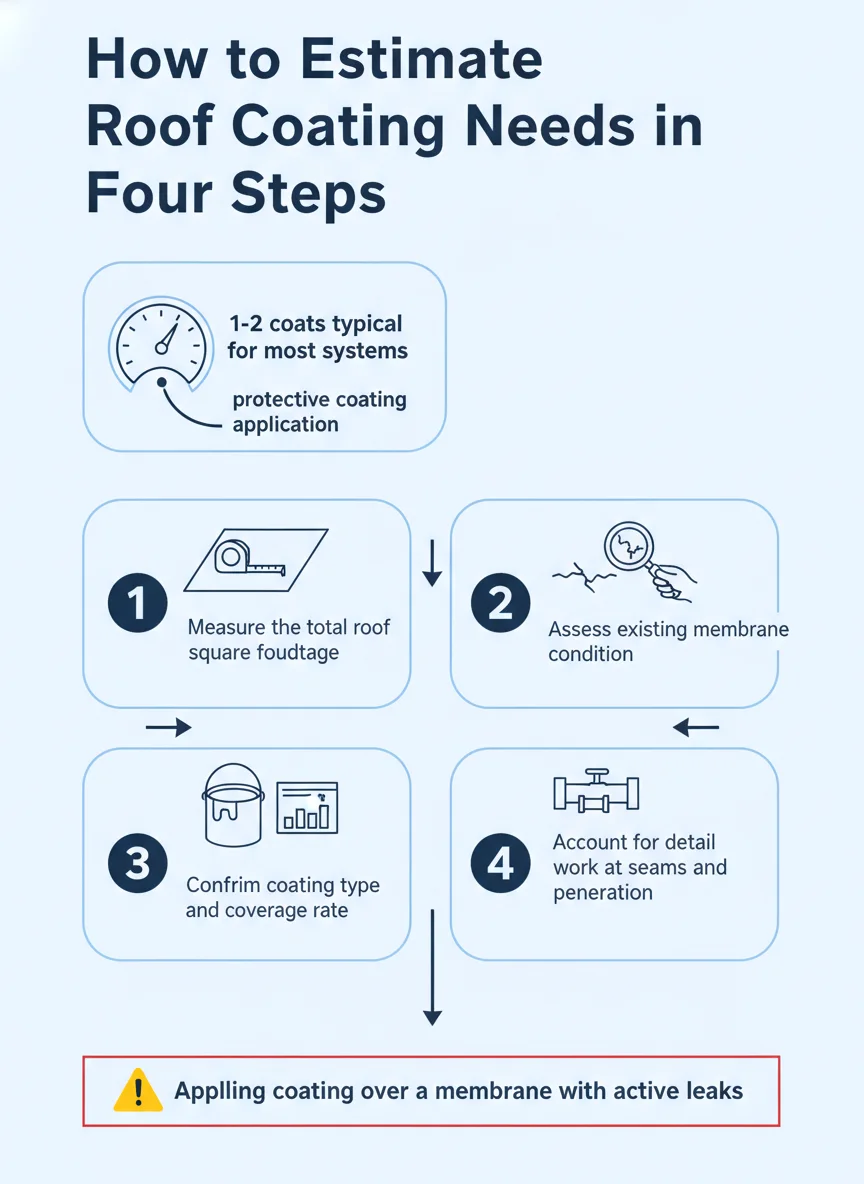
This is the general approach used to scope a coating project on a flat or low-slope roof before any material goes down.
- Measure total area: Get the accurate total square footage of the roof, including any distinct sections with different conditions.
- Identify membrane type: Confirm whether the existing membrane is TPO, EPDM, or modified bitumen, since this affects primer needs and coverage rate.
- Assess overall condition: Note ponding areas, existing patches, seam condition, and any chalking or degradation across the surface.
- Check manufacturer spread rate: Reference the specific coating product's coverage rate per gallon to calculate base material needs.
- Add detail work allowance: Account for extra material at seams, flashings, and penetrations that need reinforced coverage.
- Confirm dry film thickness target: Plan the number of coats needed to reach the manufacturer's specified thickness, not just a visual coverage look.
How to Tell If Coating Is Even the Right Call
When coating makes sense
Coating works well on a membrane that's still structurally sound, without widespread seam failure or membrane deterioration, but showing UV wear, chalking, or minor surface cracking. On a roof like this, coating extends the service life and improves reflectivity against Texas sun without the cost of a full membrane replacement.
Buildings looking to reduce interior heat load and extend a roof's usable life on a maintenance schedule are good candidates, since coating is fundamentally a protective and restorative treatment rather than a repair for active failure.
When coating isn't the answer
A membrane with active leaks, widespread seam separation, or soft spots in the underlying insulation needs those issues addressed directly before any coating goes down. Coating over unresolved problems just seals moisture in rather than solving anything, and it wastes material on a surface that's going to need replacement regardless.
In these cases, a full evaluation of the membrane and insulation typically points toward targeted repair or replacement as part of a broader commercial roofing scope, with coating reserved for a future maintenance cycle after the roof is sound again.
What a Building Owner Can Check vs. What Needs a Roofing Contractor
A building owner can walk the roof and note obvious issues, ponding areas after rain, visible cracking, or patches from past repairs. This gives a starting point for the conversation with a contractor about scope.
Calculating actual coverage rates, identifying membrane type accurately, and determining whether coating or repair is the right move requires someone experienced with these systems specifically. Misjudging membrane condition leads to coating applied where a repair was actually needed.
For flat roofs approaching the point of real deterioration rather than surface wear, it's worth comparing coating against the bigger picture in our guide on how much roof replacement your building actually needs, since the same age-versus-condition logic applies to commercial membranes too.
Getting the Coating Amount Right the First Time
The right amount of coating for a roof is whatever amount gets that specific membrane to its proper dry film thickness given its actual condition, not a generic number pulled from a different building. Getting an accurate measurement and condition assessment up front is what makes a coating project actually protect the roof for years rather than needing a redo.
Absolute Professional Roofing Contractors evaluates flat and low-slope roofs across North Texas before recommending coating, so building owners know whether coating, repair, or replacement is the right fit before any material is applied.
Frequently asked questions
How much roof coating does a flat roof typically need?
Coverage depends on the coating type, roof condition, and manufacturer coverage rate, but most systems call for one to two full coats to reach proper thickness. A rougher or more weathered membrane may need more material to achieve even coverage.
Does the type of membrane affect how much coating I need?
Yes, TPO, EPDM, and modified bitumen surfaces each absorb and hold coating differently, so the coverage rate and number of coats can vary by membrane type. Some membranes also require a primer coat before the main coating goes on.
Can roof coating fix an already leaking roof?
Coating is a protective and restorative treatment for a sound membrane, not a fix for active leaks or structural membrane failure. Any leaks or damaged sections need to be repaired before coating is applied, otherwise the coating just seals in the problem temporarily.
How long does a roof coating last before recoating?
It varies by coating type, roof exposure, and application quality, but coatings are generally reapplied on a maintenance cycle rather than a one-time application. Regular inspection helps determine when a recoat is due based on wear rather than a fixed calendar date.
Is coating cheaper than a full roof replacement?
Coating is typically a lower-cost maintenance option compared to full membrane replacement, but it only makes sense on a roof that's structurally sound and not past the point where coating can still protect it. A roof with widespread membrane failure usually needs replacement instead of coating.