
Why Winter Still Matters For A North Texas Roof
Winters across the DFW Metro don't bring the deep, sustained freezes you'd see further north, but they do bring swings between mild afternoons and hard overnight freezes. That back-and-forth is exactly the kind of stress that finds the weak points in a roof that's already spent a summer baking under Texas sun. Materials expand and contract with every swing, and a roof that was fine in October can start showing problems by January if it went into winter with existing wear.
The good news is that a little attention before the first hard freeze goes a long way. Clearing gutters, checking attic ventilation, and looking over flashing and sealant are all manageable tasks that catch problems while they're still small. Waiting until a leak shows up on the ceiling means dealing with interior damage on top of the roof repair itself.
What Cold Weather Actually Does To An Aging Roof
Asphalt shingles are more flexible in warm weather and more brittle when temperatures drop, which is why older, sun-worn shingles are more prone to cracking during a hard freeze than newer ones. The same goes for the sealant used around flashing and vent boots, which loses elasticity as it ages and can crack open during a cold snap.
Flashing And Sealant In Cold Weather
Flashing relies on a tight mechanical fit backed up by sealant at the joints, and that sealant is one of the first things to fail as temperatures swing. A bead of sealant that looked fine in summer can develop hairline cracks once it's gone through a few freeze-thaw cycles, and those cracks are an open invitation for water once the next rain or freeze arrives.
This is part of why a fall or early winter check of flashing around chimneys, skylights, and roof-to-wall transitions matters. Catching a small crack in sealant is a quick fix. Missing it usually means dealing with water intrusion sometime over the winter, often in a spot that's hard to trace back to its source.
Ventilation, Insulation, And Ice Damming
Ice damming isn't as common here as it is in colder states, but the conditions for it can still show up during a hard freeze. Warm air escaping from a poorly insulated or poorly ventilated attic melts any accumulated ice or frost on the roof, which then refreezes at the colder eaves and backs water up under the shingle edge.
Good ventilation keeps the attic and roof deck closer to outside temperature, which reduces this melt-and-refreeze pattern and also cuts down on condensation buildup inside the attic itself. A well-vented attic is one of the easiest ways to protect a roof through winter without spending money on the shingles themselves.
| Condition | Summer | Winter |
|---|---|---|
| Shingle flexibility | More pliable, resists cracking | More brittle, prone to cracking |
| Sealant performance | Expands, stays pliable | Contracts, can crack open |
| Attic risk | Heat buildup, UV stress | Condensation, possible ice damming |
| Gutter load | Debris and pollen buildup | Frozen debris blocks drainage |
The Parts Of Your Roof System That Do The Work In Winter
Your roof's winter performance comes down to a handful of components working together: the shingles themselves, the flashing at every penetration and transition, the attic ventilation system, and the gutters that move water away from the structure. None of these work in isolation, which is why a problem in one area often shows up as a symptom somewhere else, like a stained ceiling that actually traces back to a cracked flashing seam three feet away.
Gutters deserve particular attention heading into winter because a clogged gutter that freezes solid can't do its job at all. Water that would normally drain away instead sits against the roof edge or overflows behind the gutter, which can lead to rot at the fascia over time. Clearing gutters before the first hard freeze is one of the cheapest ways to protect the rest of the system.
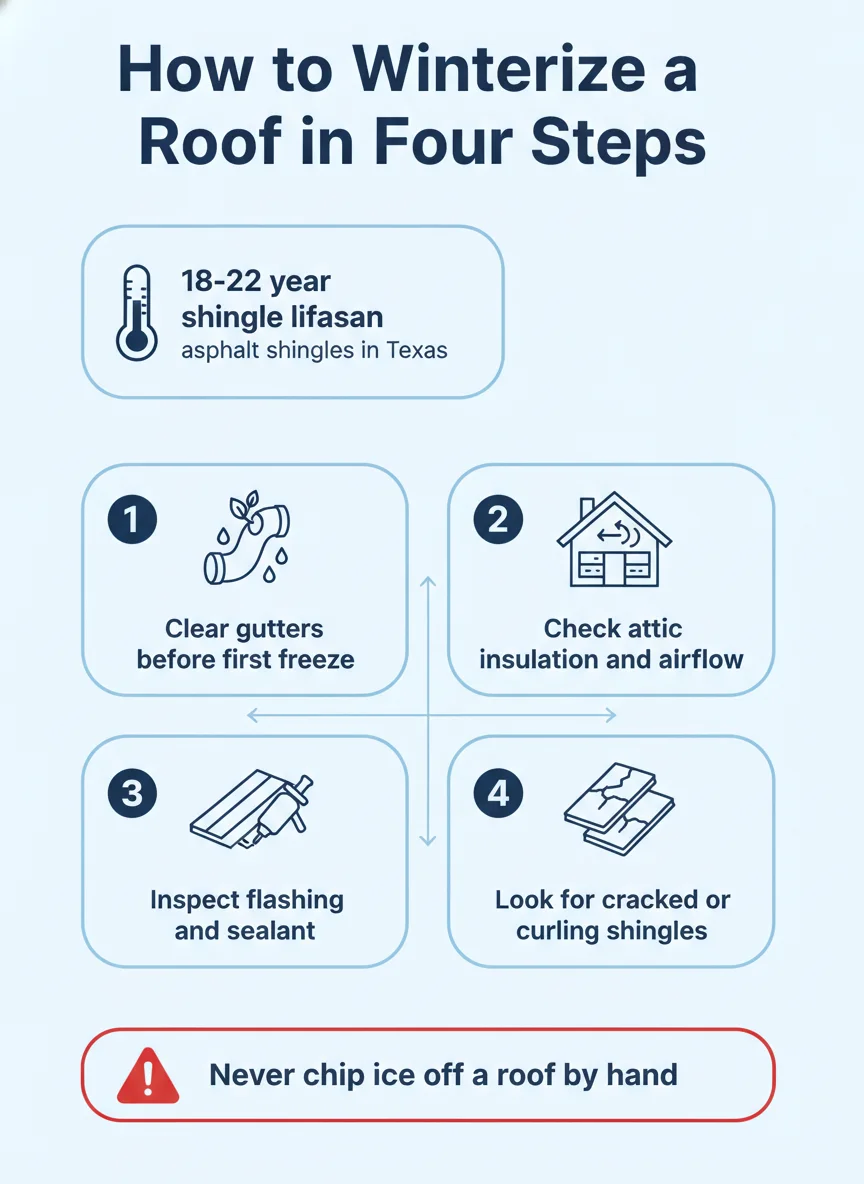
Step-by-step: Preparing Your Roof For A North Texas Winter
None of these steps require special equipment, and most can be done from the ground or attic without climbing onto the roof itself.
- Clear the gutters: Remove leaves and debris before the first hard freeze so water has a clear path off the roof edge.
- Check attic insulation: Look for thin or displaced insulation near the eaves, which lets heat escape and speeds up freeze-thaw stress.
- Inspect flashing: Look at sealant around chimneys, skylights, and vent boots for cracking before cold weather sets in.
- Scan the shingles: Check for curling, cracking, or missing shingles from the ground with binoculars.
- Confirm vent airflow: Make sure ridge and soffit vents aren't blocked by insulation or debris so air can move freely.
- Note any repairs needed: Write down and photograph anything that looks worn so it can be addressed before winter progresses.
What A Winter Walkthrough Usually Turns Up
Common Findings On Older Roofs
Roofs that are approaching the later years of their expected life often show curling shingle edges, visible granule loss, and small cracks in flashing sealant by the time a winter check rolls around. None of these are emergencies on their own, but together they're a sign the roof has less reserve capacity to handle whatever the season brings.
It's also common to find gutter sections that have started to sag or pull away slightly from the fascia, especially if they've carried the weight of wet leaves through fall. That extra strain can make a gutter more prone to failure during a winter storm when it's also dealing with ice or heavy rain.
What Attic Checks Reveal
Inside the attic, a winter check often turns up thin spots in insulation, especially near the eaves where it tends to settle or get pushed aside. This is also a good time to look for any staining on the decking that wasn't there in the fall, which can indicate a leak that started with the season's first hard rain or freeze.
Moisture buildup on the underside of the roof deck, sometimes visible as darkened wood or a faint musty smell, points to a ventilation problem rather than a leak. This is worth addressing since trapped moisture over a winter season can lead to wood rot that's more expensive to fix than the ventilation issue that caused it.
DIY vs Calling A Pro For Winter Roof Prep
Clearing gutters, checking attic insulation, and scanning shingles from the ground are all reasonable DIY tasks that don't require special training. These are the same checks worth doing before storm season too, and doing them each fall is a good habit that catches problems early, before cold weather makes them worse.
Anything involving flashing repair, sealant replacement, or actually walking the roof surface is better left to a professional, especially in cold weather when shingles are more brittle and more prone to cracking underfoot. A licensed roofer also knows how to read subtle signs of ventilation trouble that aren't obvious from a flashlight check alone.
If your walkthrough turns up cracked flashing, a sagging gutter section, or attic staining, that's the point to call in a professional rather than waiting to see if it gets worse over the season. A Roof Repair visit before winter fully sets in usually costs less time and money than dealing with an active leak in January.
Start Winter With A Roof You Can Count On
A North Texas winter isn't the harshest test a roof will face all year, but it's still a test, especially for a roof that's already logged several summers of UV exposure and wear. Homeowners in McKinney and across the metro see the same freeze-thaw pattern each year, and a fall check is the simplest way to head off surprises.
For a longer look at how much life you can expect from a roof in this climate overall, see our guide on how long a roof lasts in Texas. If your walkthrough turns up something worth a second opinion, Absolute Professional Roofing Contractors offers free inspections across the DFW Metro before winter sets in.
Frequently asked questions
Does cold weather actually damage a Texas roof?
Yes, even North Texas winters bring freeze-thaw cycles that make aging shingles more brittle and can widen small cracks in flashing sealant. It's not the deep freeze some northern states see, but the temperature swings still add stress to a roof that's already worn from summer UV exposure.
What is ice damming and does it happen in Texas?
Ice damming happens when heat escaping through the attic melts snow or ice on the roof, which then refreezes at the colder eaves and backs water up under the shingles. It's less common here than in colder climates, but a poorly ventilated attic and a hard freeze can still create the conditions for it.
Should I clean my gutters before winter?
Yes, clogged gutters that freeze can't drain properly, which puts extra weight on the gutter system and can force water back under the roof edge. Clearing leaves and debris before the first hard freeze is one of the simplest ways to protect the roof edge through winter.
How does attic ventilation affect winter roof performance?
Good attic ventilation keeps the underside of the roof deck closer to outdoor temperature, which reduces the melt-and-refreeze cycle that causes ice damming and moisture buildup. Poor ventilation traps warm, moist air against the decking, which can lead to condensation and wood rot over time.
Is winter a bad time to replace a roof in Texas?
Roof replacements can generally happen through the winter in North Texas since hard freezes are brief and infrequent compared to colder regions. The bigger factor is scheduling around any active precipitation, which a professional crew accounts for when planning the work.